![GreenPort[PortStrategy]](https://www.portstrategy.com/greenport/wp-content/uploads/sites/4/2026/09/GreenPortPortStrategy.svg)


PODCAST: Shore power and the future power mix
GreenPort talks to Jacob Bjarkam, head of sales, PowerCon, to find out how shore power fits into a future with alternative power
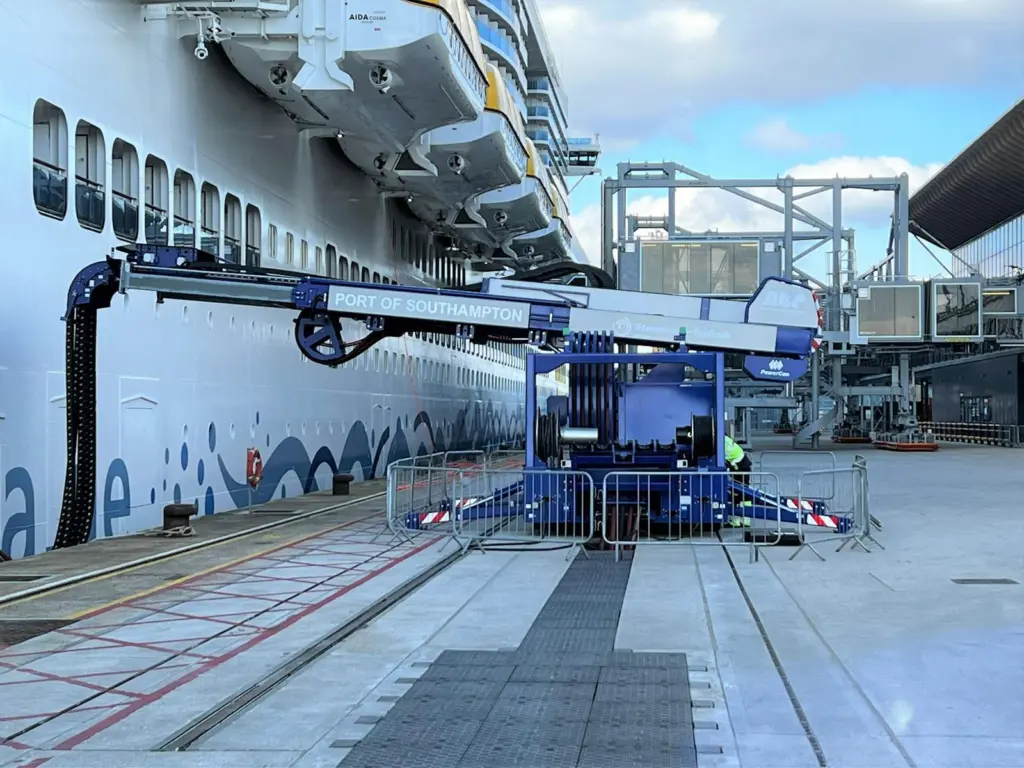
In light of the exponential growth of the alternative fuels market over the last few years, many of us are interested in learning how shore power now fits in to a port’s energy and fuel offering.
“I think it’s important to just establish that when we talk about the future of energy in the maritime industry as a whole, there’s many different technologies to address. But when we talk about ships in ports, shore power in particular, is the most effective technology. So basically, by providing electrical energy to ships in ports, that’s how shore power fits into the power mix, alongside other technologies,” Mr Bjarkam says.
“In my opinion, there are endless opportunities for ports to develop this electrical infrastructure to make it a business in itself, both in terms of making money, but also creating a business that is good for the environment and fits with all the sustainable actions that we’re trying to take these days.”
Unilateral benefits
The good thing about shore power is that it’s suitable for almost all vessels so there are efficiency gains to be had by both large and small terminal operators.
And given that the energy mix on the grids is becoming more and more sustainable, shore power will inevitably give operators a sustainable source of energy when in port, says Mr Bjarkam.
The transition between ships making their own power by running diesel generators while at berth and going over to electrical energy provides operators with huge gains in power efficiency.
Then there are the gains to be had with emissions reduction – CO2, GHG, NOx, SOx, both on a global and local scale.
But what about the thorny issue of how electricity is being generated – is it coming from sustainable sources, or is it coming from a power plant that is burning fossil fuels?
“Although the question is valid, still the power efficiency of the power plants is so much better than that of a diesel generator onboard a ship,” Mr Bjarkam says.
“So, in that regard, there’s still tremendous benefits on a sustainability scale. Generally speaking, with electrical power from grid to the ship, we have an efficiency of around 95%.”
Mr Bjarkam is keen to stress that the ultimate goal is to have shore power become truly independent from fossil fuels. But that will happen at different times in different places as infrastructure and supply and demand catch up.
“I think it’s a question with many answers depending on where you are. A country like Denmark, where I’m from, we have a fairly good mix on the power grid, meaning that most of the power is from renewable sources, predominantly wind, but also hydropower. If you take a country like Norway, I believe they have 96% of power coming from sustainable sources. So, I think it differs from country to country but over time it will happen.”
“There’s a clear trend that we are all making the transition to more sustainable power generation across all countries.”
It’s interesting to note that PowerCon is seeing a rise in demand for its technology from both the cruise and container segments.
Mr Bjarkam says there is a case to be made for different segments to switch to shore power, but generally speaking, large ships that stay in port for longer are the main target market.
“You would never see a cruise vessel enter a port and leave again within an hour and the same for container vessels. So in cases where ships are in ports for many hours, sometimes even up to 48 hours, shore power has a tremendous benefit.”
“We tend to talk most about the environment when we talk about shore power benefits. But it also provides other benefits like noise elimination for the local community.”
This is especially true of cruise terminals where passengers are brought right into the heart of the city.
Power provision
Tackling the tricky issue of grid capacity is top of the list when it comes to shore power provision.
It’s something that varies from country to country and even city to city. How do operators provide for shore power when the infrastructure just simply isn’t there?
“It’s an issue and it’s something where we have a lot of catching up to do. The transition towards electrification seems to have caught many countries off guard a bit and a lot more focus should be on upgrading the national power grids,” says Mr Bjarkam.
“You cannot create that within just a few years, it is long-term planning. We now see that the cars need electrical power to run and we will soon all have electric cars. We see the industry, the land-based industry transition turning more and more to electrical energy. And now we also want the ports to become energy hubs and power all the ships that call at the ports.”
“There are issues and I don’t think we can solve all of them on a short-term basis, but I don’t think it’s tricky to solve because we know the issue and we know how to solve it, we need to generate more power . But let’s try to make them from renewable sources. More wind power, more solar power and so on. And then we need to strengthen the distribution.”
And distribution and electrical power conversion is where PowerCon comes in.
PowerCon originates from Denmark’s successful wind turbine industry. Add to that its expertise in designing large-scale frequency converters and then you have a business which specialises in high voltage power conversion aplications.
The company’s success largely comes from utilising this technology in the port sector.
PowerCon introduced its modular shore power concept back in 2018, with its first installation of a 16 MVA shore power system for cruise vessels in the Norwegian port of Kristiansand.
Since then, the company has completed eight other cruise shore power installations and currently ten more are under implementation, all at various stages of completion.
However, it is not only shore power for cruise, also container ports are now adopting the idea of shore power. The Port of Hamburg was the first European container port to adopt shore power. Here PowerCon built a system that services two container vessels simultaneously.
All new shore power systems are being developed to comply with the the worldwide shore power standard. This means that cruise systems should deliver up to 16 MVA and container systems should deliver a maximum of 7.5 MVA.
“But one thing that is maybe more important from a port perspective when it comes to efficiency is not power efficiency, but operational efficiency and there we have optimised all aspects. We have tried to make the systems connect and disconnect as easily as possible, so it does not hinder day-to-day operations,” Mr Bjarkam says.
Into the future
Mr Bjarkam explains that there used to be this discussion when it came to shore power about whether the port or ship operator should pay. Should it be the ports that invested in electrical infrastructure or should it be the ships demanding it?
“But now I believe that discussion has been totally put to rest, so now all the major cruise lines and the container shipping lines are demanding the ports build infrastructure, so the future of shore power in general is looking great.”
He explains that shore power used to be something that was just an aid to help from an environmental perspective.
But now it’s widely accepted that shore power is a very good business for all the stakeholders, including the ports and the consumers.
As we speak, PowerCon is installing the world’s biggest shore power system in the Port of Miami – a capacity of 80 MVA for five cruise vessels. It’s a great example of what used to be a small and almost niche market becoming very much mainstream.
Legislation has played its part too in making the technology mainstream both in the EU and the USA.
Many national governments have understood the need for funding in order to develop shore power infrastructure , so we generally see that there are lots of funding schemes for ports to tap into, Mr Bjarkam says.
But incentives are important too, says Mr Bjarkam. Despite the fact that cruise ports are there to make money by having cruise ships come in on a regular basis, they are setting up incentives for the cruise lines that take on shore power.
Consumer demand has played its part too.
If you are a passenger on a ferry or cruise vessel then you can see the immediate effect that shore power has on emissions. And now there is a huge push for the not so obviously polluting container vessel segment.
Mr Bjarkam says that over the last few years there is clear evidence that the container segment is aware that the overall perception of how we should do stuff sustainably is changing.
He points out that more retail giants are conscious on their environmental footprint, and are now leading the way for more sustainable actions. One such action will be shore power for all container vessels.
Going back some years now, ports and operators were afraid to put their money where their mouth is in terms of shelling out for shore power.
“It was perceived as a risk to investing in shore power if other alternative technologies would take that spot, only for the ports to be left with a very expensive investment,” says Mr Bjarkam.
“But fast forward to the present day and we can put to rest the idea that maybe shore power will not become the future, that won’t be the case. We now talk about shore power and other technologies, not shore power or other technologies.”
“The other technologies are for ships when they are sailing. But for ships that are in ports, they need shore power.”
Mr Bjarkam shares some insights for ports to consider when developing new shore power projects.
“Since shore power remains a relative new form of technology, the typical advisors that ports consult simply don’t have the sufficient experience.”
“So, my advice would be to just go out and ask the suppliers as a starting point. Just go out with an open mindset and ask the industry how it can help build the port infrastructure of tomorrow because there are so many good solutions out there.”
Related Articles
 ENERGY & TECHNOLOGY GREENPORT
 ENERGY & TECHNOLOGY GREENPORT
 PRODUCTS & SERVICES GREENPORT