![GreenPort[PortStrategy]](https://www.portstrategy.com/greenport/wp-content/uploads/sites/4/2026/09/GreenPortPortStrategy.svg)

San Diego’s electric tug milestone
A new chapter in vessel electrification is beginning for America’s the Port of San Diego as it christens its new all-electric, battery-powered tug.
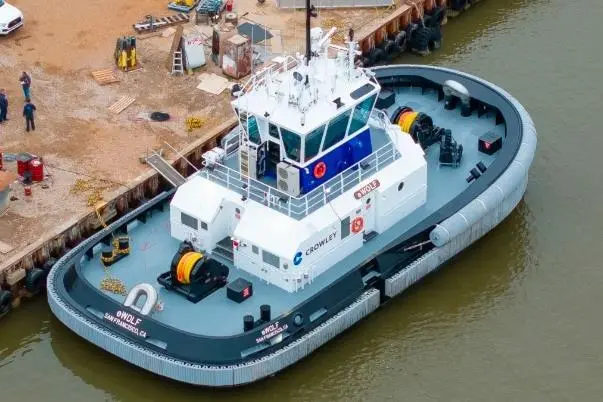
Owned and operated by Crowley, eWolf will use its ABB electric propulsion system to help achieve zero-emission operations at the port.
“We’re thrilled to see the first all-electric tug in the U.S. enter into service in the Port of San Diego as it checks off a signature goal of our Maritime Clean Air Strategy,” said Chairman Frank Urtasun, Port of San Diego Board of Port Commissioners.
“The eWolf adds to the work the Port and our partners are doing to significantly reduce emissions on and around San Diego Bay and demonstrates our commitment to clean, efficient maritime operations.”
Clean air strategy
Using all-electric tug propulsion will significantly reduce greenhouse gas emissions as part of Port of San Diego’s Maritime Clean Air Strategy
eWolf features an end-to-end electric propulsion system from ABB including a 6.2-megawatt-hour energy storage system (ESS). This allows the vessel to achieve 70 short tonnes of bollard pull with zero emissions and complete a full day of work on a single charge.
Given electricity is cheaper to produce on shore than onboard a vessel, the ESS also minimises operating costs. The eWolf will significantly reduce greenhouse gas emissions in the port area of San Diego, replacing a tug that consumed over 30,000 gallons of diesel per year.
Crowley selected ABB as the full systems integrator for eWolf. In addition to the ESS, ABB supplied its award-winning Onboard DC Grid power distribution platform for optimised energy use, the ABB Ability Marine Diagnostic system for continuous monitoring of equipment and ABB Ability Marine Pilot products to enhance safety and reduce crew workload.
The vessel was designed by Crowley’s engineering services group in collaboration with ABB and built by Alabama-based Master Boat Builders, Inc. It was delivered in January 2024.
eWolf was developed through a partnership among the Port of San Diego, San Diego County Air Pollution Control District, the California Air Resources Board (CARB), the U.S. EPA and the U.S. Maritime Administration.
Related Articles
 ENERGY & TECHNOLOGY GREENPORT
 ENERGY & TECHNOLOGY GREENPORT
 PRODUCTS & SERVICES GREENPORT