![GreenPort[PortStrategy]](https://www.portstrategy.com/greenport/wp-content/uploads/sites/4/2026/09/GreenPortPortStrategy.svg)

The count down to OPS go live at Barcelona
The arrival of the BEST terminal OPS at the Port of Barcelona marks the beginning of the countdown to connect the first container ships in July.
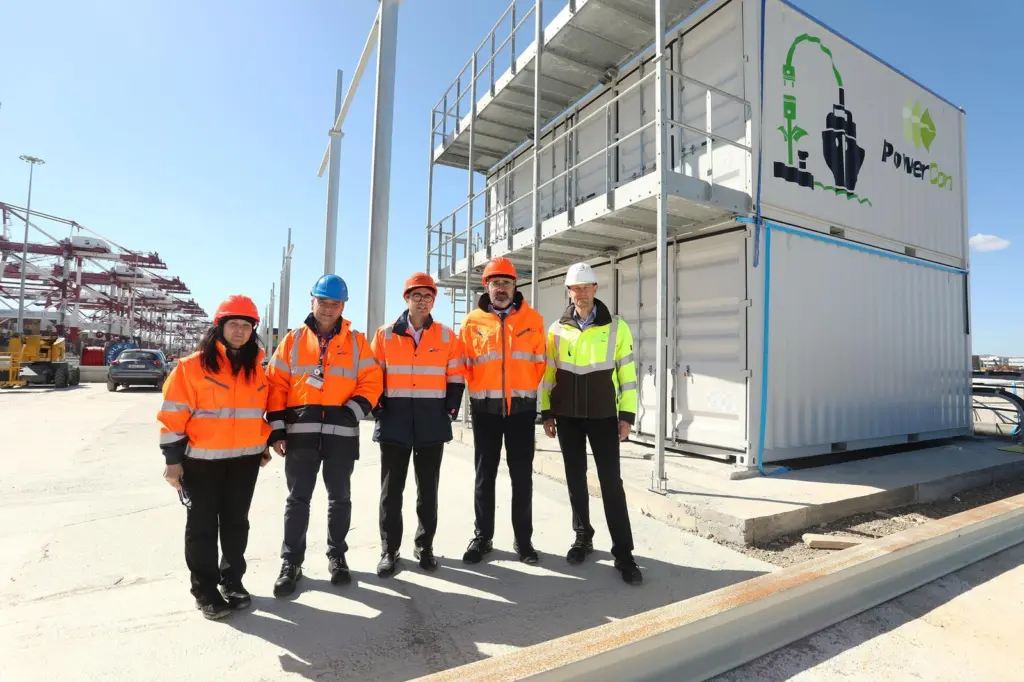
Barcelona’s first OPS substation, supplied by PowerCon, is the centrepiece of what will be the first Onshore Power Supply (OPS) system to supply electricity to container ships arriving at the port, allowing them to stop their engines while docked, reducing they generate.
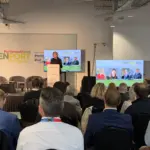
“The arrival of the OPS of the BEST terminal is a very important milestone in the roll-out of the Nexigen project,” said Lluís Salvadó, president of the Port of Barcelona.
”It is the result of years of work to set up the first system of this type in southern Europe and the first part of a network that will make it possible to significantly reduce the emissions generated by port activity.”
Turnkey solution
The OPS substation comprises six modules assembled in Denmark by PowerCon, which will allow up to two container ships to be connected simultaneously.
Its arrival represents a milestone for the Hutchison Ports BEST terminal wharf electrification project, where the works on both the civil engineering and electrical network and the rolling out of the cables to the wharf had already been performed, coinciding with the terminal enlargement works.
The OPS connection will be completed over the next four months with the arrival of the equipment to be installed wharfside to connect the vessels and all necessary checks and tests will be performed. If all goes as planned, the aim is to start supplying ships with clean energy certified as 100% renewable as of July.
BEST’s OPS system and the one being built at the Ferry Terminal will in fact function as a pilot test, making it possible to gather data and information on their operation to optimise the roll-out of the rest of the OPS as well as the medium-voltage network that will supply them with renewable electricity.
The Nexigen project is one of the Port of Barcelona’s big bets to halve CO2 emissions from port operations by 2030 and become a carbon-neutral port by 2050.
Electrifying the main wharves at the Port of Barcelona will make it possible to eliminate 66,000 tonnes of CO2 and 1,234 tonnes of NOx from the emissions generated by port activity.
Related Articles
 ENERGY & TECHNOLOGY GREENPORT
 ENERGY & TECHNOLOGY GREENPORT
 PRODUCTS & SERVICES GREENPORT