![GreenPort[PortStrategy]](https://www.portstrategy.com/greenport/wp-content/uploads/sites/4/2026/09/GreenPortPortStrategy.svg)


Anti-collision emphasis
Growing levels of automation and the handling of increased cargo volumes mean that collision prevention technology is more important than ever for port operating units.
SECTOR ANALYSIS: SYSTEMS TO BOOST SAFETY & PRODUCTIVITY
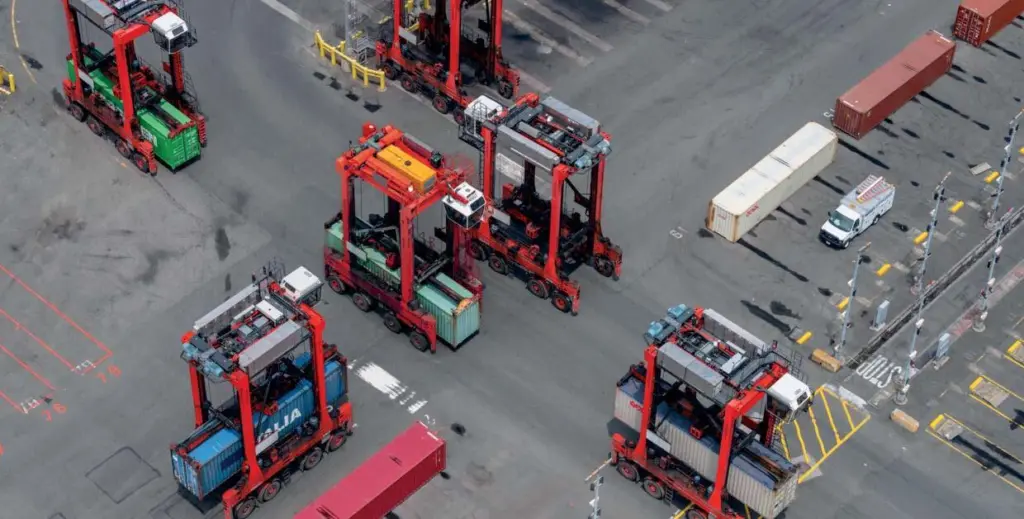
All areas of a terminal require protection against potential collisions, from avoiding a clash between a ship-to-shore crane’s boom and the superstructure of a ship to between cranes, to protecting straddle carriers, reach stackers, empty container handlers and other lifting equipment from collision. ZoneSafe points out that obstructed views and blind spots are a common problem for drivers of vehicles such as large reach stackers, making it difficult for them to see workers or other obstacles in their vicinity, thereby increasing the risk of accidents. The growth of automation in ports means that port operators require an increasing high-level of sensing technologies to prevent collisions. But manually driven equipment also needs anti-collision measures due to the ever present risk of human error. As well as reducing loss of life, injuries and protecting against equipment damage, anti-collision solutions can cut costs and boost efficiency. Lehnert Crane Systems highlights how anti-collision solutions can increase productivity. It says, for example, that an anti-sway function leads to a 10 per cent increase in productivity, due to assistance which relieves the crane driver. As the below coverage highlights, there is a growing number of state-of-the-art technologies for collision prevention that can greatly improve the safe use of equipment safety and play an influential role in maximising efficiency.
DATA ANALYSIS, NEW DESIGNS, INNOVATION AND PARTNERSHIPS
Kalmar: In May this year Kalmar, part of Cargotec, launched a collision warning system for its manually operated straddle carrier portfolio as part of its commitment to “safety-first design”. The system is available as an optional add-on for new machines and as a retrofit upgrade for existing machines. Kalmar explains that it increases safety by providing the driver with both visible and audible warnings when there is a risk of collision, providing more time to react to potential hazards. The warnings help to prevent or reduce the severity of collisions and also reduce stress on the driver by helping them to remain alert and attentive at all times. In addition to detecting obstacles in the machine’s path or blind spots, the system also warns the driver if the spreader (whether empty or laden) is too low when the machine is approaching a container stack. The driver remains in full control of the machine at all times. Jeroka Alanko, Senior Manager, Product Management, Kalmar, sums up the advantages: “The collision warning system will help our customers to make machine operation safer and improve overall terminal safety as well as reduce repair costs and extend equipment lifetime.”
LASE Industrielle Lasertechnik: Laser-based sensor application company LASE has boosted its terminal anti-collision systems after signing a multi-year supply agreement with Ouster to automate and retrofit container terminals and their cranes with 3D digital lidar sensors. The agreement, announced in March this year, includes a binding commitment for several hundred Ouster OS sensors through 2025. LASE says that it plans to offer new solutions using Ouster’s 3D digital lidar sensors to increase and enhance the capabilities of its existing and new installations. LASE is typically equipping gantry cranes and other port equipment with two or four Ouster OS1 sensors for precise position measurement and object detection to enable the safer autonomous or semi-automated handling of containers. This digital lidar-based solution supports collision avoidance between handling machines, people and other port equipment. The high-resolution and wide field-of-view of Ouster’s sensors enables LASE to reduce the number of sensors currently required on an installation while increasing the coverage area and overall system performance for equal or less cost. Lars Ambrosy, Managing Director, LASE, says: “We see a massive opportunity for new equipment and to retrofit existing machines with the LASE system using Ouster’s sensors. We have several hundred installations around the world which can be upgraded with 3D lidar to provide multi-functionality and subsequent cost savings and safety benefits.” LASE’s 1D, 2D and 3D laser measurement systems provide collision protection between handling machines, people, other machines and container ships in ports.
Lehnert Crane Intelligence: Lehnert Crane Intelligence’s LENNIX® Pro is a control and regulation system which enables ship-to-shore gantry cranes to position their loads quickly and reduce the risk of collision. The company, which manufactures control systems for cranes, says that its solution “independently eliminates the unavoidable oscillations that occur while the crane is in operation,” as well as easing the crane operator’s job and supporting inexperienced operators while facilitating the automatic positioning of the crane. The danger of collision is therefore reduced because the spreader hangs steadily at the end of every crane transaction, each time. The desired speeds that are set by the crane operator in the manual operation mode are controlled by acceleration and braking processes so that swaying movements that occur during operation and after stopping are automatically eliminated. This, in turn, enables a quick positioning of the load. The controller includes torsional vibration damping. Trim, list and skew cylinders are used to calm down the torsional vibrations of the spreader during handling operations.
Mi-Jack Europe: The Mi-Jack Europe Anti Collision System prevents suspended loads above vehicles and people, which, the company says, increases the “safety, reliability and availability of the complete automation solution”. To avoid a decrease in terminal efficiency, the Mi-Jack Europe system allows parallel operation between fully automated equipment and personnel in the same working environment. An interactive digital twin of the terminal shows all object positions for the purpose of asset tracking and basic trouble shooting. The Crane Collision Avoidance System is the “core safety component”. The sensor fusion of Mi-Jack Europe’s GNSS and RFID technology system prevents the crane trolley from moving over any vehicle or personnel. Cranes, vehicles and even personnel are tracked, and to avoid collisions, halos are generated around them. When overlapping, the crane is prompted to stop. Mi-Jack Products completed the acquisition of Germany-based terminal technology provider Yardeye in May 2022 and in June 2023, Yardeye officially became Mi-Jack Europe.A company statement said that combining both companies’ technology groups into one aimed to boost “continued innovation” for areas including collision avoidance within ports.
Navtech Radar: Designer and manufacturer of commercially deployed radar solutions Navtech Radar says that its industrial grade sensors provide anti-collision detection in all weather and light conditions for automated ports. Navtech Radar sensors can be fixed to current infrastructure and integrated with existing systems. They are reportedly quick to install with low power requirements and are designed to be maintenance free for 10 years. The sensor, which has a compact design and a 360-degree field of view, differentiates between machinery or debris and dangerous obstacles, leading to a low false alarm rate. “Alarms are only raised when true collision threats are detected. This increases operator confidence in the system,” says Navtech Radar. Operators can work in a small cabin close to the ship. The radar can scan the area the loader is operating in and easily identify any potential risks or movement from the ship. The long detection range means the sensors are suitable for port automation on large sites.
Rombit: Rombit’s Collision Avoidance solution not only includes a proximity detection system to safeguard workers from collisions, but its real time monitoring and analytics platform provides insights on near-misses and unsafe behaviours. The company explains that because every vehicle is continuously monitored and tracked, comprehensive data is collected, including information on driver behaviour. “Speeding, sharp turning, lane crossing, excessive acceleration or braking, … factual data on individual driving behaviour feeds directly into driver coaching and ultimately a safer, more efficient worksite,” says Rombit. Furthermore, the always-on location tracking of every vehicle allows for the visualisation of traffic density. This can expose unknown high-risk areas, prompting preventive measures. Real-time and continuous tracking can provide precise data regarding the number of incidents, their locations and the personnel involved in near misses.
SICK: Global sensor manufacturer SICK has developed what it calls a “super-tough” radar sensor for collision avoidance duties in challenging industrial environments such as for cranes in container ports. SICK has developed a new platform for anti-collision radar sensor technology and the SICK RMS1000, launched last year, is the latest release in this product family. The radar sensor uses 61GHz FMCW (Frequency Modulated Continuous Wave) technology to detect obstacles up to 100m away in up to four monitored areas simultaneously, as well as to determine distance and radial speed. The SICK RMS1000 is housed in aluminium and because it has no moving parts, it is highly robust to shocks and vibration. The SICK RMS1000 is a 1D radar sensor, the first in a roll-out of radar sensors on the new platform, which will see 2D and 3D models launched in the near future. SICK has developed its radar sensor platform to complement its existing portfolios of LiDAR and ultrasonic technologies.
Siemens: Siemens Load Collision Prevention System (LCPS) reduces the risk of collisions by assisting drivers with blind spots on manually operated cranes and supporting automated moves with automated cranes. Safe distances are monitored in real time to avoid collisions and therefore reduce the risk of damage and consequent repair costs. Dynamically adjusted safety distances are monitored and integrated into the drive and control system, which monitors the position of the spreader and the load. When an obstacle is detected, a virtual speed-dependent safety box dynamically restricts motions according to defined safety margins. To reduce the risk of colliding towards the stack, the sway prediction is taken into account. With this smart pendulum calculation, LCPS considers the residual sway and the stack gradient to define the safety margins around the load.
ZoneSafe: ZoneSafe’s Proximity Warning Systems reduce the risk of accidental vehicle collisions within ports. They use sensors and alerts to detect and warn port operators of potential collisions with personnel, vehicles, or other objects in their vicinity. A detection antenna – using Radio Frequency Identification (RFID) technology – is fitted to the vehicle creating a 360-degree invisible detection zone around the vehicle and will sense ZoneSafe tags up to ten metres away. An in-cab control unit is also fitted to the vehicle within the operator’s reach. The ZoneSafe control unit is positioned next to the driver inside the vehicle, while personnel working in the area wear active RFID tags. When tags are detected by the antenna, an alarm sounds. The tag will also vibrate (when Vibratags are used), warning of any approaching vehicle. When the detection zone is breached, an audible/visual alarm alerts the driver of pedestrians in close proximity. ZoneSafe’s customers include APM Terminals in Callao Port, which fitted the Vehicle to Person Alert Application to reach stackers to improve safety and awareness.
Related Articles
 ENERGY & TECHNOLOGY GREENPORT
 ENERGY & TECHNOLOGY GREENPORT
 PROJECTS & INITIATIVES GREENPORT