![GreenPort[PortStrategy]](https://www.portstrategy.com/greenport/wp-content/uploads/sites/4/2026/09/GreenPortPortStrategy.svg)



Bridging the cyber-physical gap
INFORM’s Dr Eva Savelsberg, Ulrich Dorndorf and Matthew Wittemeier discuss how hybrid AI is transforming port operations
Terminal operations are a complicated mixture of manned physical machinery, unmanned robotics systems, human-operated software platforms and, increasingly, artificial intelligence-based (AI-based) software systems. In a broader production sense, these complex systems where connected robotics systems (hardware) and AI (software) converge are referred to as Cyber-Physical Systems (CPS). And it is at this convergence that one will find the future of AI in container terminal operations.
Ports around the world are set to evolve into digital ecosystems comprised of various ‘intelligent agents’, or modular decision-making processes, that are highly specialised AI processes existing as a specialised component within the broader digital ecosystem. Paired with human experts, these CPS will be empowered to resolve the automation challenges that plague the industry today.
To start, we need to understand how combining AI and traditional physical systems works. At the core of a CPS is an AI algorithm making decisions for the connected robotics systems. This has become increasing possible over the past decade due to advancements in both hardware and software.
In the past 28 years, improvements in computer hardware have resulted in an increase in computing power by a factor of 2,000. This seems impressive until one compares it with the advances in optimisation algorithms over the same period. For instance, linear programming algorithms, considered the most important class of optimisation techniques by many experts, have improved by a factor of 1.5m. When combined, the effects of both advances generate a tremendous 3bn times improvement in processing capability. To better understand this, a planning model, using linear programming, that takes us a second to solve today, would have taken almost 100 years to solve in the 1990s — we’d still be waiting for the result for some time to come!
This approach uses both knowledge-driven algorithms based on mathematical optimisation, operations research, and human know-how as well as data-driven algorithms based on advanced analytics, machine learning (ML), deep learning and so on. Hybrid AI enables terminals to get the best out of both worlds, as leveraging computer algorithms with human expertise yields results significantly superior to both. Humans will have a significant role to play in terminal operations for years to come. One can choose to fight this reality, or build a digital ecosystem that includes humans at the core of its decision-making process.
Driving continuous improvement
Key to the advancement, and improvement, of CPS is the implementation of ML. As such, in 2018, INFORM undertook an ML assessment project, looking at maritime container terminals and how ML could be used to improve operational and optimisation outcomes. Several implementation areas were identified in the assessment including connected robotics systems, container dwell time, and outbound mode of transport, to name a few. While additional research is required, the assessment quantifiably showed that machine learning will have a significant role to play in improving terminal operations today and into the future.
Connected robotics systems are typified in the terminal industry by semi or fully-autonomous terminal equipment, such as cranes, straddle carriers, automated guided vehicles and so on. We analysed data from such systems and gained decisive knowledge on how reality differs from expectations, and found that the behaviour of connected robotics systems can be better understood, leading to improved decision-making.
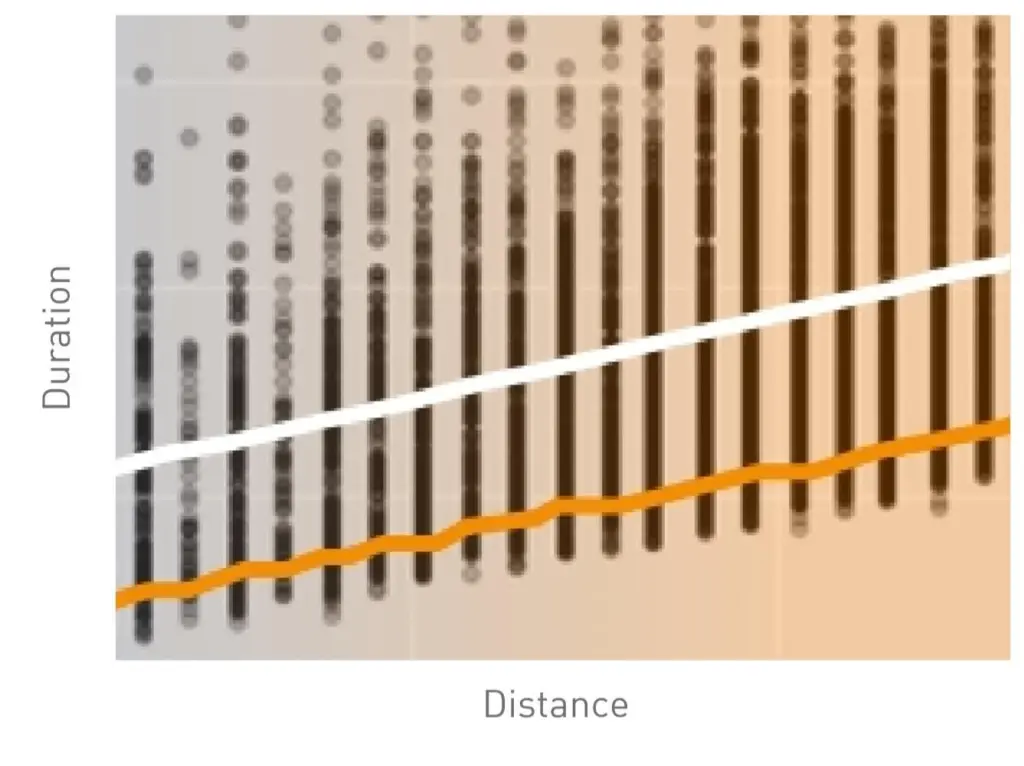
Figure 1 is an example of the findings from the application of ML to analyse past data sets. The figure shows a snapshot of loaded crane travel durations within a terminal block. Each grey dot indicates the actual duration of a move for a given distance.
The orange line indicates the human expert’s calculated task completion time prediction based on the robotic system’s physical hardware capabilities (i.e., using the manufacturer’s predicted acceleration and speed of travel) and predictions for fine positioning.
Looking at Figure 1, it’s clear that using the hardware’s physical capabilities to build the prediction model has consistently produced an overly optimistic parameter for expected task performance. In contrast, the ML algorithm’s regression model output is represented in white. It provides a considerably more realistic prediction of expected task completion. That said, when an expert reviews the model they can quickly see that it isn’t necessarily a tidy fit either. It is overly cautious of job-completion time for shorter runs and still, too optimistic on longer runs.
While the above is a basic example of ML in terminal operations, it does demonstrate that a combination of AI and human experts working in conjunction will lead to an overall improvement in terminal operations. Like all CPS, we still need big picture thinking and while AI is steadily advancing towards the ability to deliver this — an agent of agents model, so to speak — keeping humans in the loop and freeing them up from the monotonous tasks of daily decision-making enables them to question assumptions about, and derive clever solutions to, the underperformance challenges that plague robotics systems and full automation in terminals around the world. It’s a win-win.
German-headquartered INFORM offers technologies for digital decision making in a number of verticals, including logistics and the supply chain. For more information go to www.inform-software.com.
Related Articles
 ENERGY & TECHNOLOGY GREENPORT
 ENERGY & TECHNOLOGY GREENPORT
 PROJECTS & INITIATIVES GREENPORT