![GreenPort[PortStrategy]](https://www.portstrategy.com/greenport/wp-content/uploads/sites/4/2026/09/GreenPortPortStrategy.svg)


4. EXCLUSIVE: Tauranga prevents a beachside ‘Dust Up’
Dust pollution from industrial activities is a major concern for residents at Mount Maunganui, an idyllic beachside suburb in the Bay of Plenty, in New Zealand’s North Island, writes Dave MacIntyre
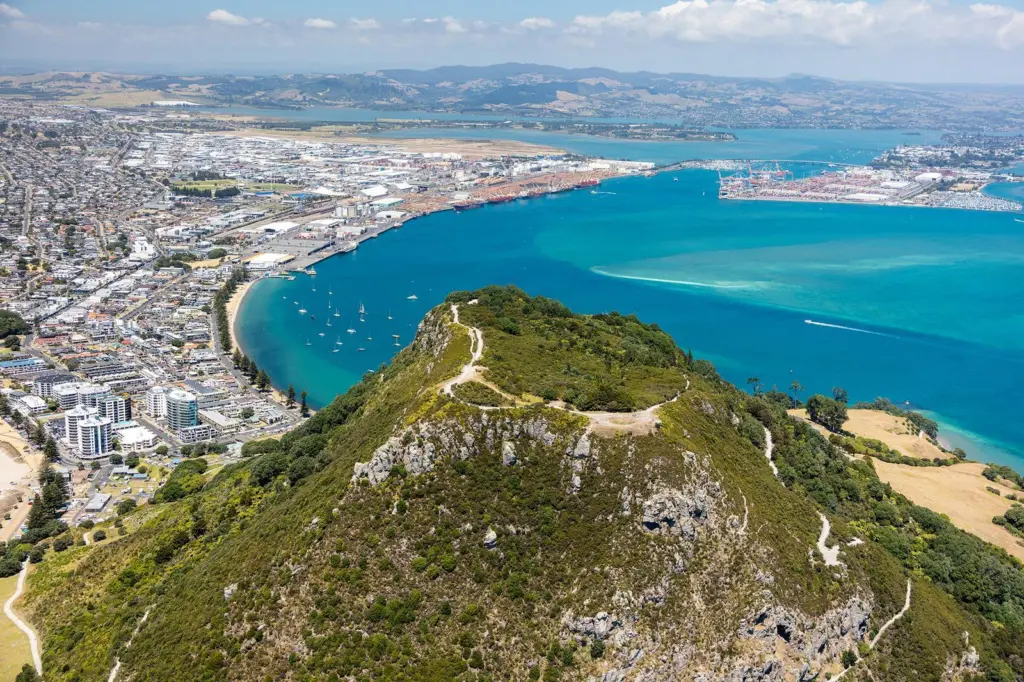
In response, the adjacent Port of Tauranga, the country’s largest port, has undertaken a range of dust suppression and mitigation measures to produce a dramatic improvement in air quality since 2019.
New Zealand’s National Environmental Standards for Air Quality (NESAQ) provide a level of protection for the health of people and protection of the natural environment. The country’s air space is divided into 74 ‘airsheds’, or legally-designated air quality management areas.
Mount Maunganui has its own airshed which encompasses the Port of Tauranga and the Mount Maunganui industrial area, which has traditionally had an issue with PM10 discharges (smoke and fine dust particulate matter smaller than 10 millionths of a metre). For this reason, the airshed is classified as polluted under the NESAQ.
Tighter rules
The Mount Maunganui airshed was introduced to enable tighter rules and resource consent decisions and a greater ability for the regional council to manage industrial discharges.
New consent applications for activities that discharge PM10 cannot be granted consent if they are likely to increase offsite PM10 concentrations – unless the discharge can be offset by at least an equivalent PM10 reduction in another part of the airshed.
For the Port of Tauranga, a main focus on improving air quality has been to tackle the threat of dust pollution.
The port is split between container wharves on one side of the harbour and bulk and breakbulk on the other side, next to the residential and holiday destination of Mount Maunganui.
High-risk cargoes handled on the Mount Maunganui wharves include stock feed, fertiliser, export logs and clinker (the main component of cement) but many other cargo-handling activities and vehicle movements can create dust if not managed well.
Port’s response
The port’s response has been to increase its pollution-mitigation measures, starting with sealing all cargo-handling areas between about 2010 and 2015. This was then complemented by the erection of wind fences to prevent dust blowing onto adjoining roads. Close to two kilometres of wind fences encourage any airborne dust to settle on the ground, where it can be swept up.
Sweeping is undertaken at the container terminal, throughout the Mount Maunganui wharves and at the Hewletts Road log marshalling yard. Vacuum sweeper trucks collect dust and debris from the wharves, and concrete barriers have been installed to keep traffic and heavy equipment on more frequently-swept roadways.
The sweepings collected from bulk handling berths are segregated and stored in a purpose-built facility designed to reduce dust generation. At the completion of the operation (before being removed from the port by the cargo owner), they are reintroduced to the importer’s processes where possible to minimise waste to landfill.
Log yard area sweepings consist of finer earth and bark materials, which are also recycled and used by local landscaping company Daltons, which has been collecting log bark from the wharves for more than 45 years.
The port also enforces wind limits on handling potentially dusty cargoes. Wind speed is monitored by the stevedores via multiple LED light systems located on the berths. These lights are similar in appearance to traffic lights to advise the stevedores, including those operating the ship’s cranes on board, if the wind speeds are within limits, approaching limits or are exceeding limits.
The 15-minute average wind speed needs to be 15 knots or less. The port also has several (more complicated) gust speed wind limits which are frequently reviewed to ensure they remain fit for purpose. The system is completely automated to ensure good decisions can be made in response to changing wind conditions.
Air quality focus
Port of Tauranga has a history of working to improve air quality over decades, as witnessed by Dalton’s collection of log bark for nearly half a century. There has been an increased focus since about 2018, with the appointment of the port’s first Environmental Manager, Joey McKenzie. He now has a team of three.
The designation of the polluted airshed in 2019 resulted in increased monitoring of air quality by the port, to identify opportunities for improvement. The monitoring has also allowed the port to quantify the improvements.
The results show significant reductions in sulphur dioxide and dust. A recent report for the Toi Te Ora Public Health Unit identified air quality improvements since 2019, just before Mount Maunganui industrial zone was designated a polluted airshed.
The study showed a reduction in fine dust (PM10 ), with annual PM10 concentrations on a port boundary reducing by 15% since 2019, and annual levels of PM2.5 reducing 35% in the three years to 2022.
In addition, the introduction of mandatory low-sulphur shipping fuels in early 2020 has had a major impact on improving air quality by reducing sulphur dioxide emissions.
Port of Tauranga has recently agreed to help fund some of the air quality monitoring being undertaken in the industrial area to enable Bay of Plenty Regional Council to introduce supplementary air sensors into nearby residential areas.
The 12 new sensors, while not as accurate as the monitors in the industrial area, are designed to detect particulate matter, including salt-laden air, as well as NO2 (nitrogen dioxide) which is also generated from petrol and diesel vehicles. The Council is posting real-time air quality indicators on its website.
The port consults regularly with its neighbours, the Bay of Plenty Regional Council and residents’ groups through various forums.
Related Articles
 ALTERNATIVE FUELS GREENPORT
 ENERGY & TECHNOLOGY GREENPORT
 PROJECTS & INITIATIVES GREENPORT