![GreenPort[PortStrategy]](https://www.portstrategy.com/greenport/wp-content/uploads/sites/4/2026/09/GreenPortPortStrategy.svg)
Analysing the benefits of water-based freight
Industry leaders met recently at a “Freight by Water” seminar to share latest thinking and best practice in the environmental benefits of short-sea, coastal and inland shipping. Kate Royston reports.
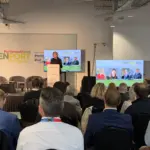
“Freight by Water” is the UK Department for Transport’s (DfT) Shortsea Promotion Centre. The organisation recently hosted an industry seminar entitled: “Short-sea Coastal and Inland Shipping: tackling congestion, reducing emissions and generating cost efficiencies”; the event was hosted by the Port of Bristol. Opening the seminar, Francis Power, Executive Director of Freight by Water, emphasised the potential for expanding short-sea water transport. The UK supports more coast line and secondary ports per head of population than any other EU member state. Some 96 percent of all goods by volume arrive in the UK by water. Major conurbations are also better served by water for freight than most of their continental neighbours. However, the UK continues its “love affair” with road transport (see figure 1).
Mike Garratt, Acting Chairman of Freight by Water (FbW) explained the organisations re-branding from its previous ‘Sea and Water’, and its intentions for the future. FbW’s primary objective is to achieve modal shift moving more freight off the roads and onto water. The key is to facilitate making water transport work. Short-sea and coastal shipping deliver around 65 percent carbon emissions savings over road transport (see figure 2). Expansion of their use should be a critical component of a sustainable transport system. Potential applications for successful deployment of freight by water were discussed – for example, in the construction and management of power stations. Requiring vast quantities of water and a waterside location, water transport should be designed into all the life cycle phases.
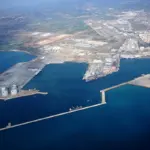
Patrick Kearon, Director of Communications, Bristol Port Company (BPC) provided an overview of the considerable investment in the Port of Bristol (Avonmouth & Royal Portbury Docks) since its acquisition by BPC in 1991. State of the art facilities have been developed and wind turbines installed for renewable energy. The port’s attractions include its proximity to markets and distribution centres in the South West, North Wales and the Midlands. A study conducted into the distribution of imported containers to UK markets shows Bristol’s potential to provide access to 34 percent of the market, whilst reducing distribution road miles and related CO2 emissions. This is supporting plans for the Deep Sea Container Terminal (DSCT) development, now awaiting government approval. Bristol handles various cargos (12m tonnes in 2007). These include motor vehicle imports and exports (750,000 in 2007), coal (5-6 million tonnes pa), aviation fuel, petrol and diesel, animal feed and forest products. A fresh produce terminal and orange juice terminal have also been developed to support hinterland markets. The port hopes that coastal distribution, which can be supported technically and operationally, will increase. Distributors still need to grasp this as a viable strategic alternative.
Joe Besch, Commercial Director, Milford Haven Port Authority shared his views on the potential that Milford Haven offers for short-sea shipping. Milford Haven, including Pembroke Dock, is the 6th largest port in the UK with 36m tonnes of cargo in 2007. Predominantly oil related (70 percent), daily passenger and freight services to Rosslare are also key (23 percent). Milford Haven transformed from the 1950’s to meet the growing need for refinery capacity. Now benefiting from the developing LNG market, the two new terminals (South Hook and Dragon) can provide 30 percent of the UK gas needs. Milford Haven may also become an important base for offshore renewable energy projects. The port could be better served by the road network but is well positioned for coastal movements. Short-sea shipping offers opportunities in three areas:
– The ferry services to Rosslare, which attract cargoes from South Wales and Southern England for the Irish market and vice versa;
– project and ro-ro cargos
– coastal tanker movements.
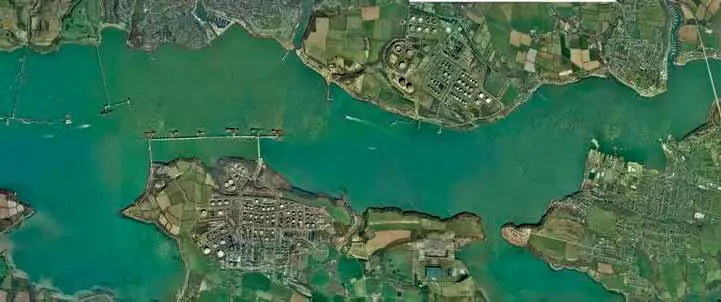
The major oil refineries, tank farms and LNG facilities in the Haven (see picture on page 48) are geared to access, maintenance and delivery including big plant, from the water via their ro-ro berths. The new Pembroke Power station, under construction, will also be serviced this way. Local fabrication works e.g. Ledwood Mechanical Engineering also support project cargoes. Picture 1 shows a refinery cracker head on its way to Norway. Of the 1.2m tonnes of crude imported in October 2008, 304,000 tonnes were moved coastally around the UK, including Aberdeen, Immingham and Shoreham. Could similar concepts be developed e.g. networks of waste transfer stations?
David Cox, Group Operations Director at ASD Steel described his frustration in trying to set up a water freight operation to Transport Structural Steel Sections from the Humber Ports and Wharfs to Leeds. The key to success for ASD Steel’s business is stocking a wide range of components, adding value as required, and delivering to customers on demand across the UK. Expanded storage facilities were required, preferably without re-location. A site nearby was identified with sufficient space and ground bearing strength and access to the Aire and Calder Navigation. With 60,000 tons being imported annually through Immingham it was decided to set up a trial of 2000 tons to test the feasibility of water freight. Finding the right support and guidance was difficult. Peter Hugman, International Barge Master and Consultant proved a critical element. After much tribulation the trial took place (see Picture 2), received wide media coverage and was an absolute success. The company decided to progress to full scale but obstacles were met from Leeds City Council and Yorkshire Forward (Regional Development Agency). The area in question has been identified for housing, despite its current contamination and proximity to other industrial uses. Achieving a long term commitment and grant aid to help finance the project is proving trying. However ASD Steel continues to persevere. Duncan Buchanan, Head of Sustainable Distribution Policy, Freight & Logistics Division, Department for Transport provided an update on the changes taking place within the Mode Shift Programme of the Sustainable Distribution Fund. He confirmed revenue funding would be continued through to 2010/11 for the Efficiency programmes, including Freight Best Practice (see later presentation). The mode shift programme provides Freight Facilities Grants (FFG), Waterways Facilities Grants (WFG) and Domestic Mode-Shift Schemes (DMS) to assist moving transport from road to water and/or rail. With £61m funding announced for 2011/12 to 2013/14, beyond that already pledged for current years, the schemes were also being modified and simplified. The Grants provide support for capital investment in facilities required for water and/or rail to work. Their value is based on Sensitive Lorry Miles (SLMs) – an estimation of the carbon benefit from the mode shift. The audience stressed their concern of the government’s seeming lack of understanding of how to structure the schemes to meet the need, and a lack of industry consultation on the setting of the new levels for SLMs. To date the schemes have had limited success due mainly to their complexity and poor fit to requirements. To find out more go to: http://www.dft.gov.uk/pgr/freight/ sustainable/thesustainabledistributionfund.
Patrick Moss, Associate, Peter Brett Associates discussed the opportunities for urban water transport. Urban areas with major populations are suffering from congestion and pollution, yet are dependant upon efficient freight operations. Could urban water transport provide some answers? The inland waterways freight market is growing and Moss provided some examples. The Thames supports 2m tonnes of internal traffic. Whilst there is river capacity, there is a shortage of wharfage. This is like “motorways without exits” and needs attention. An Olympics Waterbus may help relieve strain on the public transport system. Olympic Access by water for freight is being enabled by a lock construction. For each 350 ton barge, 35 lorry movements can be saved. At maximum capacity this amounts to replacing 280 lorry movements through the congested streets of Stratford. Smart barges are being developed for smaller waterways (see picture), able to accommodate standard road units into a dumb barge. The West London Canals offer potential with a 20 mile reach. Powerdays Wharf has been developed on the Grand Union canal recycling construction and demolition waste. Water freight has supported development of wind turbine manufacturing on the Isle of Wight. The vessels Bladerunners 1 and 2 transport the blades from their plant to Southampton for onward shipment. There is potential but it must be supported by enabling policy and regulation. Geoff Clarke, Technical Manager, Freight Best Practice (FBP) introduced the guide to ‘Choosing and developing a Multi-modal Transport Solution’. Funded by the Department for Transport, FBP is an educational initiative to support reduction of costs and environmental impact of distributing freight. The organisation provides free information and advice to freight operators – for example, in saving The Milford Haven Waterway, showing major oil refineries, tank farms and LNG facilities. fuel and improving equipment and systems. During 2005-2007, FBP has supported savings of 240,000 tonnes of CO2 and a saving of £80m in operating costs. In 2008 a multi-modal dimension was added to encourage a modal shift from road to rail and/or water freight. The guide has proved very popular. It provides an overview of the Rail and Water markets, and a clear step by step approach on how to choose and develop a multi-model transport solution. The steps are illustrated by case study examples including water freight for abnormal loads, such as the transport of Concorde from London to Scotland (see photo). A market analysis has also identified the commodity types most suitable for the different modes. The water freight market is significant: 126m tonnes of domestic freight in 2006. FBP looks forward to supporting greater use and increasing efficiency through further research and publications in 2009. See http://www.freightbestpractice.org.uk/ multi-modal for further information. FBP would like to hear from anyone with suggestions of anything FBP should cover in terms of environmental efficiency or indeed any other area that needs investigation. Please get in touch through FBP or FbW. Francis Power closed the presentations and discussion, which was followed by lunch and a tour of Bristol Port Company’s Avonmouth and Royal Portbury Docks. Hosted by Patrick Kearon, delegates were able to see examples of the ports investment programme at first hand. This included the coal distribution operation utilising systems of conveyors and rail transport, an example of short-sea transhipment, the site planned for the DSCT expansion and the extension to the port’s rail network supported by a Freight Facilities Grant.
In conclusion, following intense sessions and debate, it was agreed that future seminars should be organised and the role of Freight by Water was important. There was a clear need for committed governmental support and focus on the benefits of freight by water for UK plc. Critically this also requires pro-active support for the infrastructure needed to support it. Francis Power: “This was our first regional seminar as Freight by Water and we felt on some levels it was a great success; particularly regarding the calibre of the attendees and the quality of the presentations. Unfortunately, neither the South West Regional Development Agency nor the Welsh Assembly attended. The world has moved on to a different place economically since the seminar last November; and we are reviewing our strategy for bringing together water freight professionals with regional transport planners and users of the distribution industry. In these very difficult trading conditions a more direct approach might be more appropriate.” The conference presentations, and other valuable resources, are available to view and download at: http://www.freightbywater.org kate.royston@robbeesmole.com
Related Articles
 ALTERNATIVE FUELS GREENPORT
 ENERGY & TECHNOLOGY GREENPORT
 PROJECTS & INITIATIVES GREENPORT