![GreenPort[PortStrategy]](https://www.portstrategy.com/greenport/wp-content/uploads/sites/4/2026/09/GreenPortPortStrategy.svg)



APM Terminals and the eco-efficiency philosophy
Good business practices and proactive, sound environmental policies are not mutually exclusive principles, as APM Terminals, one of the world’s leading container terminal operating companies seeks to demonstrate
With a global terminal network of 48 container facilities, 10 port projects in 34 countries on five continents, APM Terminals’ port operations are an integral part of the global logistics chain, and a key factor in the economic development of emerging countries in Asia, Africa and Latin America. This position bestows great significance on the company’s actions, and also confers great responsibility.
It is a responsibility that APM Terminals and its 19,000 employees worldwide take very seriously. The company has announced that its environmental performance target is to cut CO2 emissions from terminal operations worldwide by 15 percent from the 2007 base figure within three years. In 2007, APM Terminals’ total global CO2 emissions were 543,000 metric tons world-wide, or 17.5 kg CO2 per TEU handled. APM Terminals plans to reduce this number through innovative operational initiatives, best practice sharing, benchmarking, strategic investments and energy-conscious planning at every terminal. The figure of 14.96 kg per TEU has been established as the goal.
APM Terminals CEO Kim Fejfer states, “Our strategy is to minimize our global environmental footprint through our daily operations, across all terminals and in any new business opportunities we pursue. This means we will update our terminal procedures and environmental performance standards to exceed local and national environmental regulatory compliance levels”.
“Diesel magnets”
Today’s global economy is increasingly dependent upon world trade, as the recent global recession and credit crisis has (often painfully) illustrated. The boom in trade of the past decades is due, in no small part, to the increased efficiencies of moving merchandise, and an increasing share of refrigerated products and basic commodities in 20ft and 40ft shipping containers. Including container loadings, discharges and transhipments, overall container handling world-wide is estimated at 500 million TEU at present. A terminal’s responsibility for emissions entails more than the emissions produced by the facility’s own equipment. Container terminals function by their very nature as so-called “diesel-magnets”. They attract such diesel fuel consuming machinery such as large ocean-going vessels, and landside trains and heavy truck traffic. Vehicular traffic congestion in many port areas substantially adds to overall pollutant emissions.
The relative impact of container terminals on the total port pollution thus is a function of a variety of factors, including the number of vessels calling at the port, local vehicular traffic conditions, relative size of the container terminal, modal split (rail/barge/road) and the age and type of equipment employed. It is estimated that the contribution of terminal operations to port air pollution is less than 4 percent of the total supply chain.
Eco-efficiency policy
In recognition of this, APM Terminals has introduced a policy of Eco-efficiency and made a commitment to maximize environmental performance at every facility. “Eco- Efficiency” is defined as providing more goods and services to the customer while decreasing resources and energy consumption, reducing waste and pollution. This strategy requires surpassing basic local, environmental, regulatory compliance in order to create a competitive advantage. The combustion of fossil fuels by terminals’ diesel-powered cargo handling equipment is the single largest source of air pollution caused by terminal operations. The movement of steel and aluminum containers loaded with as much as 30 tons of cargo each is an energy-intensive function. With newer, larger vessels capable of carrying as many as 14,000 TEU, terminal operations have also become very time intensive. To obtain maximum benefit from the economies of scale provided by such large vessels, port calls must be as brief and yet as productive as possible. Such concentrations of equipment and emissions can cause severe strain on air quality in local environments and so as terminals and ports expand to meet growing demand for larger volumes of container throughput, proactive solutions must be designed into new terminal construction and operating procedures.
At present, more than one third of the electric power consumed by APM Terminals’ facilities is Carbon Dioxide (CO2) neutral. This means the electricity is generated from power grids sourced from nuclear power plants or by such renewable energy sources as wind, solar or hydroelectric power.
Green-powered
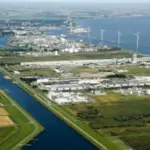
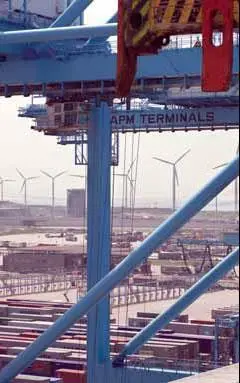
In a major first for the company, and the industry, APM Terminals Rotterdam, which handled approximately 2 million TEUs in 2008, has become “green-powered” with the introduction of electricity-generating wind turbines into the power grid.
On October 16th, APM Terminals officially opened its new 12.5 million Euro power distribution network at the Rotterdam container terminal with electricity generated solely by wind power. APM Terminals Rotterdam is one of the busiest terminals in the company’s Global Terminal Network, accommodating weekly port calls from 11 large “mother” vessels, 20 smaller feeder vessels and 160 barges. The terminal also requires more than 5,500 truck trips to drop off and pick up containers each week, as well as moving 3000 containers a week by rail to inland European locations. By using non-fossil fuel produced power the terminal reduces its CO2 emissions by 45% per year.
The electricity feeding the Rotterdam terminal is produced by two windmill farms constructed near the terminal at Hagenwind in Aalten and De Landtong in Rotterdam. The wind-generated electricity is sufficient to power 14 gantry shore cranes which serve the largest container ships in the world, the refrigerated containers delivered and received into the yard from vessels and trucks, as well as the terminal, light poles, workshops and other power consumption needs. It is anticipated that the Rotterdam green power supply can serve as a model for other terminal locations.
Alternative fuels
One of the other methods APM Terminals is pursuing to reduce terminal equipment emissions is the use of alternative fuels, including low sulphur and ultralow sulphur diesel fuel and compressed or liquid natural gas for terminal vehicles. In order to limit the consumption of energy, necessary to maintain high performance in operations, steps are being taken to eliminate idle running time for yard equipment, reducing unnecessary fuel consumption.
This can be accomplished by standardized and clearly communicated shutdown procedures both on terminal equipment and third-party equipment (e.g. trucks entering the terminal) but also through electronically-controlled engines that monitor their own idle times and automatically shut themselves off.
It is the company’s policy to also develop and employ efficient innovative yard equipment. A successful example of this innovation are Eco- Rubber-Tyred Gantry Cranes (RTGs) which save up to 40 percent on fuel and emissions through more efficient engine operation, and improved conservation of kinetic energy. Some APM Terminals facilities have moved to electric Rubber Tyred Mobile Gantry Cranes – which run semi-automatically, and can be programmed for greater efficiency at full automation.
APM Terminals also utilizes software process optimization tools to enhance equipment deployment procedures, resulting in further operating efficiencies, and reduced pollution and emissions with expected fuel savings of 5-8 percent. The optimization tools anticipate yard traffic and container flows and minimize RTG moves in the yard through sophisticated planning algorithms. Global Pooling processes also eliminate unproductive driving, idling, crane delays and traffic congestion.
Benchmarking
A major initiative undertaken by APM Terminals has been to monitor air quality performance at individual terminals for benchmarking and comparative purposes both internally and within the industry. Local air quality surveys and environmental risk assessment and impact studies are conducted comparing data with other locations for the creation of standards for further performance improvement. Through dedicated energy awareness campaigns, terminals instruct personnel on CO2 and other greenhouse gas emissions, and the steps which can be taken to reduce these on a day-to-day basis through exercising caution, prudent business decisions and general good sense. It is emphasized that even small measures, when combined with operations across the Global Terminal Network, can add up to big changes. In a similar way, this philosophy was also applied to the company’s global safety program – which successfully led to getting all employees engaged and delivered significant results. The best practices gained are now being applied to the environmental campaign, making it a global initiative with local targets, a leadership challenge and part of APM Terminals’ drive to meet and exceed Corporate Social Responsibility goals. These initiatives all come together to allow APM Terminals to pursue environmental innovation and improvement to benefit the shipping lines which constitute its customer base, and to benefit the people and local communities in which the terminal does business.
Related Articles
 ALTERNATIVE FUELS GREENPORT
 ENERGY & TECHNOLOGY GREENPORT
 PROJECTS & INITIATIVES GREENPORT