![GreenPort[PortStrategy]](https://www.portstrategy.com/greenport/wp-content/uploads/sites/4/2026/09/GreenPortPortStrategy.svg)



Clean-up robots
Robotic vacuums to clean litter from the seabed passes test in Croatia.
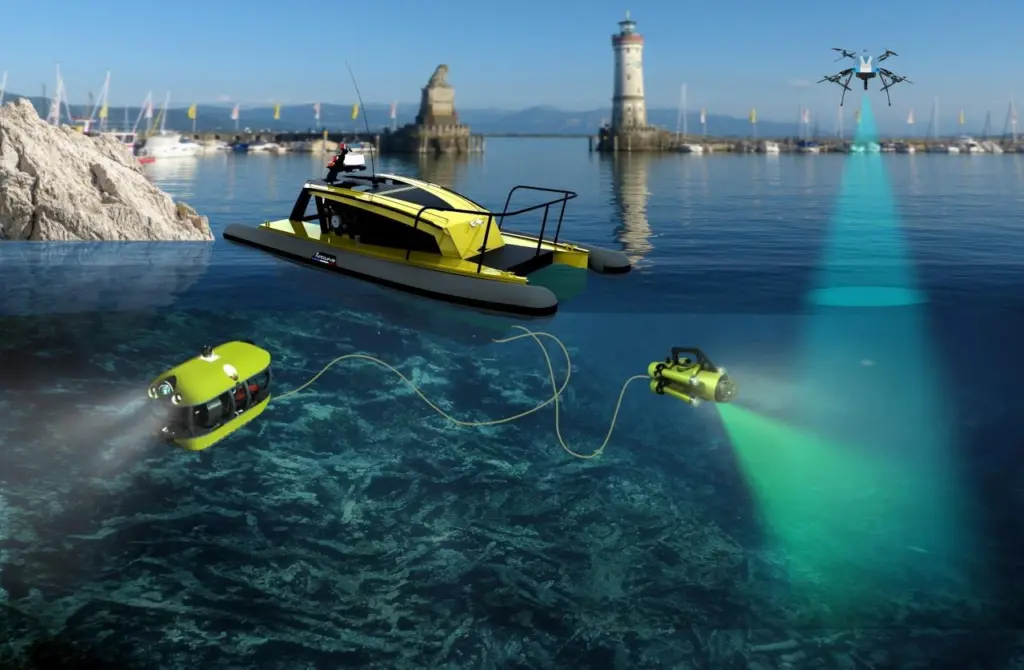
The SeaClear cleaning system, which works similarly to home robot vacuums, is being tested in Dubrovnik following a two year development project by the European-funded SeaClear project (SEarch, identificAtion and Collection of marine Litter with Autonomous Robots).
Consisting of underwater robots, a surface vessel and drones working together, sensor data and artificial intelligence is used to locate and identify litter on the sea floor. Then an underwater robot equipped with a gripper is deployed to collect the waste.
“The concept is simple on paper and not unlike our home robot vacuum cleaners,” said Professor Lucian Bușoniu, from Technical University Cluj, Romania, who is leading the litter-search part of the project.
“However, the complexity of robot positioning and control, as well as of litter identification and collection, is much higher and makes the objectives much more difficult to achieve. We wanted to test out our concept and we now need to go through all the data sets from our cameras, the sonar and the robot positioning sensors. This will help improve our software.”
Software tweaks
The team tested a 3D printed prototype of its newly designed gripper, to identify weak spots in the design and operation under real-life conditions and indeed, it broke. However, to have a proof-of-concept, the researchers were able to repurpose an existing, sturdier gripper which worked to pick up the litter.
A plastic bottle became the first official litter to be picked up from the seabed. This series of tests is a small step in humanity’s goal of cost-effectively cleaning the seafloor, where more than 90% of the sea garbage is found.
The researchers say that a completely autonomous robotic system for sea litter cleaning could be a vital and cheap solution to one of the largest environmental problems our planet is facing.
Today’s oceans contain 26 to 66 million tonnes of waste, such as pieces of plastic, bottles or tyres. The waste that we see at the surface represents a mere 6% of the total, the rest is resting at the bottom. Tourist resorts and port authorities currently resort to divers to clean up this waste from the seabed, sometimes at the cost of their safety.
In September 2020, a human-only marine litter clean-up that took place in the same test area close to Lokrum Island, resulted in 17 divers collecting more than 88 kg of waste from the seafloor in a one-hour period. When completed, the SeaClear system should achieve similar results with minimal human intervention.
SeaClear is a European Horizon 2020 project that was launched on 1 January 2020 through to December 2023. There are eight partners from five countries and 49 researchers involved: TU Delft, Hamburg Port Authority, TU Cluj-Napoca, Subsea Tech, TU Munich, Fraunhofer CML, University of Dubrovnik and DUNEA.
Related Articles
 ALTERNATIVE FUELS GREENPORT
 ENERGY & TECHNOLOGY GREENPORT
 PROJECTS & INITIATIVES GREENPORT