![GreenPort[PortStrategy]](https://www.portstrategy.com/greenport/wp-content/uploads/sites/4/2026/09/GreenPortPortStrategy.svg)




Climate neutral warehousing
A European logistics expert is looking at operating its warehouse district in a carbon-neutral way as a UNESCO World Heritage Site.
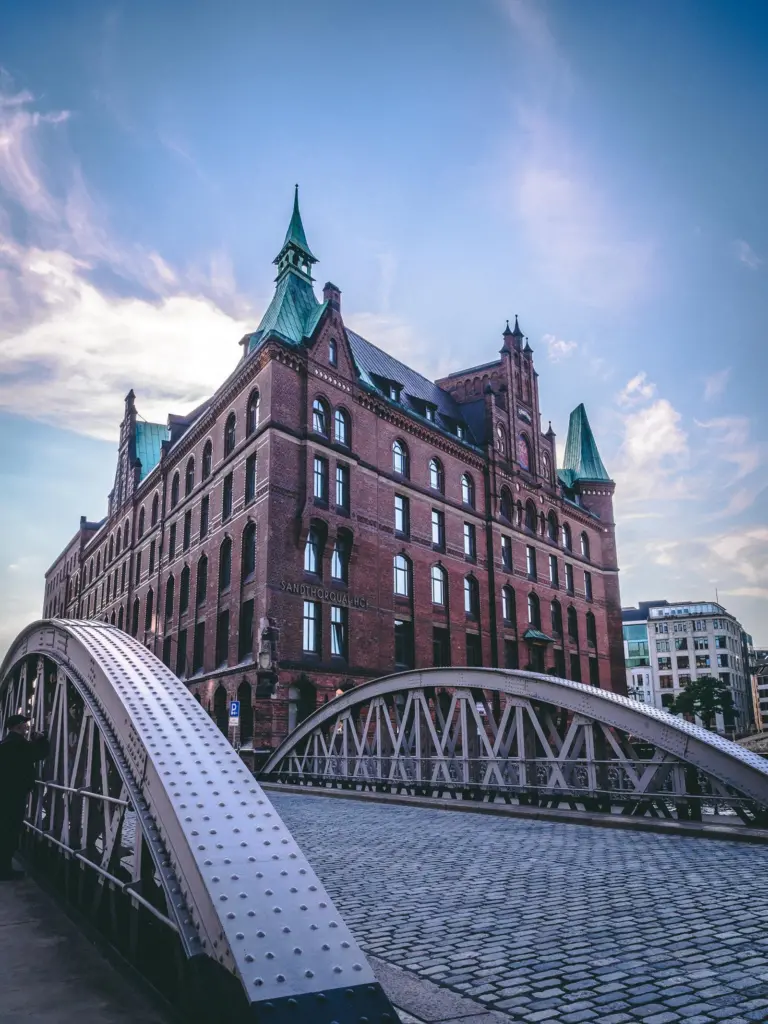
In a first for Germany, HHLA Real Estate, part of Hamburger Hafen und Logistik AG, is cooperating with the universities of Stuttgart, Aachen and Hamburg, on how the Speicherstadt historical warehouse district can be operated in a carbon-neutral way under the special requirements of a UNESCO World Heritage Site.
HHLA plans to supply the historically important block buildings of the Speicherstadt with carbon-neutral energy by 2040.
Block H is intended to become a multi-use ’energy generator’, for which a holistically oriented energy supply concept is being developed. Another goal is to have the highest possible energy efficiency, which will be achieved through architectural innovations that are in line with the preservation of the building.
“In its sustainability strategy, HHLA committed to reducing its absolute CO2 emissions by at least half by 2030 and to becoming climate-neutral by 2040 at the latest,” said Dr Rainer Lappin, HHLA Executive Board member.
”To achieve these goals, we are consistently exploring new ways to renovate and manage real estate. The application of new technologies and holistic systems are necessary in the collective fight to stop climate change.”
Energy storage
One research project called ’0-CO2-WSHH’ looks into how the energy required to run a property can be generated, stored and used in the property itself. In doing so, a number of requirements for the world heritage landmarked building must be observed and factored into the planning.
Since the pilot project involves a landmarked neighbourhood, it is subsidised by the German Federal Ministry for Economic Affairs and Energy (BMWi) as part of the seventh energy research programme with the focus ’climate-neutral quarter and buildings’.
The entire operation has been broken down into three project phases, of which only Phase I – materials research and testing – is subsidised. If the research goals of the phase are achieved, the measures to optimise the building’s operation can begin to be gradually implemented with phases II and III. Work will be carried out on testing and further developing the system to be adapted in line with the requirements of a landmarked building.
HHLA Real Estate is responsible for the overall coordination of the project. The project sponsor is Forschungszentrum Jülich (FZJ) and research coordination is run by the Institute of Construction Materials at the University of Stuttgart.
Partners of the project include the HafenCity University Hamburg (BIMLab) and RWTH Aachen University (EONERC). The German Ministry for Environment and Energy and the monument preservation office of the Free and Hanseatic City of Hamburg support the project in a consultancy capacity as associated partners.
Founded in 1885 for the construction of Hamburg’s Speicherstadt historical warehouse district, HHLA manages the historically unique collection of clinker-brick buildings through its Real Estate segment.
Related Articles
 ALTERNATIVE FUELS GREENPORT
 ENERGY & TECHNOLOGY GREENPORT
 PROJECTS & INITIATIVES GREENPORT