![GreenPort[PortStrategy]](https://www.portstrategy.com/greenport/wp-content/uploads/sites/4/2026/09/GreenPortPortStrategy.svg)
EXCLUSIVE: A floating solution to address port infrastructure gaps
ELIRE Infra has designed innovative and intelligent floating infrastructure designed to accelerate decarbonisation across ports, harbours, waterways and the industries they support.
“Smart Hubs address critical infrastructure challenges by offering a sustainable, scalable and commercially viable solution that bridges the gap between innovation and practical application,” Luke Jenkinson, CEO/Founder of ELIRE Group tells GreenPort.
”They are tailored to help clients achieve decarbonisation and net-zero goals while also future-proofing operations for emerging technologies and evolving energy demands.”
Unlike traditional floating infrastructure commonly known as pontoons, ELIRE Infra’s Smart Hubs are agile and designed to be flexible and customisable for a variety of industries, including ports, cruise lines, shipping, logistics and energy.
The Smart Hubs facilitate maritime shoreside energy connections, support renewable energy projects and provide adaptable infrastructure for the future of clean transport.
Bridging the gap
Over 70% of total global city port infrastructure is yet to be designed for the future, requiring significant investment to address aging facilities, capacity constraints and the demands of new technologies.
Many also face regulatory changes, necessitating substantial upgrades and investments. To meet the 2050 IMO targets, expanding ports and harbours with traditional infrastructure is expensive, time-consuming and comes with a significant environmental impact.
This means cities and ports quickly need affordable, future-proof infrastructure solutions that can transition with new technologies, and are quick to deploy; with minimal disruption to business continuity and the environment. That’s where ELIRE Infra Smart Hubs come into play.
Aligned with eight UN Sustainability Goals, ELIRE Infra Smart Hubs offer cost-effective and sustainable long-term solutions with a lifespan of over 30 years, to address current and future challenges of ports and harbours, while simultaneously enhancing the local economy, connecting communities and preserving local habitats.
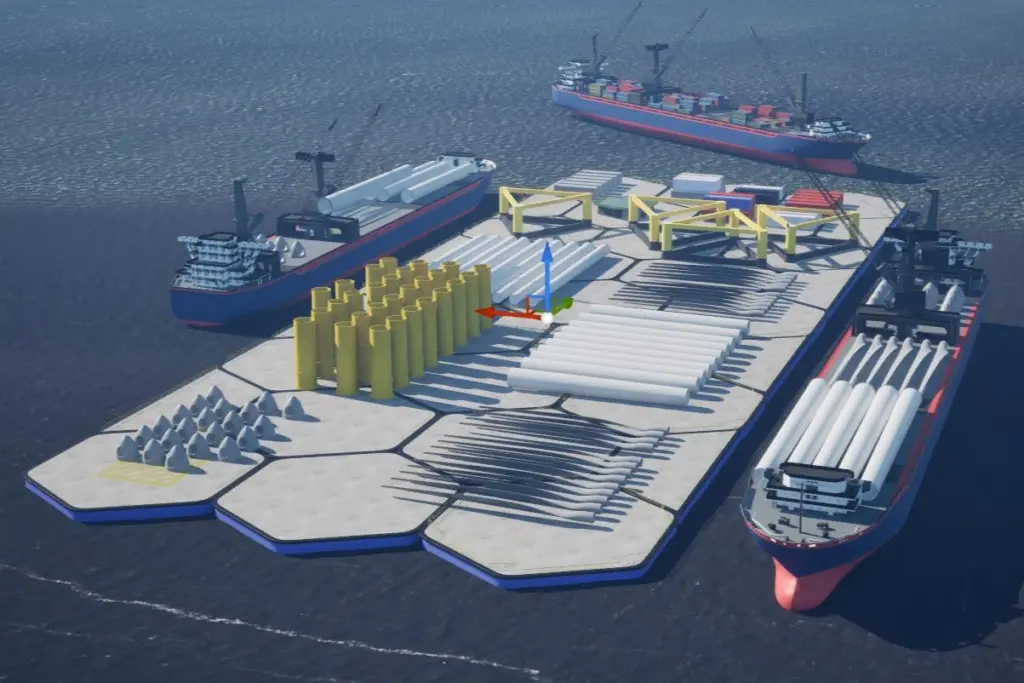
The innovative engineering behind the Smart Hubs, combined with the versatility of a unique multi-modal, agile, hexagon design, allows for endless configurations tailored to specific cases and locations; ranging from large coastal wind farm assembly setups to smaller last-mile midstream river cargo configurations to reduce CO2 emissions.
The engineering and design team at ELIRE use digital twins and simulations for planning, configuration and predictive maintenance and the floating SmartHub infrastructure remains in place regardless of tides, surges and sea level changes, building resilience for ports and cities.
Agile and flexible
ELIRE Infra was recently invited to participate in a floating port feasibility study by Scottish Energy that looks at the transformative potential of temporary floating ports in addressing critical challenges faced by the offshore wind industry.
The Smart Hubs are agile and flexible, allowing for various uses across multiple industries with rapid deployment within 12 months.
”With our solution, environmental disturbances are also kept at a minimum, with any temporary damage restored upon removal compared to the permanent habitat destruction associated with traditional port expansion,” says Mr Jenkinson.
The modular, scalable hubs are unique in design too, hexagonal in shape, they are made up of a central technical ‘nucleus’ and six outer platforms. The hexagonal form brings increased strength and connections, allowing scalability and flexibility.
Multiple hexagons can be added together, or taken apart, which means that ports and harbours are not left with an unused asset that is no longer generating revenue while continuing to carry maintenance liabilities.
The modular system is also designed for speed and flexibility, producing different size hubs ranging from 400 sqm to 1600 sqm that can be constructed from the same components.
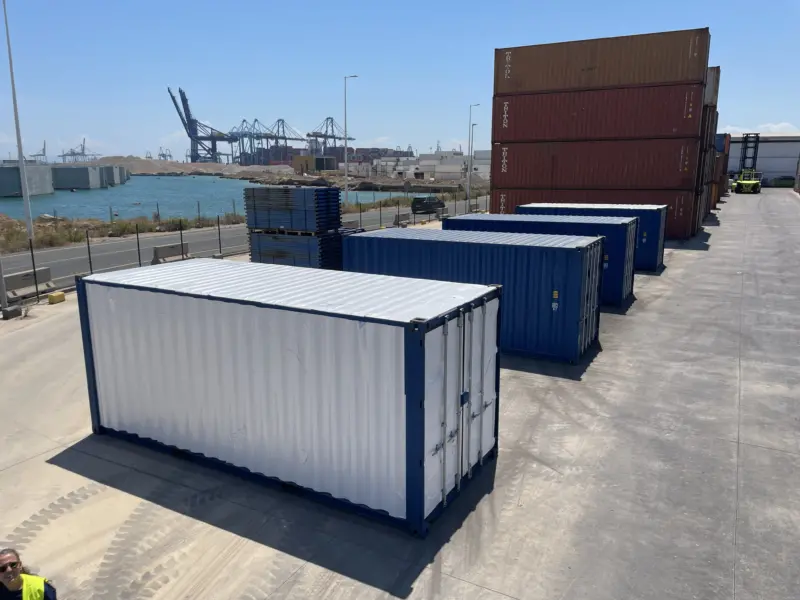
Built for containerisation, the connectable transport-friendly platforms can be shipped and moved to the site using containers and are easily manufactured at local fabrication yards or dry docks; making the journey from off to on-site, not only cost effective and fast but a seamless process that allows for faster deployment, whilst boosting the local economy.
Mr Jenkinson says that the company has conducted a study in partnership with an independent decarbonisation consulting company based in Norway, MH Tech, and discovered that a network of SmartHubs in ten small regions across the Mediterranean including Malta, a location known for its congested roads, could save the equivalent of 10 million tonnes of CO2 over ten years. This is in addition to taking off 30% of HGV vehicles off the roads by enabling logistics via electric waterborne transport.
CAPEX reduction
The Smart Hubs are designed and engineered to be cost-effective for ports and operators. They are assets that first and foremost be leased for a period of time from 5-20 years, helping eliminate high CAPEX required for infrastructure and allowing flexible finance terms.
This is due to the unique flexible value proposition that the platforms can be moved around the port, to a new port and completely taken off the water to be containerised and delivered to new clients for different purposes. They can be relocated when projects are finished, or if the location is not optimising operations.
”It’s a low-risk infrastructure investment,” says Mr Jenkinson. ”These platforms can also be repurposed, removing the need to build dedicated infrastructure for one purpose and one application. The platforms are flexible, where a passenger terminal can be converted into a logistics and cargo terminal, or energy bunkering solution and visa-versa.”
”Not only is the solution multipurpose, it can be shared between operators, significantly reducing costs associated with dedicated infra for just one purpose.”
The infrastructure is technically agnostic allowing for the integration of bunkering of clean new energy fuels including methanol, LNG, battery, solar, hydrogen fuel cells and more.
This means that the required infrastructure capex need not be allocated for every fuel and energy source, these floating platforms can be repurposed. making decisions less risky for pilot programmes and testing environments while allowing an accelerated approach for ports to adopt easily, knowing the infra can be used for other projects and operations.
“Safety with new energy is also the main problem we are solving with floating solutions as opposed to landside. Storing, transporting and using volatile energy needs a safe environment, away from people and other operations. Nearshore and on water options for energy bunkering is a far safer option than onshore,” says Mr Jenkinson.
Plug and play
The hubs have been designed to be plug and play ready, removing the need to engineer, design, develop, customise, permit and certify, comply, etc for new infrastructure.
”We estimate the time and costs to develop similar solutions on the landside are 5 times as much, that is our hubs can be pre-fabricated, transported, assembled and installed ready for operation between 12-18 months and cost approx £10M for 2000sqm,” says Mr Jenkinson.
He adds that in comparison to landside, where the cost for land alone is greater than this, when engineering, design, tech integration, project management and more are added, it becomes 6-7 times more costly.
Because the hubs are assets that can be leased for 12 months to 20 years, depending on the use and case. This allows ports to plan, install and operate with limited risk, knowing they can either build more with modular connections or remove them when they are not required.
For these reasons floating hubs are significantly more affordable and effective than landside development explains Mr Jenkinson. They create instant operational space on the water, allowing for advanced technologies gripping ports in the coming years to be adopted and integrated to ensure resilience and relevance in the maritime industry.
They will allow smaller ports to tender for larger businesses, extending their space capabilities, effectively attracting more business and ensuring current business operations are optimised.
”The Smart Hubs can also empower smaller ports maritime facilities to expand efficiently, adding new revenue streams and future-proofing their assets,” says Mr Jenkinson.
”Designed to help smaller ports grow their market presence and meet evolving demands, our modular, flexible platforms allow customers to scale at pace while reducing environmental impact.”
All of this can allow smaller ports to strengthen their competitive edge, adapt to emerging technologies and accelerate sustainable growth — creating a resilient infrastructure that meets the needs of today and tomorrow.
Smart Hubs in action
ELIRE Infra’s Smart Hubs are already making marks in the sector.
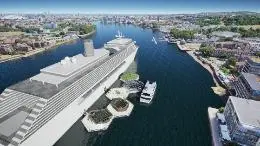
The platforms are being used to house cruise vessel cold ironing facilities on the River Thames in partnership with the Port of London Authority and Viking Cruises.
ELIRE has engineered, designed and proposed a London River Thames Smart Energy Hub. This particular project is interesting because cruise vessels make twenty annual calls at Greenwich, anchoring midstream to facilitate passengers’ embarkation on their London excursions. Unfortunately, during these calls, the vessels emit CO2 and sulphate equivalent to that of 500,000 cars on London roads annually.
Despite the benefits of shore-side power connections, logistical constraints, including limited space and significant tidal ranges, render shore connection unfeasible at this location, necessitating midstream anchorage for the vessels.
This facility will be strategically positioned midstream for vessel mooring, enabling seamless subsea electric cable connections to the shoreside grid. The cable is integrated into one of the hubs, which, via trunks, links to electrical switchgear and a comprehensive power system.
This setup enables vessels to connect to electricity, eliminating the need to use diesel engines throughout their entire duration at port.
The Smart Hub facility consists of 5 x 400sqm hubs, where hubs 1 and 2 are dedicated to electric connection to the vessel and the power system required for the subsea cables to shoreside. Hub 4 is the passenger handling terminal for the vessel Hubs 3 & 5 are dedicated to services for the visitors and community engagement activities.
Related Articles
 ALTERNATIVE FUELS GREENPORT
 ENERGY & TECHNOLOGY GREENPORT
 PROJECTS & INITIATIVES GREENPORT