![GreenPort[PortStrategy]](https://www.portstrategy.com/greenport/wp-content/uploads/sites/4/2026/09/GreenPortPortStrategy.svg)



EXCLUSIVE: Building port energy resilience through solar
In 2026, UK ports are moving increasingly from green energy ambitions to demonstrable decarbonisation benefits. At Peel Ports Group, we are firmly in the delivery phase, writes Lewis McIntyre, managing director port services, Peel Ports Group.
An important focus area for us has been solar power, which has huge potential to become a core enabler in meeting rising operational energy requirements, while accelerating our transition to lower-carbon operations.
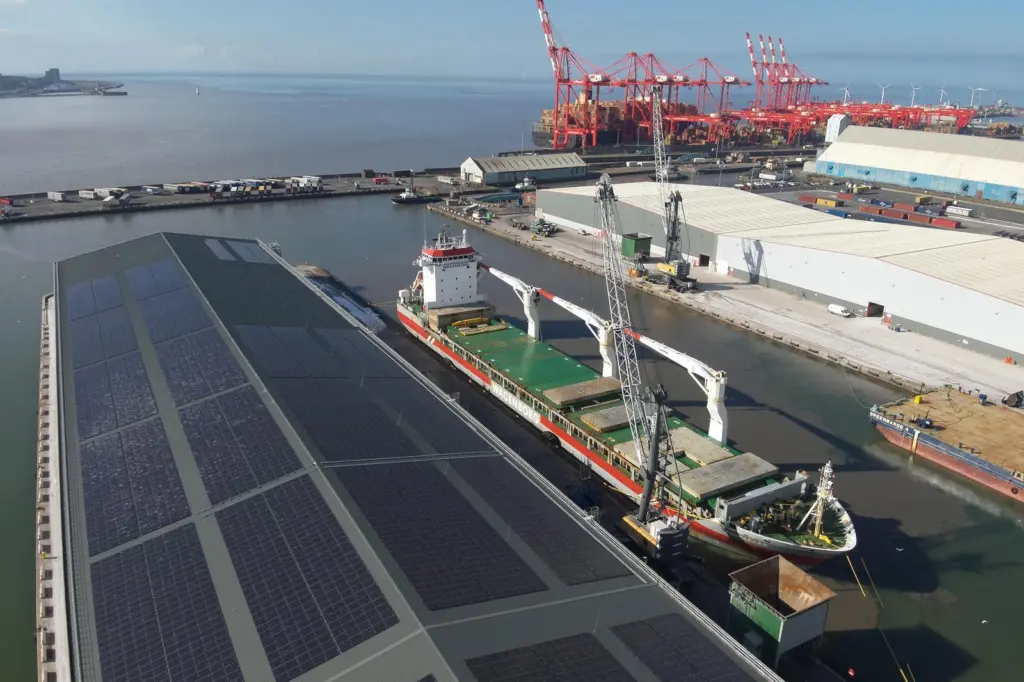
The recent installation of 7,000 solar panels at the Port of Liverpool is a significant milestone for us. It establishes one of the UK’s largest roof-mounted solar arrays within a port environment and reinforces our commitment to building a more resilient, efficient, and sustainable energy model.
The Liverpool project
In January, the Port of Liverpool generated its first solar power, marking a major step in port electrification through a large-scale renewable energy programme delivered with E.ON.
Peel Ports Group and E.ON have completed the initial grid connection of nearly 7,000 solar panels installed on the 260,000 sq ft Alexandra Dock warehouse, known as Alex Shed, forming part of a long-term strategy at the port to expand port solar power and cut emissions.
This milestone represents the first phase of a wider rollout that will ultimately see up to 48,000 panels installed across multiple port buildings to support renewable energy generation and more resilient port operations.
The project is being delivered under a 25-year agreement between Peel Ports Group and E.ON and is expected to reduce CO2e emissions by around 4,700 tonnes annually, equivalent to removing more than 1,600 cars from the road.
It’s a project which Vijay Tank, chief operating officer of E.ON Energy Solutions has called “critical national infrastructure”.
“Decarbonising places like this is essential for the UK’s environmental and economic targets. The first grid connection of this major solar project is a big leap towards creating a clean energy system fit for the future,” he says.
Once fully completed, the solar installation is expected to deliver up to 25MW of electricity, meeting around 25% of the port’s annual energy demand and contributing to a goal of sourcing 50% of energy from renewable energy by 2030.
The full array is being financed and delivered by E.ON, but local contractors are employed for installation and maintenance. All works are being completed within the existing port footprint to minimise community impact.
Why solar and why now?
We all know how much ports are inherently energy intensive.
Electricity underpins our operations, from water management to powering cargo handling equipment and the growing fleet of electric vehicles across our estate.
As we progress through our decarbonisation plan, onsite solar provides a source of clean energy that makes excellent sense from both an operational and commercial perspective.
Solar reduces reliance on external supply, improves long term cost predictability and supports grid stability during periods of market volatility. Its generation profile aligns naturally with higher daytime operational demand, strengthening the resilience of our energy infrastructure as we continue to electrify port equipment and services.
Solar is one of the most practical renewable energy sources for ports.
Large industrial roofs make highly efficient use of an existing space, provide scalable capacity without competing for valuable land.
At Liverpool, design and delivery were also carefully aligned with operational requirements, ensuring the installation could proceed without affecting customer service or throughput.
Our partnership with E.ON has been central to the success of the whole initiative, from system design and grid integration to long-term performance forecasting.
Solar also complements our broader electrification and future shoreside power ambitions, forming part of a diversified portfolio that strengthens our energy security over time.
Scaling across the portfolio
Over and above decarbonising the Liverpool operation, the project will play a central role in supporting Peel Ports Group’s target to reach net zero emissions by 2040.
The Liverpool project provides a blueprint for wider deployment across our network.
We are assessing solar and complementary renewables at several locations, including large roof estates and high-demand operational sites, where solar can meaningfully reduce carbon intensity and energy cost exposure.
Across our operations, we will continue to evaluate these opportunities alongside wind and other technologies to ensure each site adopts the most effective and commercially responsible energy solution.
Lessons for the maritime sector
For other ports considering solar adoption, three lessons stand out from our efforts.
Firstly, there is an inherent need to understand energy demand at a granular, site-specific level.
Every port operation is different and has different energy requirements – it’s about working out what solar energy could achieve for your individual operation. For example, will the power be used to provide power to port buildings alone or will it feed into the overall energy mix?
Port operators should always engage early on in a project with delivery partners to navigate grid capacity, planning and regulatory requirements.
Lastly, look to integrate solar within a wider decarbonisation roadmap, ensuring it aligns with electrification strategies and long-term operational needs at your port.
Solar is not a standalone solution, but when deployed well, it materially strengthens a port’s operational resilience and environmental performance, while still ensuring commercial competitiveness.
The recent Port of Liverpool project perfectly demonstrates how renewable energy can be integrated into complex operational environments without compromising efficiency.
Solar is now a central component of Peel Ports Group’s renewable energy strategy, supporting today’s operations while building the foundations for cleaner, more resilient ports for the future.
Renewables strategy
Peel Port Group has an overarching strategy for renewable energy, of which solar is a component.
For example, Greenwheel Electric will be building a renewable energy-powered vehicle charging hub at Hunterston PARC.
The hub in Ayrshire will deliver low-cost, ultra-rapid vehicle charging powered by 100% renewable energy from solar power, supporting wider decarbonisation goals while enhancing infrastructure across the campus.
The charging hub is a key element of our ambition to create a net zero campus, an environment that not only hosts world leading renewable energy companies but is itself powered by green energy.
This initiative, led by Chris Walker, founder of Muirhall Energy, follows an options agreement with Peel Ports Group to pursue planning for an electric vehicle charging facility at the former coal terminal.
Its location is intended to provide convenient access for private and commercial users, embedding renewable energy generation directly into the vehicle charging offer.
Peel Ports Group has already been granted planning permission for the GB£150m redevelopment of the site’s marine yard.
The solar developments at Liverpool and Hunterston PARC exemplify that we’re looking to redefine the role of port operators in the climate era.
Rather than acting as passive landlords, the group is proactively building infrastructure ahead of demand, an approach which is essential to success.
For port operators, the opportunity is to move from being passive infrastructure owners to active participants in the energy transition.
By enabling clean industries, ports can lead this shift. That is what we are doing at Hunterston and across our network.
The shift to net zero isn’t achievable through wind and solar alone. A resilient energy mix needs marine renewables and these technologies are only viable with the right port infrastructure in place.
Related Articles
 ALTERNATIVE FUELS GREENPORT
 ENERGY & TECHNOLOGY GREENPORT
 PROJECTS & INITIATIVES GREENPORT