![GreenPort[PortStrategy]](https://www.portstrategy.com/greenport/wp-content/uploads/sites/4/2026/09/GreenPortPortStrategy.svg)
EXCLUSIVE: Santos Port plans expansion of hydro power
Brazil’s Santos Port, the largest in South America, is preparing to launch a call for proposals to duplicate the installed power capacity of its Itatinga hydroelectric dam and increase the port’s clean energy supply, writes Anna Flávia Rochas.
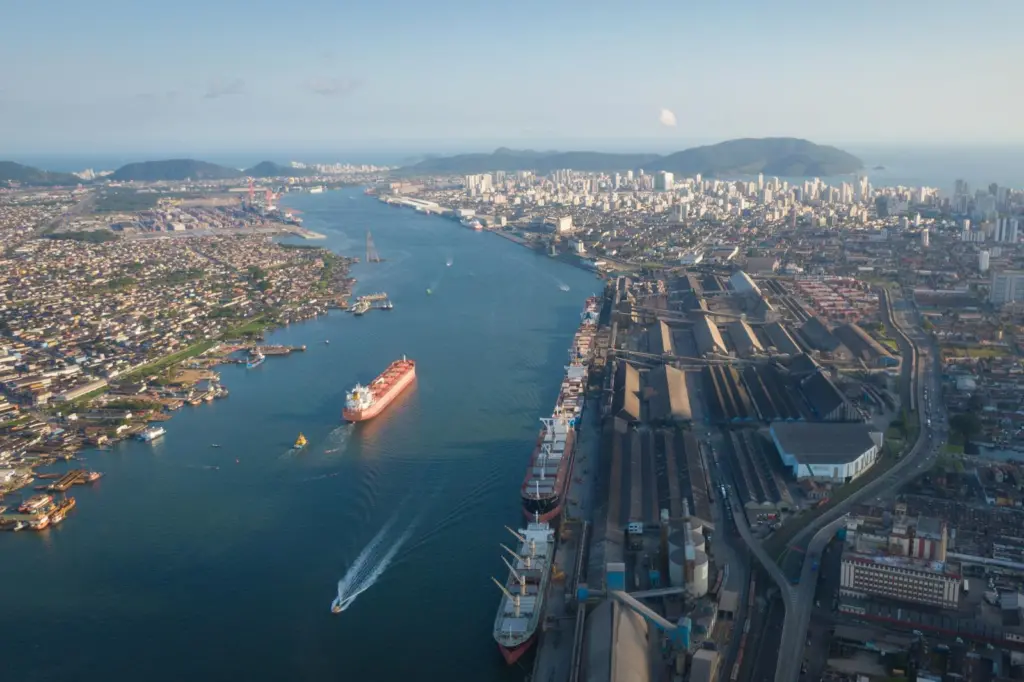
Santos Port Authority told GreenPort in mid-March that the auction notice is expected to be released in the first half of this year, seeking to expand the installed capacity of its Itatinga hydroelectric dam from 15 to 30 megawatts (MW).
The modernisation of the century-old hydroelectric dam is part of Santos Port’s efforts to decarbonise operations and improve sustainability, according to Sidnei Aranha, the environmental and sustainability superintendent at the Santos Port Authority.
Multiple benefits
Discussions on expanding the power plant, which currently supplies 30% of the port’s energy needs, have been ongoing over the past couple of years and also consider using the hydroelectric dam to support future green hydrogen production.
The details of the proposed public-private concession model have yet to be officially announced, but the port’s energy transition strategy will be guided by an Energy Master Plan, under development with Valenciaport Foundation.
This plan will assess current and future energy needs and identify potential energy sources to meet projected demand.
The Valenciaport Foundation will also prepare a decarbonisation plan, setting up guidelines and targets for reducing emissions across port terminals, vessels and associated rail and road transport.
“I believe the solution will be a mix of everything,” Mr Aranha told GreenPort in early February, referring to energy sources and alternatives to power port operations and green vessels.
Since 2024, one Onshore Power Supply (OPS) unit has been providing clean energy from Itatinga’s hydroelectric dam to tugboats docked at the port.
However, demand for clean energy is expected to increase as the port expands and more shipping companies invest in fuel alternatives to reduce greenhouse gas emissions.
Alternative energy
In January, the port authorities of Santos and Valencia signed a memorandum of understanding in Panama to establish a green shipping corridor to support maritime decarbonisation between Europe and South America.
Mr Aranha said the Energy Master Plan will help assess the demand for additional OPS units and energy alternatives to support green vessels.
Progress on port decarbonisation and the green corridor will also require collaboration with shipping companies and energy firms.
“Fuel decisions are made by shipping companies, not ports. It is a matter of technological innovation,” says Mr Aranha, who cited liquified-natural gas (LNG) and ethanol-blended fuels as some of the potential alternatives for green vessels at the port in the future.
Santos Port is located in São Paulo state, in one of the world’s major sugarcane production regions and it could become a hub for testing and developing sugarcane ethanol-blended bunker fuel for vessels.
The port’s Energy Master Plan and the Decarbonisation Plan should be concluded by August 2027, but evaluation of green and sustainability initiatives continues before the studies are completed.
Mr Aranha says that Santos Port and the Valenciaport Foundation are preparing to apply for European green funding for three pilot projects, including the installation of an additional OPS in the port, a proposed urban waste-to-energy production project and a community rooftop solar power project in Guarujá.
These are small-scale pilot projects under evaluation, but they have the potential to support the port’s sustainability efforts in the future, says Mr Aranha.
Related Articles
 ALTERNATIVE FUELS GREENPORT
 ENERGY & TECHNOLOGY GREENPORT
 PROJECTS & INITIATIVES GREENPORT