



EXCLUSIVE: Spearheading Asia’s decarbonisation roadmap
In this Q&A with Mr New Wei Siang, director, maritime decarbonisation & net-zero pathways, Maritime and Port Authority of Singapore (MPA), talks about the port authority’s green objectives
Q Can you outline MPA’s decarbonisation strategy?
A In October 2022, Singapore raised its climate ambition to reach net-zero GHG emissions by 2050. Then in July 2023, the International Maritime Organization (IMO) revised its GHG Strategy at the 80th meeting of the Marine Environment Protection Committee (MEPC 80), increasing its ambitions for international shipping with the goal of reaching net zero GHG emissions by 2050.
At the heart of our mission is a commitment to support the global maritime sector’s transition towards a sustainable and low-carbon future. To that end, MPA’s decarbonisation strategy broadly covers multiple areas.
This includes transforming port terminals, greening our domestic harbour craft, supporting the multi-fuel transition for international shipping, encouraging green shipping practices, forging international collaborations and promoting green maritime finance
Q How does the port work with stakeholders including the shipping/logistics operators to achieve its environmental objectives? Can you give an example of this good port/shipping line relationship in practice?
A On the domestic front, harbour craft perform a range of essential marine services within the Port of Singapore, including the delivery of ship supplies and bunker as well as towage and launch services. MPA is committed to reducing emissions from domestic marine transportation with a progressive and phased approach in line with Singapore’s climate targets.
From 2030, all new harbour craft operating in the Port of Singapore will have to be electric, be capable of using B100 biofuel, or be compatible with net zero fuels such as hydrogen. The harbour craft sector (including pleasure craft and tugboats) will also be required to achieve net zero emissions by 2050.
To that end, MPA is working with industry stakeholders to develop cost effective, efficient electric harbour craft (e-HC) designs, establishing charging infrastructure, and providing green financing to support e-HC adoption.
With regards to biofuels, blends of up to B30 are commercially available today. MPA is currently developing standards for biofuel blends up to B100.
On the shipping front, the Singapore Registry of Ships (SRS) is committed to working with ship owners and operators to achieve our environmental objectives – including meeting IMO GHG targets and adopting low- and zero-emission solutions – through the provision of recognition, incentives and technical guidance. For example, the SRS.
Green Notation is awarded to Singapore vessels that adopt green technologies and/or use low or zero-carbon fuels to reduce carbon intensity.
Q What about the port’s energy transition strategy, again how is it working with its stakeholders to achieve its goals?
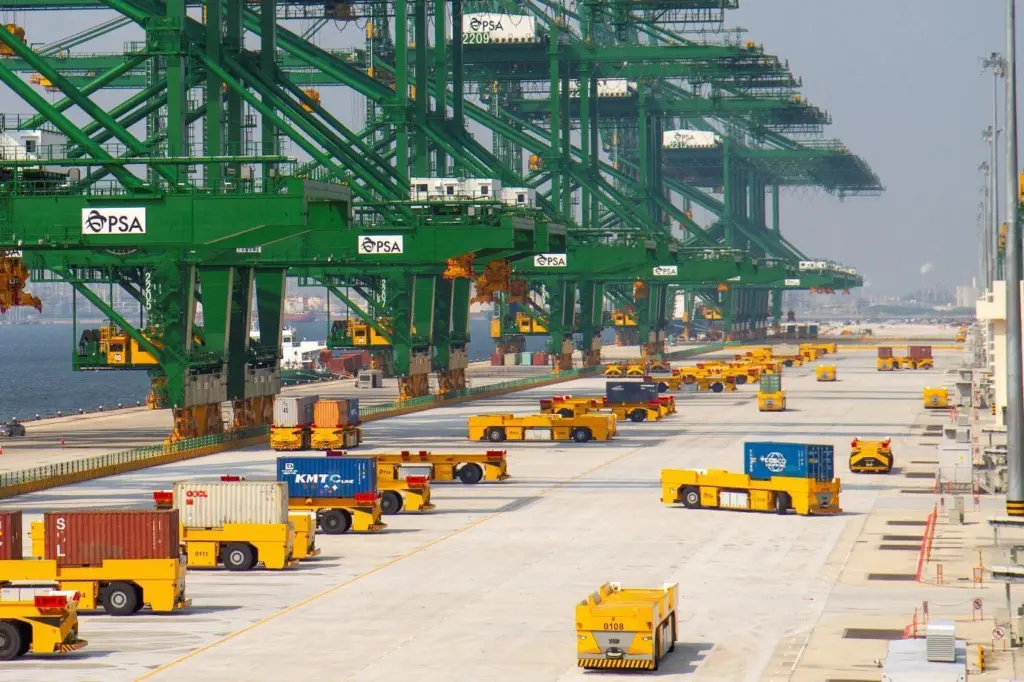
A Singapore’s port terminals will transit towards a low-carbon future, through the adoption of cleaner energy, automation, and digitalisation. By 2030, our port terminal operators, aim to collectively achieve at least 60% reduction of total emissions from port operations as compared to 2005 levels and to reach net zero emissions by 2050.
Port terminal operators (PSA and JPPL) have developed strategies that include the greening of port handling equipment, port vehicles and terminal buildings, as well as improving energy efficiency and adopting cleaner energy alternatives.
At the City and Pasir Panjang terminals, PSA has initiated projects to reduce GHG emissions, for example, by deploying equipment running on cleaner fuels, equipment electrification, and installing solar panels.
Then at JPPL, some initiatives include the electrification of port handling equipment, improving energy efficiency in buildings with LED lightings and harnessing solar energy on site.
Q With regards to alternative fuels, methanol, ammonia and hydrogen, please can you outline the port authority’s strategy there? Again how is it working with its stakeholders to achieve its objectives?
A As the world’s largest bunkering hub, Singapore remains committed to providing lower zero-carbon fuels to meet the future energy needs of the global shipping industry, by building up the value-chain and required bunkering infrastructure for ammonia/hydrogen and methanol for international shipping.
In December 2022, together with our sister agency, the Energy Market Authority (EMA), MPA published an Expression of Interest (EOI) to develop a low- or zero-carbon ammonia supply chain for power generation or bunkering to anchor global value-chain stakeholders in our port and ensure Singapore remains as a top bunkering hub moving forward.
The EOI closed in April 2023 and six out of 26 submissions were shortlisted whose proposals will be further developed in a closed Request for Proposal (RFP). This RFP is the next stage in the selection of a lead developer that the Government will work with to jointly develop the proposed end-to-end ammonia solution.
With regards to methanol, in December 2023, MPA issued an EOI to invite interested parties to submit proposals for the supply of methanol as a marine bunker fuel in the Port of Singapore.
The EOI focuses on three areas: (a) Methanol supply sources, (b) Methanol bunkering operational model at commercial scale in Singapore and (c) Alternatives to the physical transfer of methanol molecules to Singapore, such as mass balancing.
MPA is studying the returns from the EOI to help shape the methanol supply chain and development of methanol bunkering infrastructure for Singapore. In addition, MPA will enable the sector’s multi-fuel transition through safe and efficient bunkering operations and pilot trials.
In July 2023, Singapore’s first methanol bunkering operation involving a Maersk container vessel, Laura Maersk, was successfully completed at the Raffles Reserved Anchorage, with the support of MPA, government agencies and research institutes.
On ammonia, in March 2024, we successfully conducted the world’s first use of ammonia, in combination with diesel in the combustion process, as a marine fuel onboard the Singapore-flagged ammonia-powered vessel, the Fortescue Green Pioneer in the Port of Singapore.
The collective support provided for these trials demonstrates the facilitative regulatory environment, strong research and tripartite ecosystem in enabling the development Singapore’s multi-fuel bunkering capabilities.
MPA is involved in several collaborations with industry partners for R&D and trials to enable bunkering of low or zero- carbon fuels.
One example is the CASTOR Initiative, which is a multinational coalition that aims to design, build and commission the world’s first ammonia-fuelled deepsea tanker by 2026. The initiative currently comprises eight partners, MISC Berhad, Lloyd’s Register, Samsung Heavy Industries, MAN Energy Solutions, Yara Clean Ammonia, MPA, Jurong Port and TotalEnergies.
Q Can you tell us about MPA’s Green Shipping Corridors strategy?
A As part of its Green and Digital Shipping Corridor (GDSC) strategy, MPA will work with like-minded states, port authorities and industry partners to explore opportunities to develop zero or near-zero greenhouse gas (GHG) emission fuel supply chains for maritime, including building the necessary infrastructure, formalising standards, along with developing and implementing relevant training requirements.
In addition, GDSCs will provide an avenue to explore facilitating digital information exchange to enable efficient port clearance, port calls and flow of vessels.
In March 2024, Singapore and Australia signed a Memorandum of Understanding (MoU) to formally collaborate on establishing the Singapore-Australia GDSC.
Back in December 2023, The Ministry of Transport of the Republic of Singapore (MOT) and the Ministry of Land, Infrastructure, Transport and Tourism of Japan (MLIT) signed a Memorandum of Cooperation (MoC) to establish the Singapore – Japan GDSC.
MPA and the People’s Republic of China’s Tianjin Municipal Transportation Commission also signed a MoU to establish the Singapore – Tianjin GDSC.
Earlier, in April 2023 MPA, Port of Los Angeles (POLA), and Port of Long Beach (POLB), with the support of C40 Cities, signed a memorandum of understanding (MoU) to establish a GDSC between Singapore and the San Pedro Bay port complex.
But the focus on the project really began in August 2022, when MPA together with the Port of Rotterdam, first established the GDSC strategy to bring together partners across the supply chain to realise zero and near-zero emissions shipping on the Rotterdam-Singapore route.
Since then, the Singapore-Rotterdam corridor has moved decisively into the implementation phase to study key net-zero pathways and launch first-mover pilot projects.
Q What next for the port with regards to its sustainability strategy?
A The Next Generation Port (NGP) in Tuas represents a key component of the future of Maritime Singapore. When it is completed in the 2040s, it will be an automated, intelligent, and sustainable port, with a handling capacity of 65 million teu.
Sustainability is integral in Tuas Port’s design, planning and construction. For instance, excavated earth from other land construction projects and dredged materials was reused as reclamation fill for the port.
Tuas Port will also be built at least five metres above mean sea level to adapt to anticipated rising sea levels. Further adaption measures such as building a higher wall along its perimeter and storm water detention tanks are being studied to ensure the port remains climate resilient.
In addition, the port operator PSA aims to achieve net-zero carbon emissions by 2050. To that end, PSA has built green buildings such as the administrative building at Tuas Maintenance Base, which is Tuas Port’s first super low-energy building, that uses 58% less energy compared to other similar sized buildings.
Tuas Maintenance Base, comprising this administration building together with other workshop buildings, is a net-zero development as it generates enough solar energy to offset its electricity consumption.
In addition, PSA will also rely on electrified equipment for port operations and implement smart grid solutions and battery energy storage systems to optimise energy use.
The port will feature smart technology to make it more efficient, productive and sustainable. Automated yard cranes, drones and electric and driverless automated guided vehicles will be deployed to enable safer and more efficient transport of containers between the berth and yard.
These vehicles have a carbon footprint that is 25% smaller than the regular vehicles, making the port greener and more sustainable.
Furthermore, automated terminal operations are remotely controlled and monitored by smart computer systems from an operations centre, improving labour productivity and creating better jobs for port workers.
Q In your own words, why should people attend the GreenPorts & Shipping conference?
A The maritime sector is working towards the IMO’s revised GHG emissions strategy to achieve net-zero by 2050.
As we work together towards the energy transition, it is crucial that all stakeholders in the maritime space convene to share insightful ideas and engage in constructive discussions to learn from each other’s experience and advance the deployment of zero and near-zero emission fuels and technologies.
MPA’s chief sustainability officer, Er Tham Wai Wah will join the Green Ports and Shipping Congress first day keynote panel together with BIMCO, IAPH, GCMD, Singapore, Port KLANG Authority and Maersk, discussing the port’s role in achieving IMO’s 2050 zero carbon shipping goals.
Mr Wei Siang New, MPA’s director of decarbonisation & net-zero pathways, MPA, will be presenting on green shipping corridor projects in the opening session of day two of the conference.
The Green Ports and Shipping Congress will take place from 8 to 9 May at Marina Bay Sands.
Related Articles
 ENERGY & TECHNOLOGY GREENPORT
 NEWS GREENPORT
 PROJECTS & INITIATIVES GREENPORT