![GreenPort[PortStrategy]](https://www.portstrategy.com/greenport/wp-content/uploads/sites/4/2026/09/GreenPortPortStrategy.svg)


EXCLUSIVE: Tasmania looks to exploit wind energy boom
Tasmania is moving to play a big part in Australia’s transition to renewable energy, with TasPorts announcing its vision for a Bass Strait Renewable Energy Terminal at Bell Bay, writes Dave MacIntyre.
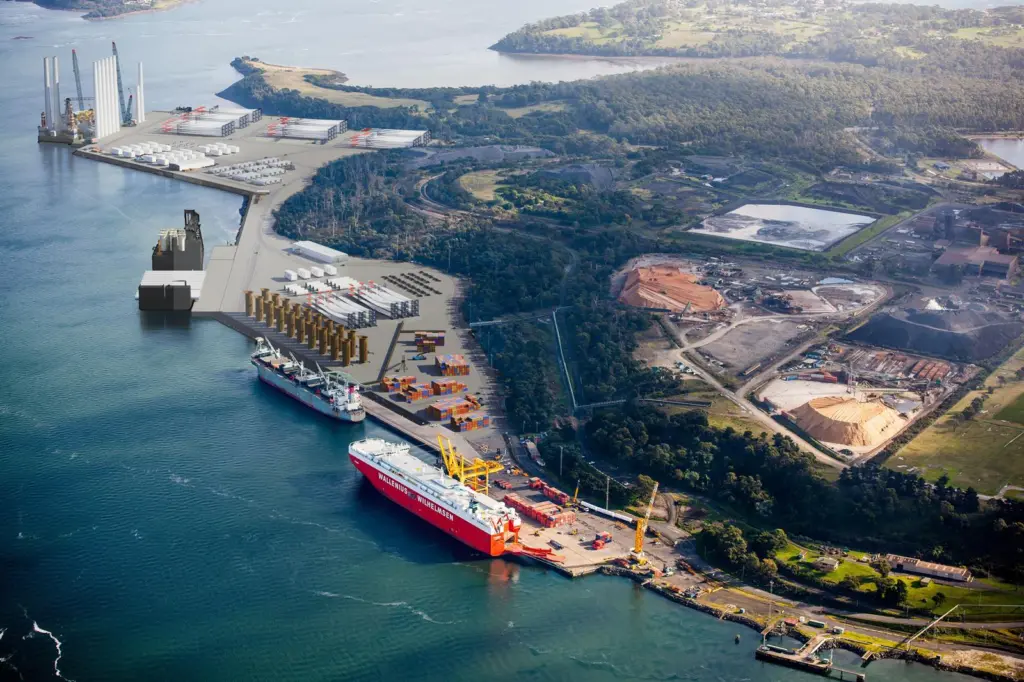
TasPorts is the state-owned company responsible for 11 Tasmanian ports and the Devonport Airport and it’s looking to support the state as a key player in offshore wind energy generation.
Anthony Donald, chief executive,TasPorts sees a commercial opportunity for itself in the wind generation market and says the terminal has the potential to deliver bespoke infrastructure, large-scale laydown and storage and vital berthing facilities.
“TasPorts recognises that ports are a critical enabler of offshore wind projects, providing the infrastructure needed for construction, maintenance and operations,” he told GreenPort.
”With Australia’s offshore wind industry gaining momentum and the Commonwealth Government declaring Bass Strait as a priority renewable energy zone, it became clear that Tasmania – and particularly Bell Bay – was strategically positioned to play a leading role.”
Clear vision
TasPorts vision is for a dedicated terminal to be created with a staged development of up to 25 hectares of additional reclaimed land at the port to support projects in the strait that separates Tasmania from the Australian mainland.
The operator believes Bell Bay’s proximity to Bass Strait’s renewable energy zones provides a strategic advantage, by delivering the infrastructure needed to assure offshore wind developers that they have the onshore support facilities required.
“Engagement with offshore wind proponents revealed a strong need for purpose-built port infrastructure that could support large-scale laydown, component assembly and heavy-lift vessel operations,” says Mr Donald.
“Early studies identified a shortage of ports suitable for these needs, positioning Bass Strait Renewable Energy Terminal to service projects in the declared Gippsland, Bass Strait and Southern Ocean offshore wind zones.
“TasPorts’ expertise in port development and maritime logistics made this an ideal opportunity to align our long-term infrastructure planning with Australia’s renewable energy transition.”
Strategic location
Bell Bay is considered an ideal location for the terminal due to its proximity to offshore wind zones, deepwater access and established industrial infrastructure.
While it is already equipped to handle a variety of large vessels, with deepwater berths and experience in handling project cargo, TasPorts recognises that offshore wind infrastructure will require enhanced port capabilities, particularly for assembling and deploying large turbine components.
The port’s ability to accommodate large-scale laydown areas, plus the additional 25 hectares identified for staged expansion, means it has the capacity to grow as needed, alongside industry demand.
The expansion can be developed in stages to accommodate wind project needs, with flexibility for future expansion, making Bell Bay capable of supporting both current and future offshore wind projects.
By unlocking Bell Bay’s potential, TasPorts aims to deliver the infrastructure needed to attract investment that could bring enormous benefits locally, regionally and nationally, by supporting offshore wind developments that will drive significant renewable energy generation.
Mr Donald highlights the terminal’s economic impact. “This project has the potential to power the local economy and reinforce Tasmania’s reputation as a renewable energy leader, but progress will depend on rigorous planning and collaboration with key stakeholders at every stage,” he said.
“The project has now passed the concept and identification phase, with timing of future phases carefully considered to align with the investment funding decisions of offshore wind proponents, ensuring TasPorts’ business case meets industry timelines and needs.”
Project groundwork
Work so far has included market testing, extensive groundwork, including environmental studies, advanced drone and Light Detection and Ranging surveys (LIDAR), using laser light to develop a distance map of the potential terminal area.
In addition, 3D bathymetry mapping has identified preferred reclamation areas to create new land tailored to the massive scale of offshore wind projects.
In late 2024, TasPorts presented the vision for the terminal at the Bell Bay Major Projects Conference in Launceston, receiving valuable feedback from industry representatives. The project team is finalising studies and other works required to inform the selection phase.
It is now moving into its selection phase, where TasPorts will conduct more in-depth feasibility studies in consultation with industry proponents and the Tasmanian Government.
A preferred project case is expected by the middle of this year, with the ultimate goal of presenting a comprehensive business case by mid-2026, subject to funding and commercial agreements with industry players.
Also, as owner of land adjacent the Port of Bell Bay, TasPorts is welcoming expressions of interest from renewable energy developers considering projects in the area.
Wind potential
While the Bass Strait Renewable Energy Terminal (BRET) proposal represents TasPort’s most significant step into infrastructure dedicated to supporting windfarm development, it has previously engaged with industry stakeholders to understand the requirements for handling wind energy components and servicing offshore developments.
The company has played a key role in enabling Tasmania’s renewable energy future by supporting the development and operation of landside infrastructure. This includes facilitating logistics and port access for Tasmania’s hydrogen and wind energy sectors.
Examples include receiving and storing components for the Cattle Hill Wind Farm through the Port of Bell Bay and facilitating port-side construction areas, towage services and grid connection assistance for the Wave Swell Energy wave generator trial.
Other Tasmanian ports such as Burnie may play a role in handling smaller components, while ports like Devonport and Burnie could support long-term operations and maintenance activities post-construction.
The Tasmanian plans have been bolstered by the Federal Government declaring a new offshore wind zone in Bass Strait, saying the wind generation industry could create up to 12,000 jobs in construction.
There could be also be a further 6000 ongoing roles for engineers, electrical technicians, cable installers, boilermakers, crane operators, riggers, divers, seafarers, dockworkers and administrators.
Related Articles
 ALTERNATIVE FUELS GREENPORT
 ENERGY & TECHNOLOGY GREENPORT
 PROJECTS & INITIATIVES GREENPORT