![GreenPort[PortStrategy]](https://www.portstrategy.com/greenport/wp-content/uploads/sites/4/2026/09/GreenPortPortStrategy.svg)
EXCLUSIVE: The BlueBARGE solution to port electrification
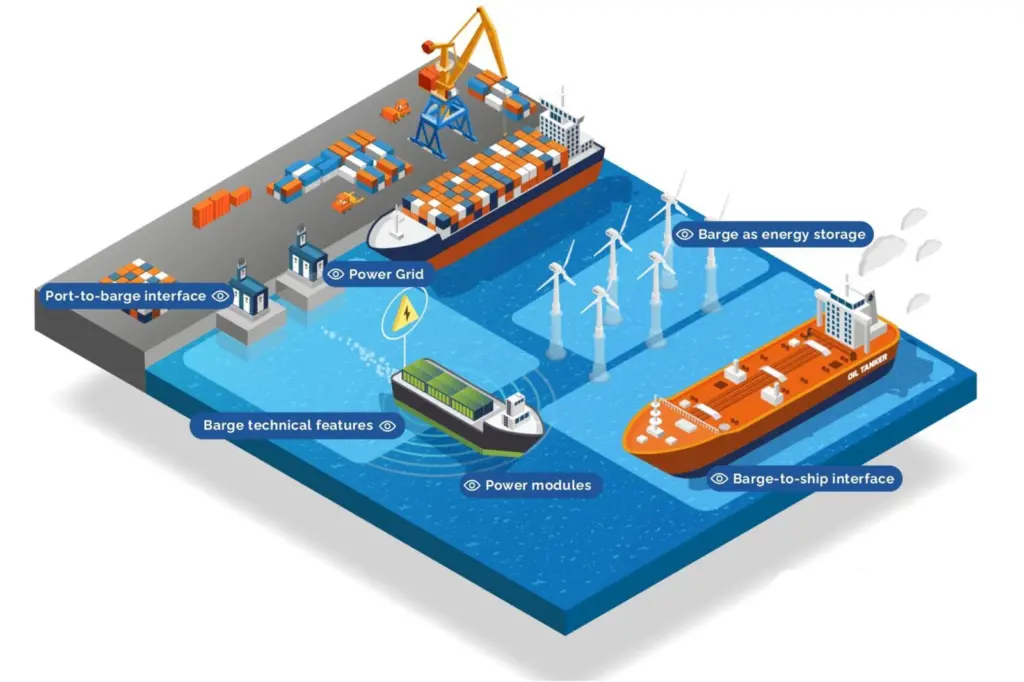
The BlueBARGE Project is creating an innovative power barge to supply electricity to moored and anchored vessels as an alternative to a fixed electricity supply, writes Ignacio Benítez, senior project manager, Fundación Valenciaport.
Funded by the European Union (EU) Horizon Europe Programme, the project brings together an international multidisciplinary consortium where the technical and economic viability of the selected design can be analysed and a small-scale prototype is developed and tested in a real environment, as a proof of concept.
It is a collaborative project, with 14 partners from ten different countries in Europe, led by the classification society American Bureau of Shipping (ABS) in Greece. Besides the Valenciaport Foundation, the other partners are the Aalborg University, CellCube, Columbia Shipmanagement, Corvus Energy, Danaos, Elkon, Hydrus, Magellan Circle, Multimarine Group, the Norwegian University of Science and Technology, the National Technical University of Athens and Regbes.
The results of the project, especially the technical and economic assessment of the design and the results of the proof of concept with the prototype, will provide valuable inputs to port authorities and potential “BlueBARGE” operators, that may be willing to explore the possibility of starting an electricity provision service for vessels at European ports.
A unique energy barge
The design of the barge has been created to meet the minimum requirements of energy and power defined in the different use cases identified in the project.
Therefore there was not a single solution created in the beginning, but different designs combining different barge sizes with different combinations of power units.
Later, an assessment performed by a group of selected experts by means of a specifically developed software platform, yielded the selection of one design, which was from that point onwards the one to be further developed.
An innovation in the project is the objective of hybridisation. Instead of choosing a specific technology, the project aims to combine energy storage units of at least two different technologies: Lithium ion (LI-ion) and Vanadium redox flow batteries.
The design of the barge accounts for the use of both technologies and the possibility to use the batteries in combination with hydrogen fuel cells in future.
Multiple uses
The “BlueBARGE” is a mobile electricity storage unit that can provide electricity to vessels wherever the power grid at the port is not sufficient or is not deployed. It can be used, for instance, to extend the simultaneous supply of shore connection beyond the existing OPS connection points at a quay.
Another possible use may be to provide electricity at quays where the OPS is not deployed, for technical or economic reasons.
Additionally, the units can be used in small islands or locations where the local power grid is not able the provide the needed power demand.
It is also worth noting that the “BlueBARGE” contributes to lowering emissions from the ships, therefore it is idoneous for quays located very close to environmentally critical or densely populated areas.
Other uses are being studied in the project. The “BlueBARGE” is being designed to provide electricity to the shore power grid if needed. It could therefore be used as a mobile power unit to provide energy to the grid after a blackout or a natural disaster event. Furthermore, it may also be charged from offshore platforms, providing energy to working vessels or even leisure boats along the coast.
Finally, ports willing to extend decarbonisation ambitions beyond what is strictly demanded by the European Union Alternative Fuels Infrastructure Regulation (AFIR) could use a fleet of “BlueBARGES” to provide electricity to vessels at anchorage areas in future. These areas are not currently affected by the AFIR requirements.
A complementary solution
The “BlueBARGE” is a complementary solution to the deployment of shore connection infrastructure at berth.
It provides ports a mobile, flexible, and modular “power-barge” asset to bring electricity to vessels berthed at quays where the shore connection is not available, allowing to comply with the AFIR requirements while lowering investments in power grid infrastructure.
The ”BlueBARGE” can be also used to bring electricity to vessels during their stay at anchorage areas; in this case, unless specific infrastructure is deployed from the shore, if a port authority is willing to lower emissions from vessels at anchorage areas, providing the electricity by the “BlueBARGE” may be a feasible solution.
One lesson learnt so far from the project is the study of the return of the investment.
The solution may not be profitable for a “BlueBARGE” service provider in all the scenarios, nor for all the types of ships and sizes (especially for cruise ships).
One critical issue is the adequate estimation of the electricity demand, that is the basis for the business model.
Therefore, having an estimation of the power and energy to be delivered as accurately as possible will help reducing risks for investors and justifying the business model selected.
In the project, an optimal sizing tool is being developed to help stakeholders in this decision. Cost-Benefit analyses for the different use cases are also being developed, to provide some figures and serve as input to the business model that is being defined.
With regards to challenges to be overcome, two can be cited: One is related to the complexity in the hybridisation of power units and the development of the connectors.
This is an innovative objective that has brought an intensive effort to design the appropriate electrical infrastructure able to integrate battery units of different technology, such as Li-ion and Vanadium redox flow batteries and the flexible connection systems able to provide energy to and from the shore to the barge and to and from the barge to the vessel.
As it’s a new concept, the barge system is constantly being refined, both in terms of technology and design. There will be more lessons to learn once the whole system is commissioned.
The second challenge is operation and the operating envelope for this new service of electricity provision brought by the “BlueBARGE”.
One of the specific tasks being done by Fundación Valenciaport, besides the development of the Cost-Benefit analyses for the different use cases, is the preparation of a procedure for providing future “BlueBARGE” operators with all the relevant elements for permitting to do the service of electricity supply to vessels, along with operation guidelines for personnel training.
Realising commerciality
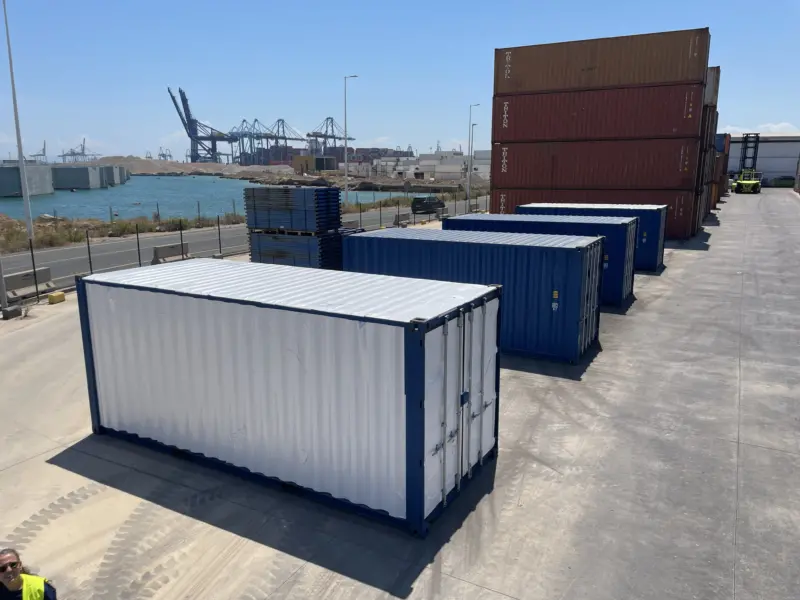
Once the design of the “BlueBARGE” has been chosen, efforts are focused currently on two main activities. One is the detailed engineering design of the concept chosen and the development of a small-scale prototype that will be tested with a retrofitted vessel in a real environment. This prototype implements Li-ion batteries and Vanadium redox flow units to reach a total capacity of 1.5 MWh.
The second activity comprehends all the tasks related to the development of the exploitation plan for the “BlueBARGE” and all the Key Exploitable Results (KER) identified, including the economic and financial assessment of the selected design, under different Use Cases and scenarios.
The commercialisation of “BlueBARGES” is the ultimate goal of the project – the development of business and exploitation models and the economic and financial assessments are a key part of the activities of the project.
Total Cost of the Ownership will be calculated from the point of view of the “BlueBARGE” potential operators.
The project has an advisory board, which includes port authorities, OPS service providers and external experts. Some of the board members have already expressed interest in the results of the project and the possibility of deploying and exploiting a commercial solution.
The “BlueBARGE” project is due to complete in December 2026.
Related Articles
 ALTERNATIVE FUELS GREENPORT
 ENERGY & TECHNOLOGY GREENPORT
 PROJECTS & INITIATIVES GREENPORT