![GreenPort[PortStrategy]](https://www.portstrategy.com/greenport/wp-content/uploads/sites/4/2026/09/GreenPortPortStrategy.svg)



How bubbles are revolutionising pollution mitigation
In this article, GreenPort talks to Richard Haine, managing director, Frog Environmental, on how bubbles are changing the face of pollution mitigation.
One doesn’t have to search far to find frequent reports in the media about the declining state of rivers and oceans and the increasing need and cost to treat water for drinking purposes.
The UK company Frog Environmental is the brain child of a number of forward thinking senior water quality ecologists and environmental scientists who are motivated by environmental protection and finding innovative, researched and tested solutions to keep apace with rapid economic growth and infrastructure affecting the UK’s waterways.
The business was founded in 2015, firstly as a consultancy to support customers with pollution control from construction projects and river and lake restoration. It has formed partnerships with both universities and industry-leading suppliers across the globe to find productised solutions to complement the company’s technical offering.
Since its inception, it has made a name for itself as an award-winning water quality and silt control specialist working with contractors, regulators and consultants within construction, utilities, marine and coastal and public sector industries across the UK. It works closely with Canadian Pond on the European market.
Sediment dispersal
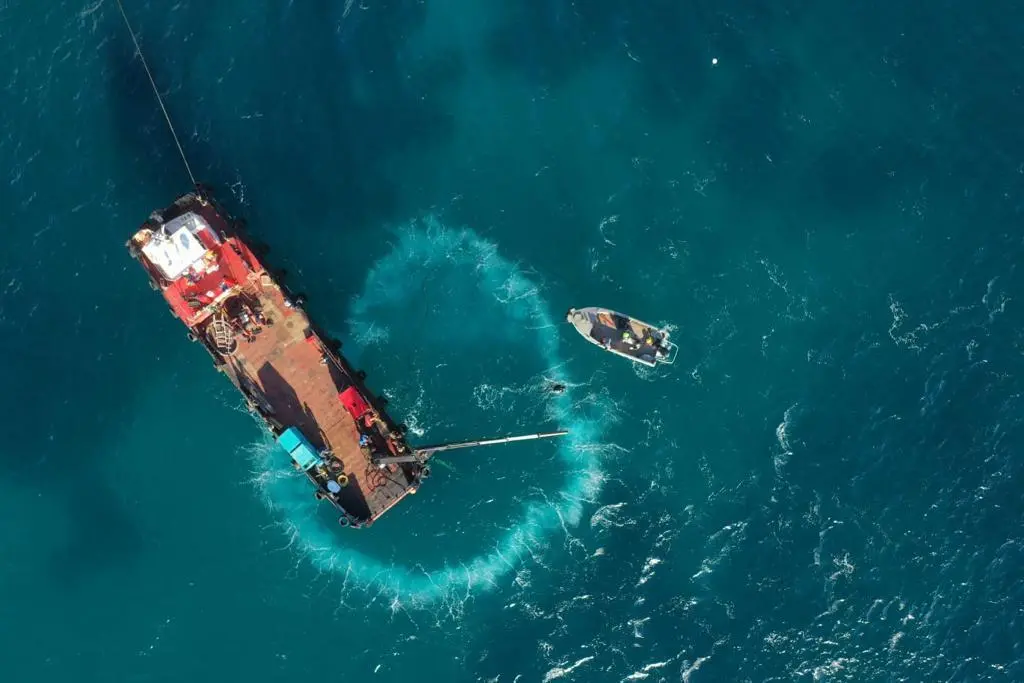
Frog Environmental is UK distributor for Bubble Tubing technology, which is used in any aquatic environment to create a bubble curtain, a vertical wall of air bubbles through a unique, self-purging perforated pipe which allows air to escape as fine bubbles.
The bubble curtain is weighted to the bed and air is pumped through the tube using a compressor. The compressor size and output is dictated by water depth, current, length and diameter of the tube, alongside the optimal airflow needed to achieve results.
The curtain can be designed to any length and depending on the size of the project or problem, there are also different sizes of tubing available to achieve optimal bubble size and performance.
This clever, robust and effective solution is being used in both marine and freshwater environments to include coastal and marine, canals, rivers, lakes, reservoirs and estuaries. It is also used in water treatment systems.
It is becoming increasingly popular with clients and regulators in providing effective environmental and infrastructure protection, ranging from reducing underwater noise pollution to protecting fish and other wildlife, avoiding silt pollution, abstraction protection, inlet protection, litter and weed prevention and emergency aeration. It’s used in both temporary and permanent applications.
”Silt and debris mitigation is a particularly interesting application as there are quite a few variables at play that will determine the efficacy of a bubble curtain,” says Mr Haine.
”Silt plumes can lead to an increase in oxygen demand in the water column, which in turn can put stress on fish and other animals. The micro-bubbles created by the Bubble Tubing technology deliver an oxygen rich environment without the use of chemicals, keeps navigation open and also prevents silt and sediment being carried downstream of water-based construction work.”
There are many locations where a bubble curtain can be deployed where a physical silt curtain cannot, for instance where navigation cannot be restricted or where there are variable flow rates.
Bubble curtains are also very simple to deploy and use and provide a huge dose of oxygen into the water column, which can help mitigate some of the impacts of dredging.
The self-cleaning ability of the tubing means that the installations can be kept in situ and there is no requirement to introduce cleaning products.
Versatile use
Bubble curtains make use of how densely packed water molecules are, they conduct sounds, such as piling or construction noise, very effectively and for long distances.
Thus, the millions of bubbles that make up a bubble curtain provide an effective ‘wall’ that refracts sounds waves and disrupts the ability of water to effectively conduct noise.
The technology is becoming more essential for port construction projects as the impact of noise on marine mammals and fish is significant. The bubble curtains have been so effective that construction working windows have been extended, allowing preliminary costs to be lowered and projects delivered more efficiently, whilst protecting the environment at all times.
“Bubble curtains are very versatile and offer wide application which extends to ports and terminals,” says Mr Haine.
“Whilst temporary applications include mitigating the harmful environmental impact of construction work or dredging operations, the permanent applications for ports and terminals are perhaps even more interesting.”
These include the use of the curtains as bubble barriers to contain the impact of serious oil spills, to protect key port assets including lock gates and abstractions from debris and deposition of silt. Bubble curtains can also be used to control litter and transfer it into collection areas.
The huge benefit for using bubble curtains in these applications is that they can sit on the bed of port or terminal without interfering with port operations and can be switched on instantly when required.
This is also true for protecting key assets from jellyfish ‘blooms’ that are becoming more frequent. Asset owners have to find a low maintenance approach to mitigating what is becoming a serious risk for cooling systems that abstract from the sea or estuarine environments.
A bubble curtain can improve oxygen levels in a port or dock too but it will have different design criteria to a project requiring deflection of silt, debris or plastic waste.
Different types of projects have different airflow and pressure requirements, not to mention considerations regarding where they are best located for optimal performance. Frog Environmental has a team of specialists who help guide customers through the scoping and design phase.
Bubble curtains are already being used to support dredging projects across the continent as an effective way to contain sediments in a specific area and therefore protect marine life, for example, during dredging in Port Saint-John, New-Brunswick, Canada.
Containing silt plumes from dredging activities is certainly one of the most interesting applications for bubble curtains. They are highly effective at controlling sediment including fine silts suspended by dredging operations in low flow environments. However, there are potentially much greater opportunities to reduce the cost of cyclical dredging by positioning bubble curtains in locations that reduce the ingress of silt and or stop it from becoming deposited in places that cause operational difficulties for the port.
The potential to use this technology to save hundreds of thousands per annum is quite clear.
Pollution mitigation
Plastic and litter pollution is a big problem globally and is of course best tackled before the debris reaches the ocean.
But bubble curtains can be used as a barrier to protect high value water spaces such as marinas, finger docks and urban ponds. The bubble barrier allows the free movement of wildlife and boat traffic whilst stopping litter and weed.
Unsightly litter and floating weed can be prevented from entering or exiting water spaces using as few as two lines of Bubble Tubing to form a barrier. As plastic and oil floats on water it is very easy to use a bubble curtain to move litter and oil to a suitable collection point.
Ports and terminals make a great location to prevent debris falling in the water but they could also be used to catch other debris coming from upstream before it reaches the sea.
The curtain will also be able to bring to the surface the debris that gets stuck in the water column. This happens when the debris has been in the water for too long and organic matter is growing on the plastic and weights it. The upward current created by a bubble curtain will bring those plastic elements to the surface where they can be easily retrieved and disposed of.
Bubble Tubing technology has also been proven in the harshest conditions when it comes to containing oil spills in Canada, with clients using it in ports and marinas. Having a system that can be operational at the flick of a switch can dramatically reduce response times and can take oil pollution control to the next level.
”Of course, we want every solution that we develop to provide value and to be proportionate to the risk that it mitigates. A bubble curtain solution won’t be the right fit for every scenario and we recognise that, but there are many locations across the UK and Europe where a bubble curtain could contribute significantly to the rapid execution and efficacy of pollution response,” says Mr Haine.
He points out that Frog Environmental will continually work to come up with solutions to overcome customers’ problems, foster innovation and support project delivery while protecting the environment.
………………………………………………………………………………………………………………
A bubble curtain for Centreport
The Seaview Energy Resilience Project is being undertaken by Brian Perry Civil (BPC) at Centreport in Wellington, New Zealand.
CentrePort’s bulk liquid fuel trade is supplied through three wharves, with the main volume supplied through the Seaview Wharf which feeds the Z-Energy, Mobil and BP tank farms.
The wharf is approaching 50 years in service and suffered damage during the 2016 Kaikōura earthquake event and needs to be upgraded to meet modern standards for fuel supply wharves.
The project comes with some significant geotechnical challenges as the site is based on a rock reef that dissects the Hutt Valley aquifer, but it is also critical the fuel terminals stay operational during construction.
Dolphins and other marine creatures are being protected by a ‘bubble curtain’ at Brian Perry Civil’s Seaview Energy Resilience Project site in New Zealand’s capital city.
The bubbles act as an acoustic screen, reducing the transmission of underwater noise generated by the piling works and protecting whales and dolphins from distress and hearing damage.
On site monitoring has shown that the use of the bubble curtain reduces the area of influence from piling noise from over 2km down to less than 10m.
Related Articles
 ALTERNATIVE FUELS GREENPORT
 ENERGY & TECHNOLOGY GREENPORT
 PROJECTS & INITIATIVES GREENPORT