![GreenPort[PortStrategy]](https://www.portstrategy.com/greenport/wp-content/uploads/sites/4/2026/09/GreenPortPortStrategy.svg)

Innovators unite to accelerate green shipping
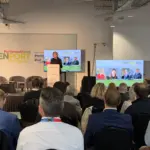
ABP’s Port of Southampton welcomed hundreds of innovators across business, policy and academia to its latest Energy Ventures Accelerator (EVA) event, which formed a key part of the inaugural Maritime UK Solent Coastal Powerhouse Summit.
The EVA Southampton Innovation Exchange is part of a nationwide programme – ABP’s Energy Ventures Accelerator (EVA), run in partnership with innovation platform Plug and Play.
“At ABP, we are committed to leading positive change when it comes to maritime decarbonisation both through our sustainability strategy ‘Ready for Tomorrow’ and initiatives like EVA,” said Alastair Welch, ABP’s regional director for Southampton.
“We are developing the infrastructure to support green shipping and working with our partners to turn ambition into reality.”
Nurturing innovation
ABP’s EVA programme provides a way for ABP to explore opportunities with high potential clean energy hardware startups.
Since its launch in June last year, ABP has spoken to hundreds of startups and has run four major innovation events in London, Hull, Cardiff and this recent one in Southampton.
EVA complements ABP’s sustainability strategy, ‘Ready for Tomorrow’, which sets out ABP’s target of achieving Net Zero greenhouse gas emissions from its own operations by 2040, as well as supporting ABP customers’ Net Zero ambitions.
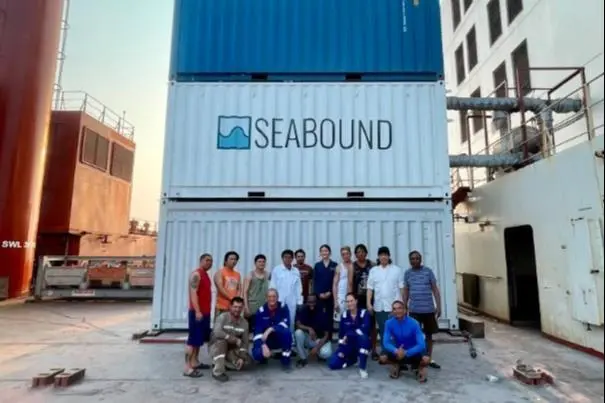
The EVA Southampton Innovation Exchange provided the stage for ABP to announce its intention to work with green maritime innovators Seabound and STAX Engineering to explore opportunities to capture at-berth emissions while vessels are in port.
ABP is currently engaging with key shipping customers looking at technical and economic feasibility with a view to deploying the technology in early 2026.
Seabound and STAX Engineering’s technology integrates through a two-step process. First, STAX connects to a ship’s exhaust pipe(s) and filters out 99% of particulate matter and 95% of NOx, releasing a purified gas.
Next, the purified gas is directed into Seabound’s capture unit, which isolates and stores the ship’s carbon and sulphur emissions before the cleaned exhaust gas enters the atmosphere, reducing the vessel’s overall greenhouse gas footprint.
The two companies have recently announced a trial collaboration at the Port of Long Beach and the Port of Los Angeles in California to offer an end-to-end emissions capture solution to shipping lines.
ABP’s next EVA eventwill be ABP’s EVA Expo on 13 May at The Royal Institution, which will focus on key successes and learnings from the programme over the past twelve months and its evolution going forward.
ABP backed clean energy startups
Seabound – UK startup offering an onboard carbon capture system for vessels, which removes up to 95% of CO₂ from a ship’s exhaust, providing a scalable decarbonisation solution both at berth and at sea.
STAX Engineering – a US-based company offering cutting-edge emissions capture and control as a service. Its system removes 99% of particulate matter and 95% of NOx while a vessel is at berth, bringing the maritime industry one step closer to a clean-air future.
XFuel – Spanish startup focused on transforming biomass waste into advanced drop-in fuels, helping to cut greenhouse gas emissions by 85% compared to fossil fuels.
Armada Technologies – UK startup providing a next-generation passive air lubrication system, which optimises ship efficiency with a smart, low-power solution that adapts to all operating conditions, reducing fuel consumption.
PuriFire Energy – UK startup which has developed an electrolyser-free methanol production technology, helping to cut CO₂ emissions by up to 95%, leveraging wastewater and waste carbon feedstocks to create sustainable fuels.
GT Wings – a technology provider designing unique wind propulsion systems to decarbonise the commercial shipping industry. Their AirWing advanced wind propulsion technology reduces fuel consumption and emissions by up to 30%, accelerating the maritime industry’s path to decarbonisation.
Related Articles
 ALTERNATIVE FUELS GREENPORT
 ENERGY & TECHNOLOGY GREENPORT
 PROJECTS & INITIATIVES GREENPORT