![GreenPort[PortStrategy]](https://www.portstrategy.com/greenport/wp-content/uploads/sites/4/2026/09/GreenPortPortStrategy.svg)

Japan’s carbon neutral ports drive
Japan has unveiled a major step toward port decarbonisation with the launch of its Carbon Neutral Ports (CNP) Certification for Japanese ports.
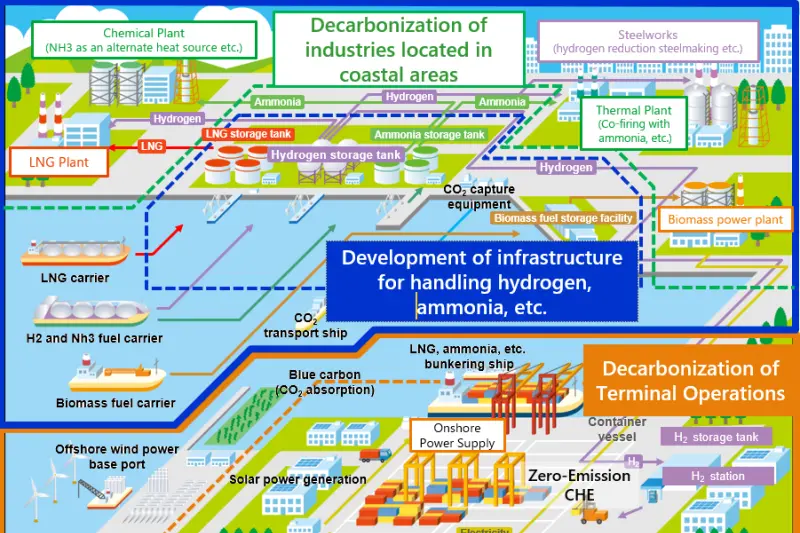
Speaking at the ICHCA AGM in Barcelona on 19 May, Yusuke Suemune of the Ministry of Land, Infrastructure, Transport and Tourism (MLIT) outlined Japan’s strategy to achieve carbon neutrality across all ports by 2050.
Central to the initiative is the new Carbon Neutral Ports certification, which will assess and recognise efforts to cut emissions at the port equipment and terminal levels.
“The evaluation will be performed at multiple certification levels from Level 1 to Level 5,” Suemune explained. “Should the detailed and stringent requirements of each level be achieved, then certification will be granted for three years…
”We believe port decarbonisation cannot be achieved in a single step, nor in the short-term; rather a long-term perspective must be pursued.”
Carbon-cutting
The CNP Certification will apply on a per-terminal basis rather than port-wide and will evaluate a range of carbon-cutting actions including low-emission port equipment, LED lighting, clean vessel fuels and truck appointment systems.
ICHCA International CEO Richard Steele welcomed the announcement, praising MLIT’s leadership in setting an example for the global cargo industry.
Evaluation results will be publicly available, promoting transparency and encouraging all port users to support the shift toward carbon neutral certification.
The CNP initiative marks a significant commitment by the Japanese government to climate goals through clear, measurable steps.
Port of Kobe, Japan, will play host to this year’s International Association of Ports & Harbors (IAPH) conference from 7 to 9 October 2025.
Related Articles
 ALTERNATIVE FUELS GREENPORT
 ENERGY & TECHNOLOGY GREENPORT
 PROJECTS & INITIATIVES GREENPORT