![GreenPort[PortStrategy]](https://www.portstrategy.com/greenport/wp-content/uploads/sites/4/2026/09/GreenPortPortStrategy.svg)

Onshore power needs collaboration
Collaboration, power availability and strong business cases are crucial for ports to meet decarbonisation goals, according to experts at the recent ‘Onshore Power Supply – Connect, Invest, Decarbonise’ webinar.
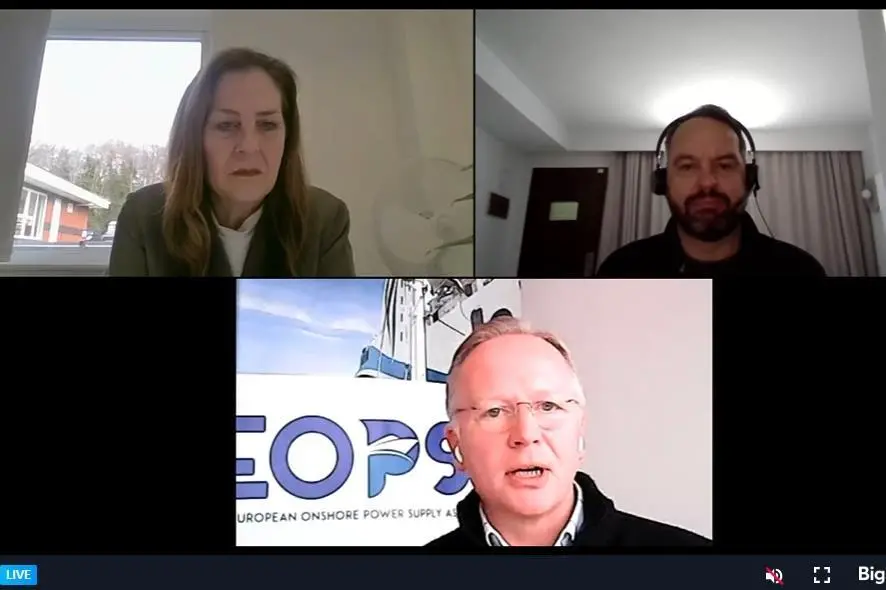
Roland Teixeira de Mattos, president of the European Onshore Power Supply Association (EOPSA) and Chris Poyner, head of shore power at ABB Marine and Ports, shared insights on the challenges and opportunities in onshore power, ahead of their Seawork Conference sessions in June.
The key takeaway: Successful electrification of ports depends on collaboration between power producers, electricity consumers and port authorities.
“Power availability is the number one challenge for shore power,” said Mr Poyner. “But there is always a business case you can find – you just need to look into the details.”
Mr Teixeira de Mattos agreed, stressing the importance of collaboration between electricity providers, consumers and port authorities. “A port environment has so many moving parts – the key is close coordination and bringing in expertise at the right time,” he added.
Opportunities & challenges
The ‘Onshore Power Supply – Connect, Invest, Decarbonise’ webinar, moderated by Debbie Mason of Maritime Journal, showcased the opportunities and challenges facing the maritime sector’s shift to shore power.
Both speakers highlighted the need for early investment and strategic partnerships to meet upcoming EU legislation for port electrification mandating that TEN-T ports retrofit by 2030.
Mr Teixeira de Mattos emphasised the scale of the transition, citing research showing an average additional power requirement of 150 megawatts per port to meet decarbonisation goals. This, he explained, would require a €45 billion investment across European ports, creating jobs and fostering innovation.
Decarbonisation toolbox
But, of course the business case for onshore power extends beyond regulation. Ports can use the infrastructure year-round by supporting industrial operations and supplementing national grids.
Innovations like microgrids and alternative fuels will also play a vital role in future.
Mr Poyner pointed to real-world examples like the Port of Toulon in France, where ABB has implemented a flexible microgrid integrating solar power, batteries and hydrogen fuel cells.
“The more we innovate with alternative fuels, the more shore power shines as one of the best tools in the decarbonisation toolbox,” said Mr Teixeira de Mattos.
Both experts agreed that while alternative fuels like hydrogen play a role in the decarbonisation toolbox, mature technologies like shore power offer immediate and proven benefits. The success of Heerema’s offshore construction vessel for example, which runs on shore power in Rotterdam, serves as a clear demonstration.
Going forward, the speakers said that both public and private investment will be crucial.
“We’re already seeing commercial companies stepping up to deliver onshore power solutions,” said Mr Teixeira de Mattos, underlining the importance of market-driven innovation.
Despite the high investment costs, the speakers said that private companies are already stepping up to develop commercial onshore power systems without relying solely on government subsidies. Norway, Spain and the Netherlands are already seeing private-led shore power projects take shape.
Related Articles
 ALTERNATIVE FUELS GREENPORT
 ENERGY & TECHNOLOGY GREENPORT
 PROJECTS & INITIATIVES GREENPORT