![GreenPort[PortStrategy]](https://www.portstrategy.com/greenport/wp-content/uploads/sites/4/2026/09/GreenPortPortStrategy.svg)



Ports urged to act now on climate threats
A new global report warns that urgent action is needed to protect port infrastructure and supply chains from mounting climate change risks.
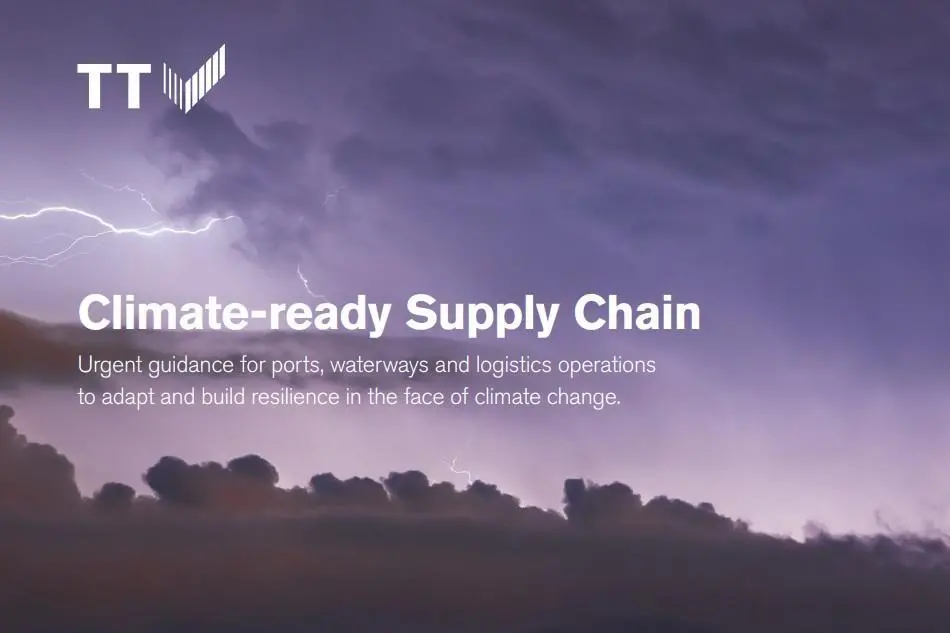
The Climate-Ready Supply Chain: Urgent Guidance for Ports, Waterways and Logistics Operations report, released by TT Club and engineering consultancy Haskoning, details how rising sea levels, extreme weather and regulatory pressures are placing billions of dollars in trade and assets at risk each year.
“Ports are the lifeblood of global trade, but they are also on the frontlines of climate change impact,” said Marika Calfas, TT Club Board Member and CEO of NSW Ports.
“This guidance provides practical steps for understanding climate risks, planning adaptive responses and embedding resilience into the core of business strategy.”
Practical guidance
The study outlines practical steps for risk mitigation and climate resilience across maritime operations.
It reveals that nearly 90% of the world’s 3,700 major ports face exposure to hurricanes, flooding, heatwaves and shifting ocean currents.
Historical case studies, including Hurricane Katrina’s Gulf Coast shutdown and the US$12 billion maritime losses from Japan’s 2011 tsunami, demonstrate the heavy economic toll of inadequate preparation.
TT Club warns that inaction will drive soaring repair costs, supply chain disruptions and lost revenue, while proactive investment can deliver long-term operational security and competitive advantage.
The report highlights the importance of strategies such as IoT-enabled monitoring, AI-powered predictive analytics and renewable energy integration to strengthen port infrastructure.
Haskoning’s Amy Savage stresses that climate adaptation should be viewed as “a strategic investment,” enabling ports to safeguard assets, improve efficiency and future-proof global trade networks.
Related Articles
 ALTERNATIVE FUELS GREENPORT
 ENERGY & TECHNOLOGY GREENPORT
 PROJECTS & INITIATIVES GREENPORT