![GreenPort[PortStrategy]](https://www.portstrategy.com/greenport/wp-content/uploads/sites/4/2026/09/GreenPortPortStrategy.svg)

Pushing the boundaries in cleaner waterways
GreenPort delves into why a new electric pusher vessel could help change the face of the inland waterways sector.
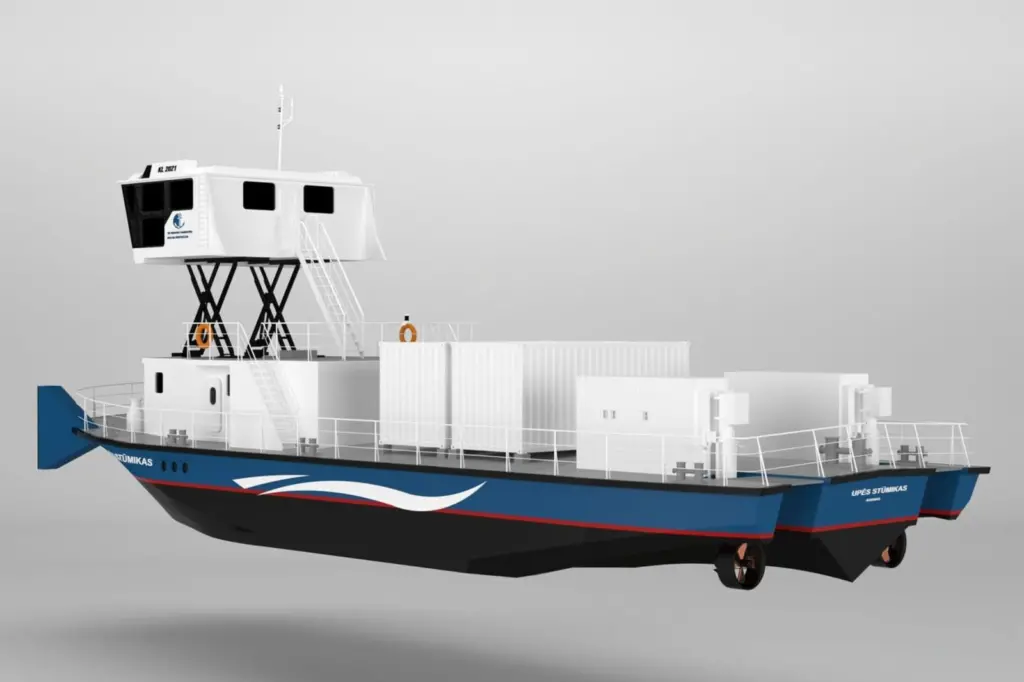
Last year, Western Baltic Engineering (WBE) went into partnership to develop its electric ‘pusher’ vessel with AYK Energy.
The design partnership came at the same time as the EU was ramping up pressure on member states to shift cargo from road to eco-friendly vessels on Europe’s extensive inland waterways network.
WBE has big ambitions to supercharge the company’s drive to roll out different models of its Electric Eel vessel for use on Europe’s inland waterways and other major markets like the United States.
“The change cannot come a moment too soon,” says Eglė Mikalauskienė, head of sales & marketing, WBE.
“Eurostat statistics show that the inland waterways fleet is very old. For example, the Danube river cargo vessels fleet age was mostly built between 1981 and 1990. So, reducing the emission in the inland waterway industry is a must, whatever measures are taken.”
Ms Mikalauskienė points to other figures which show that there is a fleet of 332 diesel pushers on the Danube alone pushing more than 2000 non-propelled barges.
WBE has estimated that each of these vessels is emitting 196,317 KGs Tank To Wheel (TTW) of CO2, per navigation, while its electric pusher design emits zero CO2.
The waterways market is a ready one for electrification. Containerised solutions are particularly well suited to pusher boats because they negate the need for charging stations along the route and this type of battery powered technology has already been tried and tested across multiple sectors.
Clever and unique
So, what is unique about the Electric Eel, what does it do that others can’t that are already out there on the market?
One of the key features of the Electric Eel is its hull. We’ve all seen that water levels are at an all time low across Europe’s inland waterways. So, the fact that pusher boat has a shallow draft and comes in three versions at 1.26m / 2.5m / 2.6m makes it tailor-made to the sector.
The vessel has a modular battery solution, meaning the batteries can be easily swapped and the vessel doesn’t have to be berthed while the batteries are charged.
This solution also does not require any new or modifications to quayside infrastructure. As long as there is a crane available that can swap out the batteries, the boat can operate.
WBE’s Electric Eel vessel can operate at a range of 300km before needing to stop.
The 26m long vessel is powered by three DNV approved AYK made batteries with a combined weight of 74 tonnes, two held in teu containers on deck which can be replaced via crane at harbour and one permanent battery below deck which can be charged at quayside.
The vessel has a pushing capacity of 2000 tonnes and a top speed of 22Km/h downstream at 85% engine load. The electric batteries create an engine power of 500 HP/400 KW compared to a diesel equivalent which has 1000 HP/800 KW.
These deck mounted, container-based battery packs can be switched out with H2 fuelcells and tanks to provide a modular, future-proofed propulsion system.
A shortened version (20 m) has been developed for river use where manoevrability is key. This version is equipped with up to four battery containers to maximise range and pushing capacity. Carrying a crew of three, it features a telescopic wheelhouse and a methanol auxiliary engine for Safe Return to Port operation.
It also features a a 5kw wind turbine to provide power for non-essential systems.
There is also a 26m EE pusher/tug 26m specially designed for tidal estuaries. With capacity for 4 20’ battery containers, it has the power to push or pull two 1600 t barges for up to 375 km. Its 2.6 m draft ensures stability in strong tidal currents.
It carries a crew of four, and like the original Electric Eel, offers a future proof solution, easily adapting to H2 fuel cells or alternative, containerised power sources.
Captive market
WBE is currently working toward attracting the attention of pusher boat and barge operators in the Rhein river and Danube river basins.
“Cargo handling activity is very active in these regions and therefore we hope that EU legislation will soon give these owners bigger opportunities to replace their existing fleets,” says Ms Mikalauskienė
She says that figures from the Lithuanian Inland Waterways authority show that one pusher boat pushing a 2000 tonnes (90 teu) barge would give a saving of 5580t of CO2 and could replace 10,000 trucks per year.
“WBE strongly believes that decarbonising Europe’s inland waterways would contribute not only to CO2 emissions, but to populations wellbeing in general. All of the rivers are part of our cities, so the less ships pollute, the healthier environment we live in,” says Ms Mikalauskienė.
“The more such vessels operate, the bigger the battery supply and swap market becomes. The bigger the latter market becomes, the more shipowners will invest in newbuilds and scrap the vessels that are polluting the most.”
Related Articles
 ALTERNATIVE FUELS GREENPORT
 ENERGY & TECHNOLOGY GREENPORT
 PROJECTS & INITIATIVES GREENPORT