![GreenPort[PortStrategy]](https://www.portstrategy.com/greenport/wp-content/uploads/sites/4/2026/09/GreenPortPortStrategy.svg)


Tauranga Port trials electric straddle carrier
New Zealand’s busiest port is set to trial the country’s first all-electric straddle carrier, marking a major milestone in port electrification.
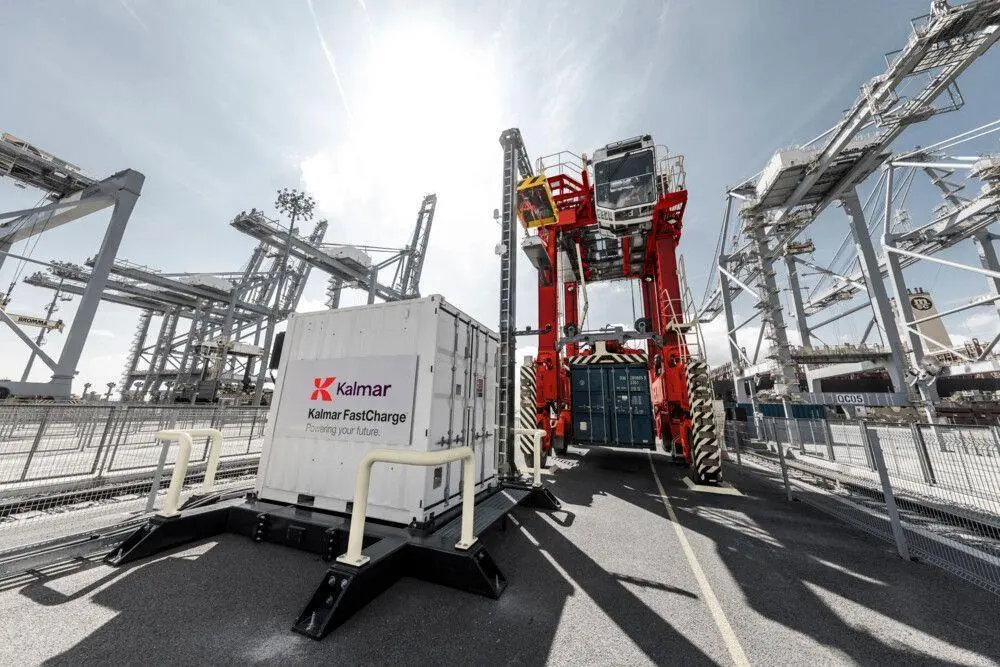
The trial at the Port of Tauranga includes the purchase of a Kalmar electric straddle carrier and the installation of specialist charging infrastructure to support its operation.
“Diesel use in straddles is our largest source of carbon emissions, contributing around 54% of our Scope 1 emissions,” said Leonard Sampson, chief executive, Port of Tauranga.
“The support of EECA makes it feasible for us to test the rapidly developing electric straddle technology in a New Zealand port context.”
A bold step
The $3.5 million project, led by Tauranga is co-funded by the Government’s Low Emission Transport Fund and administered by the Energy Efficiency and Conservation Authority (EECA).
It will see the port purchase a Kalmar electric straddle and install charging infrastructure. EECA will contribute $447,000 to the project to accelerate its implementation.
This initiative represents a bold step toward reducing the environmental impact of port operations through the adoption of electric port equipment.
The trial will assess a range of operational factors including charging times, driver training needs, safety and overall performance under high-demand conditions.
Insights from the trial will be shared with other New Zealand ports, potentially paving the way for wider port electrification.
If successful, electric straddle carriers could be integrated into Tauranga’s ongoing fleet renewal programme, contributing to an estimated 43% reduction in combined Scope 1 and 2 emissions.
With seven hybrid straddles already in operation, the port sees this trial as critical to evaluating the viability of a fully electric fleet.
Related Articles
 ALTERNATIVE FUELS GREENPORT
 ENERGY & TECHNOLOGY GREENPORT
 PROJECTS & INITIATIVES GREENPORT