



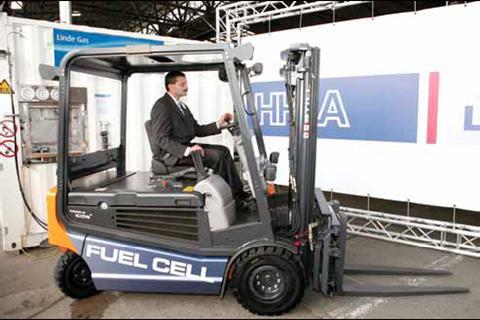
For the first time, fuel-cell forklifts will be taking part in cargo handling at HHLA Logistics.
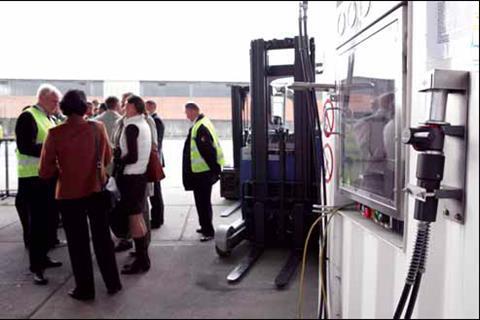
In a project backed by the City of Hamburg, HHLA Logistics, together with project partners Linde Gas and STILL, is embarking on a new, environmental, initiative within the Port of Hamburg. At a recent ceremony, Christian Maass, Under-Secretary in Hamburg’s Ministry for Urban Development and the Environment, inaugurated a STILL fuel-cell stacker R 60- 25 Fuel Cell and a new Linde Gas hydrogen fuel station at HHLA Logistics. A trial lasting two years is planned. Contract logistics provider HHLA Logistics, a subsidiary of Hamburger Hafen und Logistik AG, will be deploying the fuel-cell stackers for everyday storage operations. The test stage is aimed at establishing what advantages this alternative propulsion technology can offer in terms of efficiency, energy saving, convenience and maintenance. Should the assessments prove positive, the stacker fleet of around 100, mainly electrically-powered vehicles could in future be supplemented by fuel-cell stackers? Forklift supplier STILL is supporting Hamburg as a leading hydrogen city with hydrogen technology in the intralogistics sector. STILL has already collected a wealth of experience on various projects and meanwhile possesses the largest fleet of fuel cell powered cargo-handling vehicles. Among these are fork and reach stackers, high-level order pickers as well as tractors. The City of Hamburg already plays a leading role in Germany in the application and use of environmentally friendly hydrogen technology and is subsidizing its further development. Hydrogen buses operate along the streets of the city, Alster- Touristik GmbH runs a fuel-cell passenger boat, and a STILL fuel-cell tractor is used for baggage handling at Hamburg Airport. At Hamburg Airport, STILL fuel cell electric tractors have been operated on baggage handling since 2006. In the long tern the airport aims to expand its fleet with low-emission vehicles, cutting the emissions produced by exhaust gases. In principle, all the systems by STILL are of identical layout. They are hybrid systems, the individual components consisting of the fuel cell stack itself (with an output of 3 x 6 kilowatts, for example), interim electricity storage that stores energy during braking and disperses again it during acceleration, the gas tanks for hydrogen (loaded at a pressure of 350 bar and containing 2.5 kilograms of hydrogen), a cooler and a compressor along with an additional weight that balances the difference to the weighty battery. Depending on operating conditions, the interim electricity storage units consist of high-voltage condensers or rapid-charge/ discharge battery systems (the current partner being Hoppecke). Depending on the output range, fuel cell systems in the range between 5 and 10 KW are. The fuel cells are supplied by Hydrogenics and Nuvera.
Fuel cell technology: what are the benefits?
Clean energy
The operation of a truck with hydrogen does not cause any emission of pollutants. No emissions occur of sooty particles, nitrogen oxides or carbon dioxide that could harm our environment or climate. The “exhaust fume” caused by the reaction between hydrogen and the oxygen in the outdoor atmosphere consists simply of pure water in the form of steam.
No battery changing needed
Should the supply of hydrogen in the stacker be exhausted, all that is needed is a short stop at the hydrogen fuel station to put the truck back into full operation. Laborious changing and storage of batteries could be dispensed with in future, bringing infrastructural and ecological advantages. This solution is also more efficient for handling.
Minimised interruptions to operation
Refilling the hydrogen tank of the truck only takes 5-10 minutes. The duration of refuelling depends on the layout of the filling station. This makes the fuel cell far superior to the conventional battery requiring a charging cycle lasting several hours.
No problems with multi-shift operation
To allow multi-shift operation the fuel cell only needs to be refuelled with hydrogen in good time. This means that there is no need to keep costly exchange batteries available for each truck.
Full performance
STILL’s fuel cell PowerPack provides full rated voltage until the hydrogen is used up. The nominal voltage of a battery on the other hand is reduced continuously. Basing itself on its almost unique wealth of experience with fuel cell technology and its application towards protection of the environment STILL will systematically and intensively continue to pursue this line of development.

