



Nicaragua sidelines canal project
Ten years on from granting a 50-year renewable concession to the Chinese group Hong Kong Nicaragua Canal Development Investment Co. Limited (HKND Group), owned by Chinese businessman Wang Jing, to build a canal linking the Atlantic and Pacific, the Nicaraguan Government has cancelled the concession and reformed the rules governing the highly ambitious project.
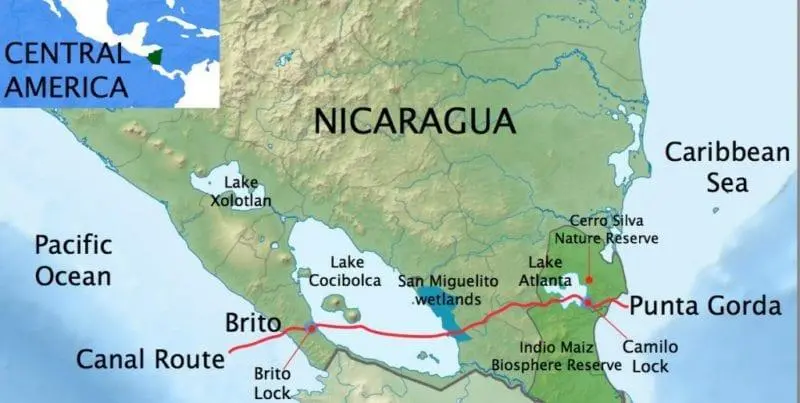
The reforms centre on the adoption of Law 800, the Legal Regime Law of the Great Interoceanic Canal of Nicaragua and the creation of the Great Canal Authority, as well as the repeal of Law 840 from 2013 under which the canal development was originally planned. The new Canal Authority will possess a board made up of six members but following the adoption of the reforms it will be headed by a president, vice president and secretary, all of whom will be government officials.
“The Directorate of the Authority of the Great Interoceanic Canal of Nicaragua is authorised to coordinate with the competent authorities of the Government of Nicaragua everything related to the planning and operation of the Great Canal of Nicaragua,” states the new law.
In reality, while the new law theoretically does keep the prospect of canal development alive it may well prove to be little more than a face-saving measure for the Government of Nicaragua.
The original Wang Jing project never gained any significant momentum in the 10-years this concession was live. The project was inherently ambitious and it never got any further than a ground-breaking ceremony and work on related access roads, but as for work on the canal itself this never commenced. It is perhaps understandable when you compare its parameters to the existing Panama Canal.
The project foresees a canal nearly 280 kilometres long, with entrances at the Brito River on the Pacific coast and near the mouth of the Punta Gorda River on the Caribbean side. The trajectory of the canal crosses Lake Nicaragua, the largest lake in Central America. The Panama Canal, which handles around six per cent of global trade annually, is just 80 kilometres long.
Looking at the proposed Nicaragua Canal alongside the Panama Canal and specifically factoring in an estimated US$50 billion development cost it is hard to see how it could prove a competitive option. Nicaragua is the second poorest country in the western hemisphere and against this background and the competitive realities there are strong reasons to believe that in the past and today it can just be regarded as a fairy tale project. A project which perhaps also fulfils the criteria of being a good story for government. President Daniel Ortega’s government certainly raised the spectre of the canal development and operation offering thousands of jobs.
NO SHORTAGE OF CRITICS
Financial and commercial viability are not the only criticisms levelled at the project. Critics highlighted serious environmental concerns. These include bisecting Lake Nicaragua and forcibly displacing an estimated 120,000 people, navigating the country’s most important fresh water reserve and obliterating protected natural spaces home to over 20 endangered species.
Concerns were also expressed over the original enabling legislation for the project which was said to be put in place without legitimate political debate, consultation and environmental studies.
Additionally of concern were the practical realities that Wang had no working knowledge of civil engineering and that he was said to have lost up to 85% of his wealth in China’s 2015 stock market crisis.
The prospect of another party or even a consortium looking at this project seriously is not at all strong. There is no balance in the risk and reward equation, and certainly zero prospect of government support or soft funding to enhance project viability. In summary, It can safely be confined to the category of a fairytale project.
Related Articles
 INSIGHT & OPINION
 INSIGHT & OPINION
 PORT & TERMINAL NEWS