



Investments and arrivals
Despite the naysayers, London Gateway remains one of DP Worlds flagship operations. Felicity Landon reports
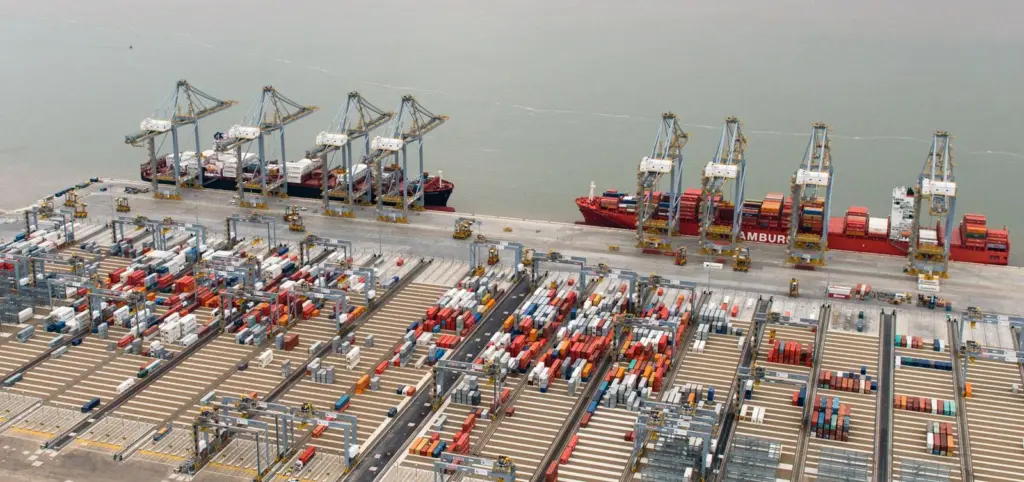
DP World handled its first scheduled call at London Gateway at the start of November 2013 – the MOL Caledon, on the South African Europe Container Service (SAECS) service.
The months that followed have been punctuated by a series of announcements of new investments and new arrivals, and last month saw the opening of the new port’s second berth.
At the beginning of May, London Gateway handled the first call of three joint services switched to the port from Tilbury by Hamburg Sud and Hapag-Lloyd – to the east and west coasts of South America and to the Middle East.
In mid May, the G6 alliance launched its new Pacific Atlantic (PA2) service, using London Gateway as the UK port of call. “It’s another milestone for the team. We are focused on delivering the best possible service for cargo owners and shippers and our connections are growing fast,” said Peter Ward, London Gateway’s commercial director.
In addition, London Gateway has signed up its first weekly feeder service, operated by X-Press Feeders, calling at Dublin and Rotterdam.
Among other announcements, container transport operator Maritime Transport has confirmed that it is to set up a depot on a three-acre site at London Gateway, freight company Westbound Shipping Services has relocated its head office to the new port, and Freightliner and DB Schenker have both launched a series of daily rail freight services from London Gateway.
Logistics loss
However, there is clearly disappointment after Marks & Spencer revealed in its annual report in May that it was abandoning plans to invest £200m in a new distribution centre at the logistics park. M&S’ London Gateway plans were announced in June last year, to coincide with a visit by Prime Minister David Cameron. But now the retailer, which reported a 4% fall in profits for 2013, has said it will develop an alternative plan, based around its two new national distribution centres at Castle Donington and Bradford.
On the positive side, DP World has announced a 50/50 joint venture with Prologis to develop a 316,000 sq ft distribution centre and also awarded a contract to the Buckingham Group to build its 375,000 sq ft Common User Facility (CUF), a multipurpose cargo handling centre.
“There were people who had the vision for London Gateway 14 or 15 years ago and people outside the UK have asked us how on earth it can take that long to build a port,” said Peter Ward, addressing a seminar at Multimodal. “We worked with three governments and numerous local authorities to achieve this.”
He described the ‘fundamental dynamics’ of London Gateway’s proximity to the largest consumption area in the UK – “we are sitting right on the doorstep of 20m consumers” – but also said: “As an industry we do tend to get wrapped up in the inbound flow, which reflects the UK trade patterns. But as the export drive gathers pace, then certainly there will be an element of looking to the continent, and we have growing interest from manufacturers.”
For Westbound, the move to London Gateway has only been positive. Director Ryan Clark says: “Being based here has made a difference – it’s good for awareness and has raised our profile. But also we have seen a little bit more the opportunities up ahead just from being here. The positive attitude among DP’s staff has rubbed off on our staff, too. And while there were plenty of sceptics before, the feeling from the outside has definitely changed towards London Gateway – because now they are ‘doing’ and not just ‘saying’, and that is the key.”
Away from the tussle between London Gateway, Felixstowe, Southampton and others, there are always plenty of people ready to speculate on whether the UK could lose out to mainland Europe rivals and become a feeder destination in future.
However, Neil Davidson of Drewry thinks not. “The analysis we have done is that the UK is a big market within northern Europe and it is also a very short deviation for the ships, so the economics are overwhelmingly in favour of main line calls into the UK. If 20% of the ship is for the UK, it doesn’t make sense to feed into the South East UK,” he says.
Dean Davison of Ocean Shipping Consultants adds: “London Gateway was designed for the big ships and to date they have not got the biggest. But DP World is committed to making London Gateway work – it is one of their flagship operations.”
Related Articles
 CONTAINER & CARGO HANDLING
 OPERATIONS
 OPERATIONS