![PortStrategy[GreenPort]](https://www.portstrategy.com/wp-content/uploads/2026/09/PortStrategyGreenPort.svg)

NIGERIA TAKES THE PLUNGE
Its been quite a year for Nigeria and its ports in particular. The successful elections last year marked the first civilian transfer of power in the countrys history and growing international support was underlined by the Commonwealth heads of Government meeting and a state visit by Her Majesty the Queen. The privatisation process gathered momentum with progress in the hotel, insurance and fertiliser industries and in particular the telecoms sector.
Now it’s the turn of Nigeria’s ports where privatisation has been discussed for more than a decade. Once the elections were successfully completed, the top tier executives were dismissed and rumours of misappropriation of funds were rife as the ports’ bank accounts were frozen and a financial audit undertaken. Since then progress has been swift with the installation of Adebayo Sarumi as md and as President Obasanjo continues at every opportunity, to urge his ministers to make progress on privatisation.
WHY NIGERIA MATTERS This process in Nigeria is one of the most important in Africa. Nigeria enjoys a GDP that is similar to South Africa but with a population of 135 million people it’s almost 3.5 times as big. This coupled with the huge oil and now gas investment in the region creates the potential to make Nigeria the power house of Africa bringing a big improvement to the economy and a huge increase to the movement of goods which will in turn stimulate healthy increases in port traffic.
The invitation to tender for Nigerian concessions, handled by the Bureau of Public Enterprise, was issued at the end of last year and has been extended twice with a cut-off date at the time of writing, of 20 February. All of Nigeria’s ports are listed in the tender, inviting concessionaires to bid for container, cars & roro, and general cargo handling at the ports of Apapa, Tin Can Island, Lagos Container Terminal, Lagos Ro-Ro Terminal, Port Harcourt, Onne (Federal Lighter Terminal & Federal Ocean Terminal), Warri, Sapele , Koko and Calabar.
This is not the first time that concessioning has been promoted in Nigeria. 20 years ago, a concession was granted to GAC to run the ro-ro terminal on Tin Can Island, Lagos and your correspondent, as operations manager O.T. Africa Line, offered GAC’s consistently high performance as a benchmark and target for European operators to match.
More recently a successful joint venture operation between APMT and Intels at Onne has expanded to three sites including the New West Africa Container Terminal. What is confusing is that the same operation is included on the tender list when the two companies are reportedly saying they have another 18 years of their concession still to run.
The tender document clearly states: “These ports constitute the hub of international trade in the West African sub-region and some landlocked countries of Sub-Saharan Africa. Prospective concessionaires, who must be local/international port operators, will be responsible for terminal operations including investment in the provision and maintenance of the superstructure and equipment”.
110 expressions of interest have been received and some clarity is emerging in terms of who the interested bidders are expected to be and whom they are paring with as local partners. Local partnership is vital in Nigeria and its constitution can be pivotal in achieving success. It should include a shareholding by suitable Nigerian companies or individuals who can guide bidders through the tender process and continue to do so once the contract is secured to protect and support the investment.
SO WHO’S RUNNING?
It was initially rumoured that P&O Ports were linked with local agents Hull Blyth but interest in Nigeria by P&O has recently been denied. The South African ports have also shown an initial interest as has the international operator ICTSI. Local observers also believe that APMT and Bollore, who compete ferociously against each other for their respective shares of the liner traffic through their organisations of Maersk-Sealand and Delmas, may actually bid together as Maersk are believed to be well connected and their local partners may include Shonekan, a former Nigerian president. If successful, this would once again in West Africa raise the issue flagged before in PS concerning potential conflict of interest when carriers operate terminals.
HPH is believed to be in discussion with local ‘experts’ and MDHC consultancy Portia has teamed up with a local liner agency. Specialist African infrastructure consultancy TCI Infrastructure lead by Oliver Andrews, has been approached by an international terminal operator to assist them and it is expected that the liner operator Grimaldi will be bidding for the ro-ro concession.
What is less clear is where this leaves the local maritime agency community that over many years has had to provide terminal handling facilities to their clients to ensure ships and containers were turned round within commercially acceptable time scales. Will all these companies be able to bid for concessions or will it be necessary for them to form consortium groupings?
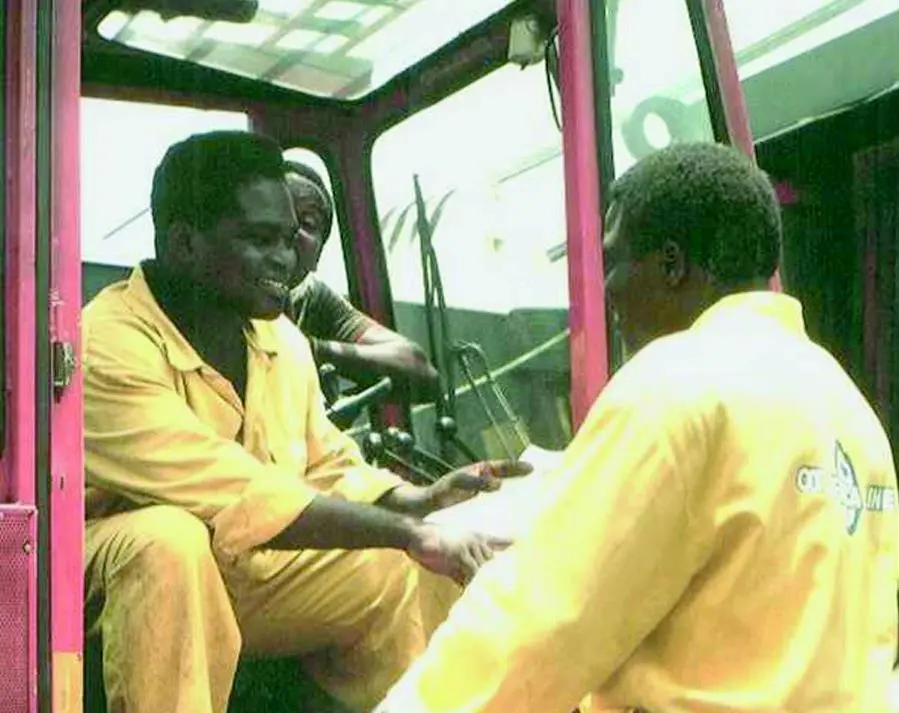
Then there’s the labour force who until recently had a reputation for confrontation and have consistently opposed privatisation. It now seems that a more conciliatory approach is emerging. With the revenue that the concessioning will generate it should give the government the opportunity to provide training for the port workers.
Investment to provide well trained multi-skilled workers and supervisors will be a strong motivator. It is also likely to reap dividends in terms of improved performance for the port and its new operators.
Related Articles
 EXPANSION & DEVELOPMENT
 CONTAINER & CARGO HANDLING
 EQUIPMENT