![PortStrategy[GreenPort]](https://www.portstrategy.com/wp-content/uploads/2026/09/PortStrategyGreenPort.svg)





Tide model to aid Australia’s blue economy
A tidal study project and resulting tide model developed by an Australian port authority has paved the way for a national tide model which is expected to contribute to Australia’s ‘blue economy’.
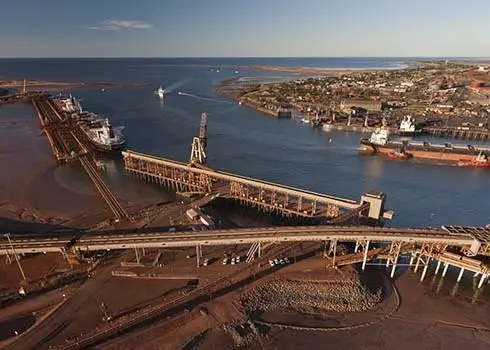
Pilbara Ports Authority’s 2013 tidal study redefined existing depths along the 42km shipping channel. This study resulted in the creation of a Lowest Astronomical Tide Model, or Hydroid, which is unique to the Port of Port Hedland. The Intergovernmental Committee on Surveying and Mapping has now formed a working group on the benefits of developing a national Hydroid model for Australia, called the AUSHYDROID.
The benefits of the Port Hedland Hydroid will be used as a case study to support the development of the AUSHYDROID, which is expected to contribute to Australia’s ‘blue economy’, that is the effective and sustainable use of maritime resources for economic growth.
Export capacity increased
Pilbara Ports Authority said the Hydroid has made Port of Port Hedland operations more efficient.
“The Port Hedland Hydroid had a significant impact on the port’s export capacity. Every additional 10cm of declared depth is equal to an extra 1,200 tonnes of cargo per vessel,” Pilbara Ports Authority’s general manager of operations, John Finch, said.
“The Hydroid also extended sailing windows, potentially increasing the number of vessels from six to eight per tide,” he added.
Pilbara Ports Authority’s tidal study gave marine operations staff in Port Hedland a more precise understanding of the navigable depths along the channel. This resulted in an increased average sailing draft of 71cm and a widening of the tidal sailing window by an hour, whilst maintaining safety and the ability to manage risk within the uni-directional channel.
This significantly increased trade capacity in Port of Port Hedland whilst reducing unit costs by allowing port users to safely load more product onto their vessels.
The Royal Australian Navy Hydrographic Office has acknowledged Pilbara Ports Authority’s study and survey work as the standard that should be applied internationally.
Related Articles
 AUSTRALASIA GREENPORT
 AUSTRALASIA GREENPORT
 AUSTRALASIA GREENPORT