

Bold decisions required
Felicity Landon charts the key talking points at the recent Coastlink Conference
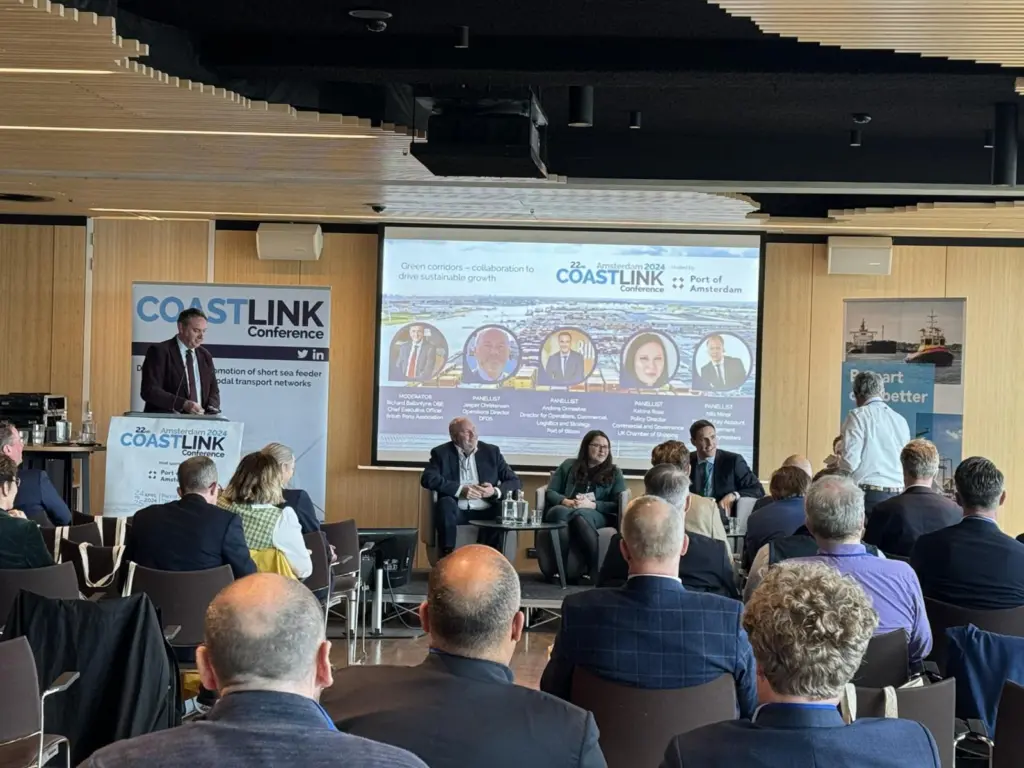
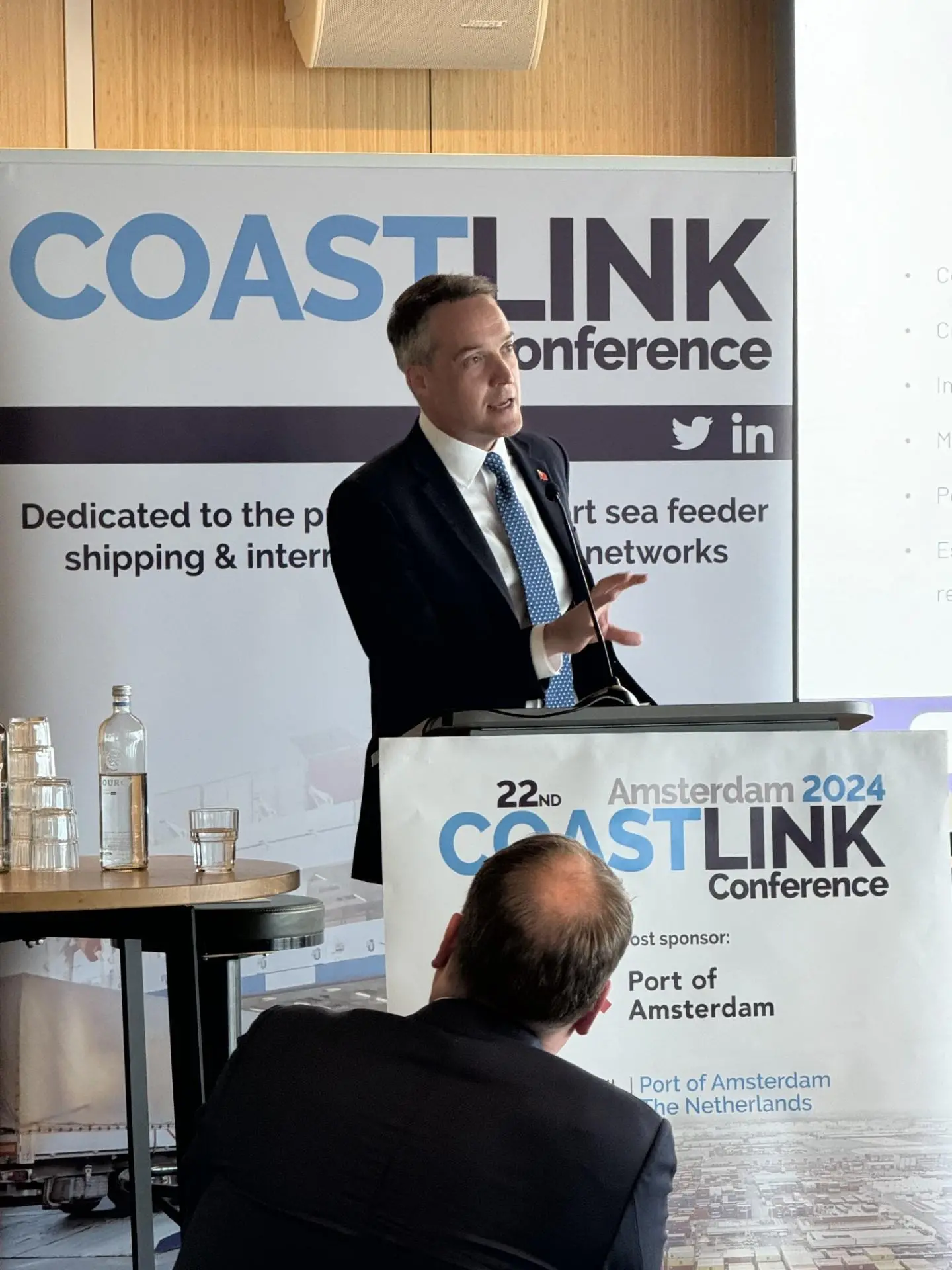
Coastlink, the pan-European network dedicated to the promotion of shortsea and feeder shipping, held its 2024 conference in Amsterdam. Key themes were the importance of creating a ‘coalition of the doing’ (as opposed to the willing) – and calls for more joined-up thinking and strategic planning at government level.
Who dares doesn’t necessarily win – but not everyone can ‘innovate second’. During two days of discussions at Coastlink 2024, numerous examples emerged of shipping lines and ports making bold decisions to lead on innovation and, in many cases, taking on significant risk in the process.
One such party was Portsmouth International Port, whose Head of Operations, James Evans, outlined the port’s Sea Change project to design, build and operate a shore power system across its three busiest berths. During a discussion around overcoming the barriers to infrastructure and delivery for shore power, he explained that Portsmouth, a municipal council-owned port, had to take a risk, agreeing to pay £3m for securing access to the last remaining energy in its area before there was any guaranteed funding or support for the project.
“If we had missed out, we would have had a significant problem to deliver on our customers’ needs and wants,” he said.
The port did subsequently gain some funding support, including from the UK government’s ZEVI (Zero Emission Vessel and Infrastructure) fund, as part of a demonstration programme.
The system allows for simultaneous powering of multiple vessels with different AC frequencies, voltages and ship-shore connections, and the energy supply is on a green tariff. As he noted: “There are different connection types and different frequencies – we have to cater for the wants and needs of our known customers and the potential of customers we don’t know of yet.”
Being council-owned, the port had a duty to do its part, including helping to improve air quality for local residents, Evans concluded – while noting a potential downside for any early adopters of shore power. “If the technology advances quickly, there is a risk of equipment obsolescence.”
The Port of Bilbao is also taking risk and helping customers and logistics to decarbonise, said Andima Ormaetxe, Bilbao’s Director for Operations, Commercial, Logistics and Strategy. Bilbao is leading the way on a Green Corridor project aiming to attract increasing volumes between Spain and the North of Europe – not only logistics volumes but also energy volumes based on Bilbao’s Strategic Energy Hub, evolving from fossil fuels to renewable sources, including the creation and supply of green hydrogen.
Bilbao port takes the view that it must help society, shipping lines and shippers to decarbonise their transport, as well as supporting the decarbonisation of industry in the region,” said Ormaetxe.
“We are taking the risk, investing in these processes and inviting shipping lines and shippers to start this trip of decarbonisation. So, we are really putting the egg before the chicken. If we just put pressure on the rest of the community, we are not going to succeed.”
ACTION AGENDA
A key theme through discussions around green corridors, shore power, emerging opportunities and modal shift was the need for governments and others to step up and take action.
Geraint Evans, chief executive of the UK Major Ports Group, noted that ports in the UK face a lot of planning issues, “but power is the thing that is keeping us awake at night”.
He said: “There is a lack of thinking about ports, especially major ports, as a strategic sector and what they will need to thrive and develop – road, rail and power.”
There are concerns around “a lack of thinking from a government perspective and then into the National Grid”, underlined Geraint Evans. “We feel that we are trying to explore the right projects and take them forward, but we shouldn’t be having these depths of discussions about power. There is a real risk that we drive away private investment.”
For shore power and other electrification needs, estimates range from multiples of four to 15 in what ports will need in terms of power in the coming years, he said. “We need to be making that case to governments at all levels. Shore power should not be as big an issue as it is; power should not be as big an issue. We need to make sure that ports are considered in the same way as airports or other critical national infrastructure (CNI).”
Arjan Meijer, Area Sales Manager at Cavotec, said: “Unfortunately, we see shore power projects postponed a couple of years because there is no grid power. There are semi-temporary solutions with batteries and generators, but that is an issue. Energy companies need to be encouraged to make the investment.”
Permitting is another issue, he added. “Surprisingly, when a tender is granted or a contractor award, all kinds of permit processes are needed to start it up after that. If we all think about that in an earlier stage, we could benefit.”
Alexandra Herdman, Senior Policy Manager at Logistics UK, called for government action to support modal shift and supply chain resilience: “A top-down policy has impact,” she said. “A target is not enough; we need the right infrastructure in the right place, be it piers, wharfs or rail facilities.”
For example, she said, a lack of infrastructure is holding back progress on the Manchester Ship Canal and the Aire & Calder Navigation.
Logistics UK is pressing for government support in terms of sustainability solutions for fleets, said Herdman – for example, ‘a little bit more certainty in terms of shore power’, so ship owners would be able to future proof their green solutions. Some operators are moving ahead anyway, said Herdman – a ‘trailblazing and world-class example’ being DHL moving express mail from London Heathrow via the Thames for final delivery by e-cargo bikes in the city.
She called for collaboration between business and government to ensure that solutions such as coastal shipping do not end up being cost-inefficient, pushing cargo back on the roads – “none of us want that”, she said. “But parcels don’t vote, and that’s often how we feel about the government direction in the UK.”
Dorine Bosman, Chief Investment Officer of the Port of Amsterdam, said: “Efficient and sustainable transport connections between regions and close cooperation to transform energy systems towards the use of more renewable energies are crucial activities we are all dealing with.” She told delegates: “We talk about the coalition of the willing; we would like to transform this to the coalition of the doing.”
SHORTSEA SHIPPING RISING
Several speakers reflected on the relative strength and rising importance of shortsea shipping. Johan-Paul Verschuure, Director of Rebel Ports & Logistics, said: “Shortsea is gaining more importance relative to overall trade.”
He highlighted the shortage of truck drivers in the UK and across Europe, which has led to more demand for unaccompanied ro-ro; rather than traditional accompanied ro-ro via the Dover Strait, more freight is moving closer to the end market, he said.
Verschuure predicted that a carbon tax or other emissions costs would shift the balance on supply chains. “Hinterlands will contract, cargo will come from closer to ports, and you will have smaller ports,” he said. However, even as demand goes up, it is not easy to find more space, he warned. The transition to new fuels that require more storage space will create even more of a squeeze on space.
The ports and shipping industry needs to accelerate greener solutions but to achieve that, it needs a level playing field and more funding – not just subsidies or grants, but all kinds of loans, said Kari-Pekka Laaksonen, Group CEO of Samskip.
He highlighted the EU Emissions Trading System (ETS), applicable to shipping since the start of 2024. “There is no EU ETS for road transport. That creates not a fair playing field for all of us. There are companies very heavily investing in the future, changing the technology, being front runners. That is very costly. At the same time, you have to carry fees or penalties on top of your operating costs, so you have a double burden being a front runner.”
All these factors hinder the green transition and slow down the transition to green energy usage, he warned.
However, Laaksonen pushed the case for innovation. Two green hydrogen-powered vessels will join the Samskip fleet by 2026, described as among the first zero-emission shortsea container vessels in the world. These, he said, were just one piece in Samskip’s highly ambitious decarbonisation and sustainability strategy.
There can be a tendency to ‘innovate second’ – holding back and letting others take the risk – “but you won’t get change unless there are companies who are front runners, he said, adding: “Leading by example and learning by doing is really a good model to follow.”
And for those content to follow, he warned: “Whether you act or just don’t do anything, you will be hit by the charges or regulations.”
Related Articles
 OPERATIONS
 OPERATIONS
 OPERATIONS