![PortStrategy[GreenPort]](https://www.portstrategy.com/wp-content/uploads/2026/09/PortStrategyGreenPort.svg)

Access all areas
Salvors and ports need to work together when disaster strikes.
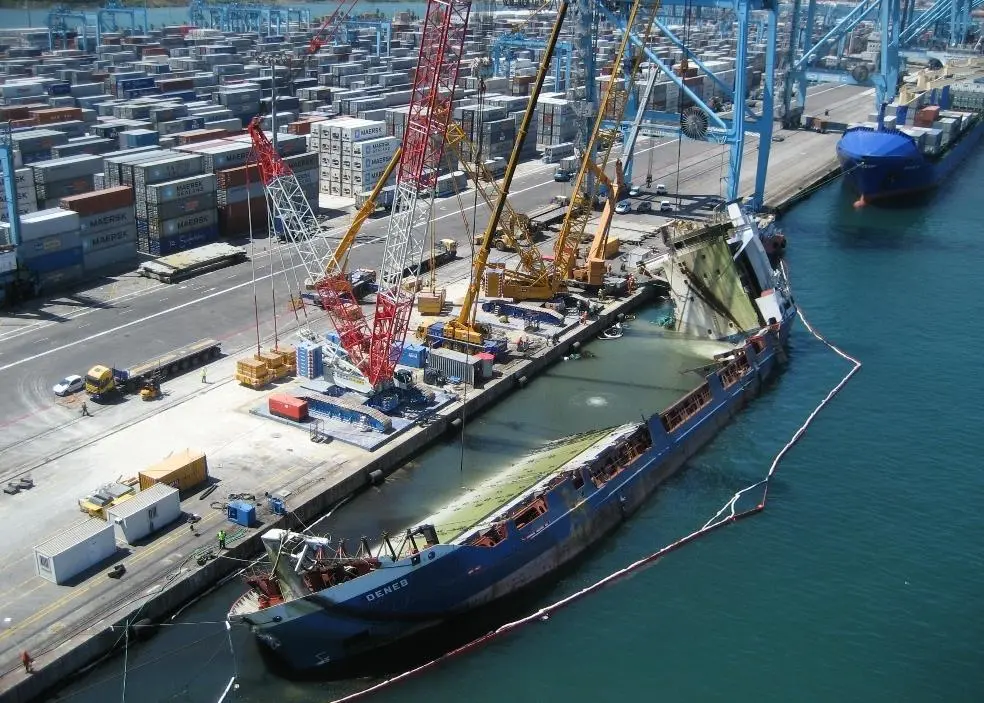
Over 75% of marine casualties occur in or around the approaches to port and if not properly and rapidly dealt with they have the potential to seriously impact port operations and profitability.
Even the loss of one berth for a comparatively short period can have real impact. Plus, there is the threat of the stricken ship causing a major hazard to other vessels and to port infrastructure.
In March 2007, for example, the car carrier, Repubblica di Genova capsized at her berth at Antwerp. It was not until August that the salvor was able to pull the vessel upright and begin the process of refloating and repair. The affected berths were out of action for the entire period and the work of the salvor in removing the vessel was vital to the port’s interests.
The role of third-party contractors working with port authorities to salve/lighten cargoes from damaged or abandoned ships within the port is therefore crucial.
The global trade association representing the interests of marine salvors is the International Salvage Union (ISU), and it reports numerous examples of cases where salvors have helped to keep a port operational or brought it back into full service after an incident.
Quake chaos
Natural disasters have been a regular cause of interruption to port operations. Recent major earthquakes in Chile and Haiti resulted in vessels sinking in port and causing significant disruption. In one of the more unusual operations, North and South American ISU members worked jointly to re-float the MV Laurel, a 26,800 dwt bulk carrier, which had been in a dry dock at Talcahuano, Chile when the 8.8-magnitude earthquake struck.
The quake generated two tsunamis which lifted the Laurel up and out of the dock, thrusting it forward on to the pier bulkhead. The salvors patched the hull; removed the vessel’s propeller and debris which was lying in the bottom of the dry dock hindering the refloating; discharged the remaining heavy fuel oil and shifted some ballast to obtain the correct trim.
The team fabricated a custom-built jacking plate on site and placed it under the bow, along rubber air bags to serve as jacks when inflated. The Laurel’s bow was lifted off the dry dock wall and the vessel was gently eased back into the water.
Mark Hoddinott, general manager of the ISU, says that when a casualty happens in port, a number of competing agenda come into play. “The shipowner will be concerned about his ship and the cost of salvage, the port authority will be concerned about the commercial impact on port operations, environmentalists will have no commercial concerns at all etc.”
Port relations

Salvors are used to working with port authorities: “My experience is that port authorities are very proactive and like to stay closely involved with the salvage operation,” says Mr Hoddinott.
One of the main problems is when vessels suffer a casualty soon after leaving the loading port. “Most bulk loading terminals do not have the capability to receive the cargo back. Discharging bulk cargoes for lightening purposes during salvage tends to be a slow process as suitable handling equipment and lightening vessels are sourced and brought in.”
Pollution prevention is also of key importance. Shore-based authorities increasingly have a “zero tolerance” attitude to any pollution and a requirement of many operations is safely to remove all fuel oil before undertaking the salvage job.
Additionally, environmentalists play a huge part in determining the course of a salvage operation.
“Some are very good and have a degree of common sense that is necessary to complete the salvage in the optimum time. A minority are totally impractical and put forward recommendations that extend the length of the operation, putting the casualty and environment at increased risk and unnecessarily increasing the costs to the shipowner and his underwriters,” says Mr Hoddinott.
Berthing plan
Ports themselves can assist the salvage operation by providing a suitable berth so that the salvage operation can proceed in relatively-sheltered conditions, plus provide the expertise and equipment for cargo handling.
“One of my own experiences involved ABP and the Port of Hull. Following a night time collision in the River Humber it was necessary to get one of the casualties into a berth to assess the damage/flooding etc.
“ABP provided the tugs, pilot and a berth in Alexandra Dock. Once alongside the shipowner, for reasons best known to himself, terminated the salvage contract and dismissed the salvors. The casualty sank alongside two days later.
“The salvors were re-engaged and managed to float the casualty two weeks later. The port provided the cargo handling equipment and storage to discharge the cargo prior to refloating.”
Out of the box
Sometimes a combination of patience and innovation is needed to complete a salvage. An in-port catastrophe was averted in Chile in 2013 during heavy seas which led to a complex salvage operation at a beach adjoining the port.
The partially laden bulk carrier approached the harbour entrance at San Antonio and dropped anchor to await calmer seas, but was forced to cut the anchor loose, sending it on to offshore sands.
With severe bottom damage, some flooding in the cargo holds and breached ballast tanks, its perishable cargo of wheat and soy beans was declared a total loss.
The owner, along with its P&I Club (Protection & Indemnity insurer), appointed Titan and partner T&T Salvage who mounted an operation from a narrow beach 300 metres away, divided from the worksite by a constantly shifting seabed.
“Not only did the 34,000 tons of cargo have to be brought ashore under these circumstances, but all of the portable salvage equipment, including hydraulic chain pullers, each weighing in excess of 10 tons, together with hundreds of metres of heavy chain, large-capacity generators and power packs, had to be placed aboard,” says Chris Peterson, vice president of Titan.
Cargo shift
The basic method employed by the salvage team was to simply discharge the cargo to the beach by use of the cranes aboard the wrecked ship, then refloat and tow it to deeper waters.
“They also used a patented aerial téléphérique, or cable carriage, set up between a crane pedestal on the wreck and a 500-tonne crawler crane tower erected ashore,” says Mr Peterson.
“To prevent the hull from becoming light and dancing around in the waves as the cargo weight was reduced and the high ocean swell continued, ballast water was flooded back into all the tanks and cargo holds to keep it steady. Later, once all other preparations were made for refloating, powerful, portable pumps were installed to drain the 48,000 tons of seawater, reducing the vessel’s weight.
“Six of Titan’s linear hydraulic chain pullers, each with a 300-metric ton capacity, were set up on the stricken vessel’s bow to eventually allow the lightened wreck to be pulled off the beach and refloated into deeper water.”
This involved bringing a tug into breaking surf while effectively “in irons” (rendered incapable of steering) and lacking the ability to freely get out of trouble. In accordance with its owner’s instruction, the wreck was cleaned and safely scuttled in approximately 2,000 metres of Pacific water.
Related Articles
 BULK HANDLING
 BULK HANDLING
 BULK HANDLING