![PortStrategy[GreenPort]](https://www.portstrategy.com/wp-content/uploads/2026/09/PortStrategyGreenPort.svg)






Keep it simple, keep it safe
The entry into the port handling industry of cheaper manufacturers from developing countries has reignited the debate over whether terminal operators need necessarily have to factor in higher life cycle costs if sourcing from these suppliers.
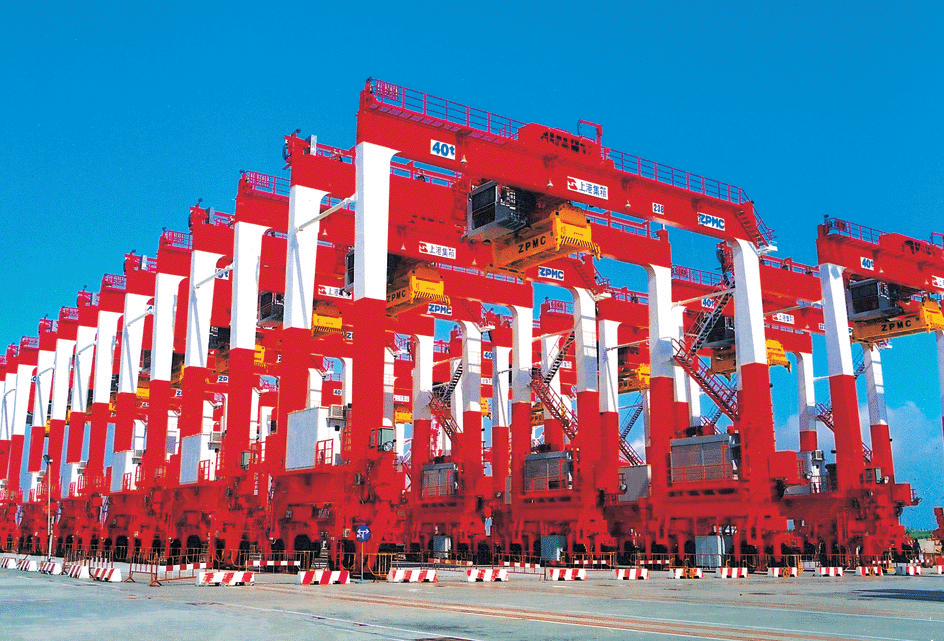
In the case of ZPMC, John Miller, operations engineer of Axis Engineering at the Port of Auckland, says you are actually getting better quality for less cash. “Their structural manufacturing is superior, while the cranes themselves are designed for higher load cycles. The components they use are built better, too. Compared to other Asian manufacturers, ZPMC is providing customised machines at catalogue prices! Given this level of quality at the basic engineering level, life-cycle costs are definitely more competitive to those of other manufacturers.”
DP World’s Andrew Adam also points out that ZPMC incorporates many European components in its cranes. However, he also observes that, when looking at costs directly, nobody has proven that a ZPMC crane specified with Chinese components is more costly to operate than a well-specified ZPMC crane with European components installed.
According to Marítima Valenciana terminal director Alfonso González: “Buying cheaper equipment doesn’t necessarily imply that life-cycle costs will automatically be higher. There are a lot of variables affecting equipment: the delivery price, the length of its working life, whether external factors are to blame for any breakdowns and things such as the cost of undertaking preventive maintenance on parts and components. It is therefore difficult to make generalisations.”
International terminal operator Gulftainer believes that although quality product and design are critical factors affecting overall life cycle costs, this does not necessarily imply the requirement for top-end expensive technology to be incorporated exclusively in operational systems. The operator is cognisant that a simple, but well-designed system, which takes into account local operating conditions, will outperform a more sophisticated system, which has received inadequate end-user input at the procurement stage.
“We very much embrace the ‘KISS’ concept: ‘Keep it Safe and Simple’,” Gulftainer says.
Related Articles
 BULK HANDLING
 BULK HANDLING
 BULK HANDLING