![PortStrategy[GreenPort]](https://www.portstrategy.com/wp-content/uploads/2026/09/PortStrategyGreenPort.svg)





Look beyond trade war, advises Drewry
The US-China trade war may continue to dominate headlines but there are macro-economic factors at work which are “more important” in determining future trade patterns, a ports expert has said.
Speaking about whether the trade war has caused a permanent shift of trade patterns during Drewry’s quarterly Ports and Terminals Market Briefing, Neil Davidson, senior analyst, ports & terminals at Drewry, stated that the nature of the Chinese economy is changing independent of the tariff war.
He explained that while Europe is benefiting from the US-China trade war, with South East Asia also in a strong position and China’s trade decreasing, there has been a “focus on domestic consumption” in China, while alongside this, “regionalisation is becoming more important”, meaning we are seeing inter-regional trade.
Global outlook
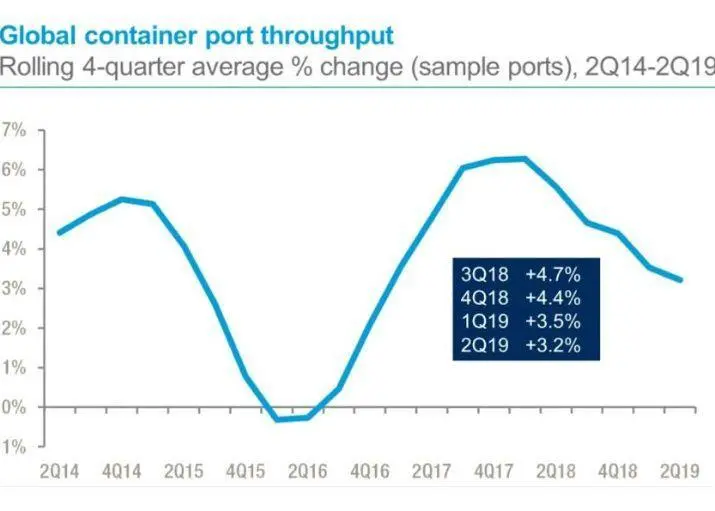
Globally, the slowdown of port throughput continues. In Q2 2019, throughput was up 3.2%, and in Q1 2019, throughout was up 3.5%. This is compared to +4.4% in Q4 2018 and +4.7% in Q3 2018. There is overall predicted growth of 3% this year.
Asia has 55% of global container traffic with South East Asia doing well and China slowing, noted Mr Davidson.
Digitalisation
Ports can’t ignore the digital maritime revolution and are adopting digitalisation gradually in stages, stated Mr Davidson. As digitalisation progresses different ports need different digital solutions, but automation is not the only focus.
He stressed: “Some traditional ports may not survive digital disruption unless they adopt some form of digitisation.”
He noted: “There is no specific technology or port size that qualifies as a smart port – it is the disposition to embrace innovation and technology that matters.”
Value is created in each stage of the digital journey, but the exact value cannot be estimated at the beginning of this process, he stated.
Growth strategies
Looking at the strategies of terminal operators, Mr Davidson said the greenfield project pipeline is still quiet, but mergers and acquisitions (M&A) “has picked up”, although there are less exits. Many M&A deals occur through opportunism, which doesn’t arise frequently anyway.
Industry stakeholders are more involved in the wider supply chain with DP World the most active. At the other end of the spectrum, Hapag-Lloyd is strictly focused on its core shipping business. Activity is the “most polarised in liner shipping” with Maersk in favour and Hapag-Lloyd against.
Mr Davidson pointed out that there is some caution amongst the industry as companies could see themselves competing against their customers, and some companies have no supply chain business at all.
Related Articles
 BULK HANDLING
 BULK HANDLING
 BULK HANDLING