![PortStrategy[GreenPort]](https://www.portstrategy.com/wp-content/uploads/2026/09/PortStrategyGreenPort.svg)





Too clever by half
Optimisation is great as long as different technologies work together, finds Stevie Knight
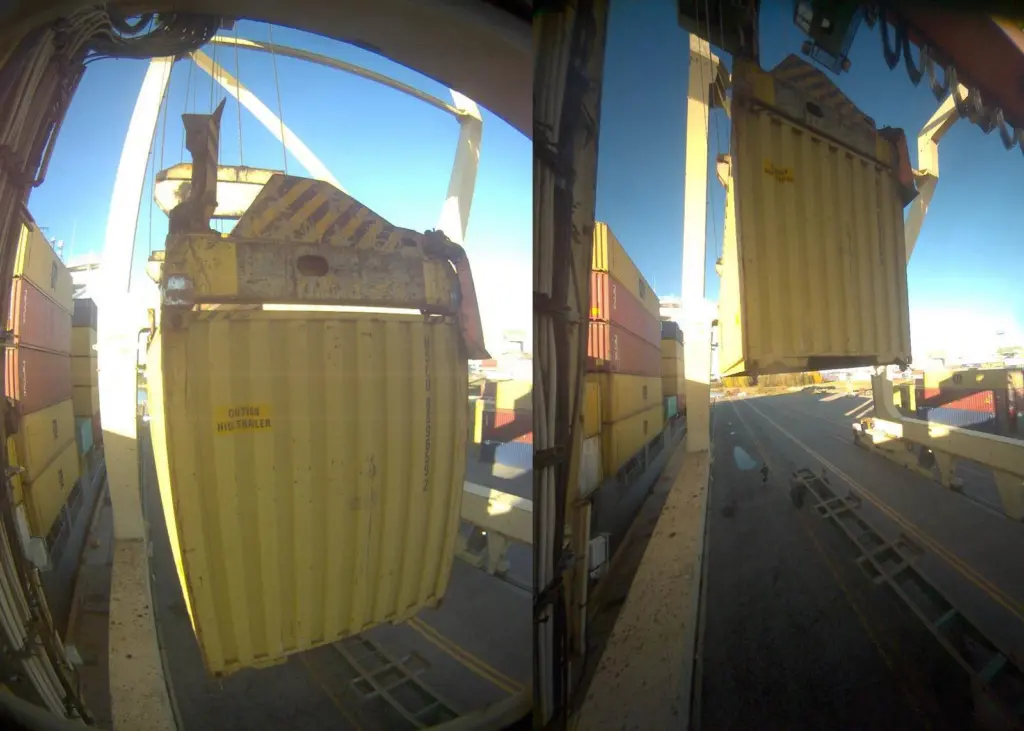
Equipment automation undoubtedly helps to reduce incidents at terminals, but getting everyone to sing from the same hymnsheet can be a challenge.
Chuck Schneider, vice president of Kalmar Automation, explains that Automated Stacking Cranes (ASCs) are really very clever, especially as they have to go beyond relying on the TOS. “Some TOS systems don’t have the ability to detect and prevent collisions. This means ASCs need safety sensors that can detect possible interactions as well as, say, a container blown off a stack. Cranes now are smart enough that one will take priority and tell the other one to stop.”
But there’s a downside to the onboard cleverness. “Everybody is doing their best to differentiate themselves and so concentrating on their own area of efficiency,” says Mr Schneider. “You’ve got ‘optimising’ control technology from one source, ‘optimising’ handling equipment from another manufacturer, and terminal operating system suppliers putting as much intelligence into the TOS as possible, but all this stuff has to work together.”
He adds: “The reality is that different layers of optimisation can clash with each other. One equipment provider had the great idea of enabling its own cranes to carry out block optimisation. However, it transpired that this could undercut the TOS’ ability to replan when the yard gets congested because an individual block cannot take a holistic approach to optimisation across the terminal.”
Fast learner
It seems that the biggest issue is that as all sorts of automated systems get cheaper, they flow down from the big operations to more modest ones, but a terminal that’s trying to upgrade can be faced with a steep learning curve.
Tomas Girdzevicius of Autepra explains: “It’s hard for a medium sized port to have the knowledge base to tie in new equipment, often they only have one or two software guys who are expected to handle everything.”
So systems integration companies like Autepra are good at joining up the dots, even when those dots are a little past their prime.
For example BCT Riga had cranes from the Soviet era, dating back to the 1970s which depended on a tallyman to read the ID number painted on each container, make a visual inspection and record the data on a handheld, along with the tractor’s ID.
Obviously the process was slow, so some kind of automation was on the cards. A brand new port gate system had also just been installed, but like many ports BCT couldn’t just ‘wipe the slate clean’ and take a run at modernising all its technology in one go: it has to undertake its upgrades slowly which left equipment and systems at very different levels of functionality – including an early Navis TOS dating from 1999.
However, as Mr Girdzevicius explains: “One of the challenges was to bring in information on spreader moves, twistlocks, and so on. We put sensors on everything along with a system that photographs the container from all sides and gave BCT a way to integrate this into the TOS, an OCR and damage inspection system along with the new port gate technology.”
Multi-tasking
There are other reasons for the integrator role as ports often need different kinds of technology focused on the same job: the metal of a crane, for example, can disrupt the GPS and so lasers may have to pick up the task.
He adds: “There’s often a continuous investment in software: after all, ports can’t stand still. But they need some kind of continuity so we will often have three of four projects over a five year period with the same customer, helping the terminal move forward in a structured way.”
This need for smaller operations to make the best of automation means “a big opportunity for existing terminals to go with automated RTGs or straddle carriers such as those deployed in Brisbane”, says Mr Schneider. “Whereas greenfield sites may just go with ASCs, you can see that if a brownfield terminal has already invested in 30 or 40 RTG units for example, they might not want to just drop all that investment.”
He explains it’s not just the expense of the new ASC equipment, existing RTG terminals may well find the strength of the concrete underfoot won’t necessarily be appropriate for ASCs deployment: “So, a terminal may well need to rip up everything, dig right down to dirt and start again.”
It helps that RTG automation has been sneaking in already, if only to make up for human frailty: typically RTGs are still manually driven but during the course of the day fatigue sets in and the operator is less productive, So, many RTGs are looking at part automation: using auto-gantry steering, lasers and very accurate GPS integrated with the PLC on the crane the unit can already track itself down the stack, leaving the driver to manage the lifts and truck transfers.
From here it’s not such a big step to full automation either. “We are looking at systems evolving enough to be comparable with ASCs; the scheduling software is smart enough to avoid conflicts and sensors that detect and stop collisions are already a reality,” says Mr Schneider.
While he says that these automated RTGs won’t give a terminal the density of ASC stacks, it still makes it a faster, safer environment and saves on labour. “It is going to be the next best option for a fraction of the cost.”
Known quantity
However, there will be a pull toward the ‘tried and trusted’. Mr Schneider points out: “Terminals look at the other’s decisions very carefully; after all it’s so risky that a big part is going with what system is proven. Euromax and APMT Virginia showed two-crane ASC systems doing a really good job, so Khalifa, London Gateway and Trapac followed, with Trapac adding ASCs to move containers from the stacks to the ship-to-shore cranes.”
So he believes patterns will emerge with the development of integrated systems and says that even now tenders are asking for combined elements: the TOS, for example, being integrated with the equipment’s control system. All this is being driven firstly by the big, global operators who will act as ring masters, putting in tenders that specify certain common points.
He adds: “Although these operators won’t necessarily go with the same manufacturers, standardising elements is a smart thing to do: it means easy maintenance and they can roll out the same technology from port to port.”
Related Articles
 BULK HANDLING
 BULK HANDLING
 BULK HANDLING