![PortStrategy[GreenPort]](https://www.portstrategy.com/wp-content/uploads/2026/09/PortStrategyGreenPort.svg)





A bit on the side
Sidelifters can add flexibility, but opinions vary on their role in the port environment. Felicity Landon reports
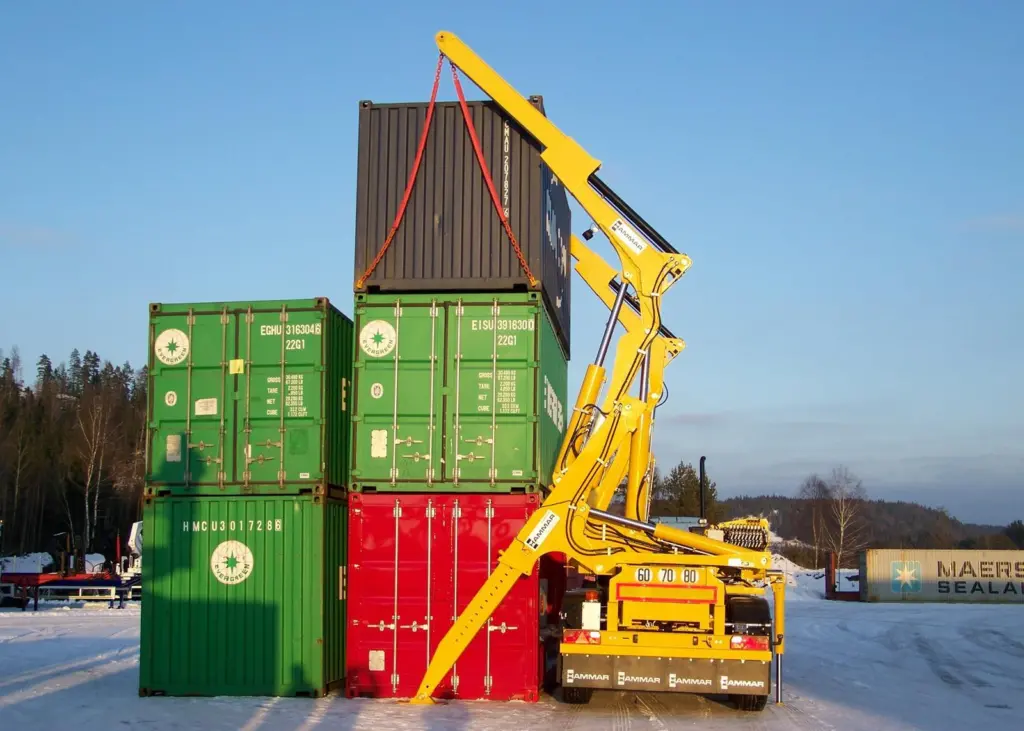
By all accounts, times remain reasonably busy for the manufacturers of sidelifters; they continue to develop new models to meet some very varied requirements, and the general view is that sidelifters are still growing in popularity.
But demand is far from uniform across the globe, with some clear geographical hotspots, and manufacturers have contrasting views on the role of sidelifters in port operations.
“The versatility of this niche product means it can be used at all ports – sidelifter equipment can provide savings and added flexibility in a container depot, intermodal or general port operations,” says Steve James, general manager of global sales at New Zealand’s Steelbro. He adds: “Since containers can be placed anywhere the sidelifter unit can access, the sidelifter unit will operate in any port environment – whether at a small emerging port in the developing world or at other more established ports in more developed economies.”
However, Anders Hallberg, head of sales for Asia, Caribbean, Middle East and Southern Africa at Sweden’s Hammar Maskin, says that in container terminal operations, sidelifters will always be a “marginalised piece of equipment in a port environment, used for special purposes only”.
“When ports buy sideloaders, it is normally to use them for transporting containers between different terminals within each port,” he says. “Ten to 15 years ago, we sold more units to small ports (of which several in the Caribbean and Middle East) that were unable to justify the cost of a straddle carrier or reachstacker, but that does not happen anymore. Which shows, I suppose, that progress and development have moved forward. Sideloaders are not designed specifically for port use – there is an array of dedicated and much better suited equipment for that. It’s the same with container terminals, although there are still many small ones which are perfectly served by our Hammar Lifts.”
Outside moves
Mr Hallberg says a sidelifter can never replace dedicated port equipment, but is useful where containers have to be moved longer distances within or outside the port perimeter. “It is far from always that a 40ft container can be moved by an RTG or broadside first by a reachstacker through a port area.”
Sidelifters are mainly used by freight forwarders and logistics and transport companies which take containers out from the ports to deliver them on the ground, says Emmanuel Fafournoux, sales and marketing manager at Boxloader. Where they are used in port terminals, his experience is that this will be specific places such as the Falkland Islands or some ports in Scandinavia where sidelifters can pick up/drop containers in designated areas without waiting for a reachstacker or straddle carrier to load/unload them.
“However, these situations are really limited, because ports and terminals are organised in such a way that they do not ‘delegate’ movements to the transport companies, although this could increase the terminal’s efficiency. I do not think sidelifters are really needed for a port, since they compete with much more efficient equipment in a terminal area, such as reachstackers.” However, he agrees, a sidelifter is a good step for a growing company before it needs a reachstacker.”
At Steelbro, Steve James says: “Traditional container handling equipment such as reachstackers can prove to be too expensive – to purchase, set up, operate and maintain. In some cases the reachstacker can’t actually ‘do the job’. This is often the case when the ground is not concreted or not stable enough to accommodate the very heavy reachstacker. A large expanse of reinforced concrete is required to support the ground loading, which is a major consideration. The Steelbro sidelifter, however, is capable of operating directly on uneven ground which hasn’t been concreted.”
Steelbro says sidelifters have ‘changed the way containers are being handled in the port environment’, with the potential to provide savings, efficiencies and added flexibility to terminal operations.
“Shipping containers can be rapidly transferred from one terminal to another, using a truck and sidelifter. The truck is quicker than traditional container handling equipment such as reachstackers and forklifts, and is compulsory if the road between terminals is a public road. When the port is congested, the sidelifter can be used to manage the dry port outside the port, loading and unloading skeletal trailers.”
In reserve
And the sidelifter is sometimes used for back-up. “The sidelifter can be used to transfer from the main port to a loading backup storage facility or dry port – for example, in Argentina and Angola,” he says. “Containers can be very quickly removed from the wharf and delivered to the holding area outside, dramatically reducing congestion.”
Sidelifters are growing in popularity as they spread to more markets, says Anders Hallberg at Hammar Maskin. Among recent orders, the company has delivered sidelifters to customers in Norway, Malaysia and Australia.
At Boxloader, Mr Fafournoux says sidelifters continue to develop but remain limited to their traditional areas – islands, Scandinavia and Australia. “The current economic situation is, of course, having an impact on the sector but activity remains good. In a crisis context, using a sidelifter could be seen as an opportunity to offer another type of service compared to the competition. Some companies have this approach and are doing well; but still, this is limited.
“Boxloader is quite busy, due to the launch of two new products – Speedloader and Multiloader – that have opened new markets for us,” he says. Among significant new orders, Boxloader has delivered to Chalmers in Australia, Bollore in Africa and Samskip in Iceland.
Steelbro reports slower activity in Europe because of the economic situation but says the slack has been ‘more than taken up’ by the growing markets of Australia, Asia, Africa, South America and the Pacific Islands.
Truck tools
Steve James says in some markets Steelbro sidelifters are used extensively to distribute containers to and from key container ports, with inbound containers being picked up from specifically designated sidelifter loading areas of the ports.
“The operation is fast and efficient, as the port’s straddle carriers are not tied up loading trucks as they arrive. Containers can be placed quickly in the loading area and left for sidelifter units to pick up when available. A dedicated sidelifter lane at the main gates ensures that trucks have a fast and easy exit from the port, while skeletal only units must wait for a straddle carrier to become available to load their particular container. With the sidelifter lane in place, operators can save up to two hours during busy periods at the port.”
In medium or large-sized ports, the sidelifter is unlikely to replace completely the reachstacker or straddle carriers, says Mr James. “However, there is still a place for the sidelifter to be successfully used to supplement that equipment and help with other jobs in the port area. Smaller ports, especially on some of the smaller islands, find that a sidelifter can handle the containers without the use of other equipment.”
Related Articles
 CONTAINER & CARGO HANDLING
 CONTAINER & CARGO HANDLING
 BULK HANDLING