![PortStrategy[GreenPort]](https://www.portstrategy.com/wp-content/uploads/2026/09/PortStrategyGreenPort.svg)





All lit up
Plasma and LED are still the dominant themes in lighting, finds Martin Rushmere
While lasers are beginning to pique the interest of manufacturers and suppliers, they are still at the experimental stage, leaving plasma is the driving force in the industry. In combination with LED, these light sources will rule the world of illumination for some years to come; like the second generation of computers they have ushered in a different world that has yet to be fully explored.
With ports and terminal operators sticking with safety and the environment as their guiding forces, research into new forms of lighting has hit a plateau where radical new materials and methods are currently not being considered.
The consensus among manufacturers and ports contacted by Port Strategy is that there is still considerable scope for improving the technology, efficiency and benefits from both light emitting plasma (LEP) and LED.
Adding fuel to the debate is the unresolved question of which is most suitable in different circumstances, with some saying plasma will soon become the better choice generally.
“At the moment, terminal operators are more aware of LED,” says John Chalmers, marketing director for Bright Light Systems. “Even though plasma has been around as long as LED, it is still seen as relatively new. Plasma’s properties are that it is compact and distributes the light over a large area – while LED’s advantage continues to be that it is directional, so is good for equipment like cranes, while plasma is being used in high mast applications.”
Gaining traction
Ryan Hertel, director of the port division of Phoenix Lighting, notes that LED technology is being used in 80 percent of new installations in automated yard equipment. “The adoption rate of LED on new equipment is increasing quickly,” he says “although retrofitting with LED is slower. We have fitted more than 300 yard cranes with LED over the last two to three years.” However, the adoption rate for ship-to-shore cranes is slower and less than 20% of STS cranes are using LED.” Phoenix’s first installation on a container crane was in February, 2012.
Rapid improvement in the technology is outstripping tender/contract specifications, even those laid down by governments and local authorities. “Customers are realising that their requirements are in some cases out of alignment with technology,” says Mr Hertel. “As an example, one requirement might be that each light on an STS crane has to be 300 lux. They are surprised at just how bright a 300 lux LED is and don’t actually need them that bright.”
Mr Chalmers says that mandatory requirements need to become more specific. “In the US they are based on OSHA (Occupational Safety and Health Agency), which stipulates 5 foot-candles for a working area. That is pretty vague.”
“Safety, productivity and the environment are the three areas that ports focus on,” says Mr Hertel. “And these are where the LED/plasma improvements in lighting score. Better vision: yard workers can see better what they are doing and reduce risks, the color spectrum is better and objects can be seen more clearly; productivity: containers can move quicker in and out of the yard; and environment: light and carbon pollution are reduced.”
Downsides
Not that the new technology is an unmitigated blessing. The Lighting Research Centre in the US warns that plasma can emit both radiated and conducted electromagnetic interference, as well as UV light. “Manufacturers should use UV-absorbing glass to shield people and objects from radiated UV,” the centre says, noting that while there are some Federal Communications Commission rules on shields against electromagnetic radiation, there are none for devices less than 3 m from radiation sources.
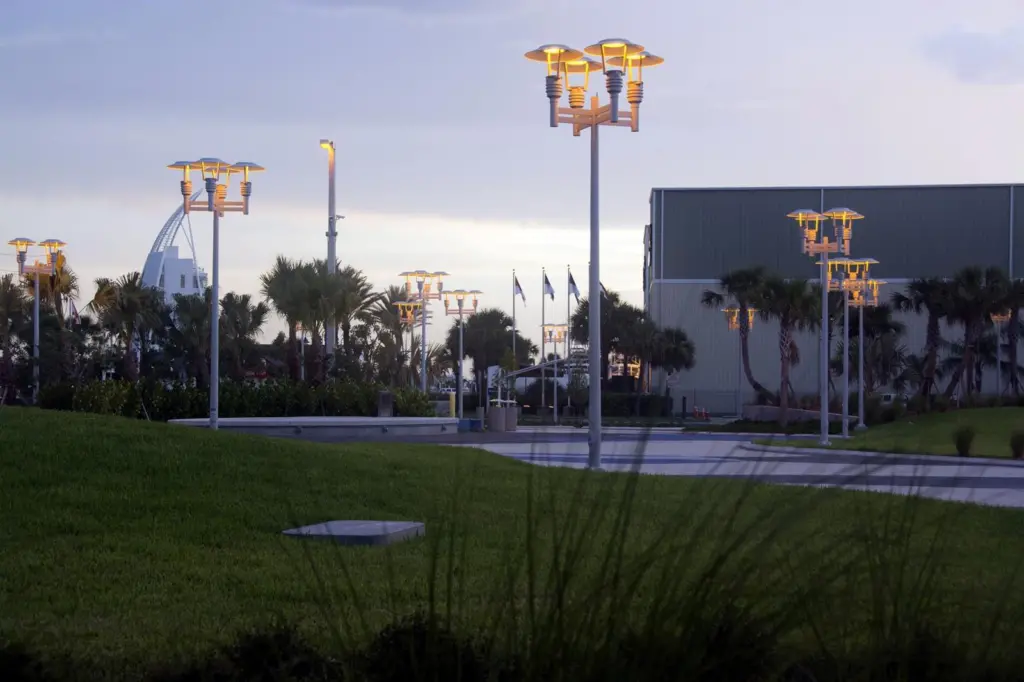
Sea life can also be affected. A study by the Royal Society in the UK found that more efficient and brighter lighting is “attracting sea creatures that damage ships and boats”. Port Canaveral in Florida has taken this on board and has installed custom-made LED units from Luminis with cutoff fixture heads to minimise the disruption of sea turtle hatching.
But no matter what type of fitting is used, cost, energy and environmental improvements are undeniable. The general industry average for lifetime durability is 50,000 hours (going up to 80,000 hours).
“But users must make sure that they pin suppliers down on exact details of what they are getting,” say Mr Chalmers and Mr Hertel. “Does the lifetime guarantee apply to all components or to the luminaires only or to just a couple of the components,” asks Mr Chalmers.
Take control
Programmable systems are now commonplace, so that yards can be instantly controlled. This is one area that suppliers say can be improved, leading to even greater savings and efficiency.
Luxim has installed its Resilient brand at APM Terminals Mumbai, resulting in 65% energy savings. Musco has installed its Green Generation Lighting for the Garden City Terminal in Savannah, Georgia, also reducing energy consumption by 65% and cutting annual carbon dioxide by 3,500 tonnes.
Los Angeles is taking a particularly forceful approach. Container terminals account for 35% of total electricity usage, with outdoor lighting using up half of that. The port’s energy plan foresees the replacement of 500 high mast lighting poles, which have 6,000 light fixtures (12 per pole) at container terminals, with LEDs. Capital cost is $20m and the return on investment is forecast to be seven to eight years. The lifespan of the LEDs is put at 25 years.
Luskin Centre for Innovation at UCLA says electricity usage at LA and neighbour Long Beach could double to almost 100 mw in 2020 and cost $100m.
Los Angeles port spokesman Phillip Sanfield says: “The Port pays for the initial infrastructure/build out of the lighting; the terminal operators pay the electricity costs associated with operations. The initial cost of building new lighting fixtures on a container terminal is expensive. It can cost about $150,000 to $175,000 per brand new pole today. That includes wiring, power source, controls, digging 35 feet below ground for poles that are 100 feet above the ground. These poles can have up to 18 lights attached to them. They’re built to withstand high winds and earthquakes.
“Container terminals can have anywhere from 50 to 125 poles. Our largest terminal, APMT (Pier 400) has about 125 poles. They’re spaced about 450 feet apart,” he adds.
“While most of the POLA complex is built out with existing structures, the Port did install 14 new poles in fiscal year 2014-15 as part of the TraPac project. The cost was approximately $2.6m. With most structures in the complex already in place, we can retrofit standard high pressure sodium lights (HPS) and convert to LED lights. Cost of retrofitting is about $20,000-$25,000 per pole.”
Filtering out
Says Mr Hertel:”The next 5-10 years will see further and faster adoption of LED/plasma savings. In the early days there were a lot of promises by suppliers/manufacturers who had still to develop the experience of what the systems could do. Now there is more sifting and filtering in the industry and at ports and more intelligent use of programming and controls to allow remote operation.
“Industry is still coming to terms with the technology. Now everyone is realising that you can have extremely detailed command and control.”
French consultancy Yole Développement says the future also holds promise for a number of new technologies, such as ‘flip-chip’, ‘chip-scale’ package, LED filament lamp and flexible LED strips. These are some years away for ports, but one advance that ports are already taking seriously is ‘li-fi’ (light fidelity), which uses light to transmit electronic signals as an alternative to wi-fi. This can be incorporated into lighting systems and boosts wireless signals at far faster rates than wi-fi.
Related Articles
 CONTAINER & CARGO HANDLING
 CONTAINER & CARGO HANDLING
 BULK HANDLING