![PortStrategy[GreenPort]](https://www.portstrategy.com/wp-content/uploads/2026/09/PortStrategyGreenPort.svg)





Buffer against competitive failure
With bigger vessels in the offing for the main East-West trades, and the “cascade effect” showering incumbent vessels down to some of the feeder routes, what are the implications in terms of fendering requirements?
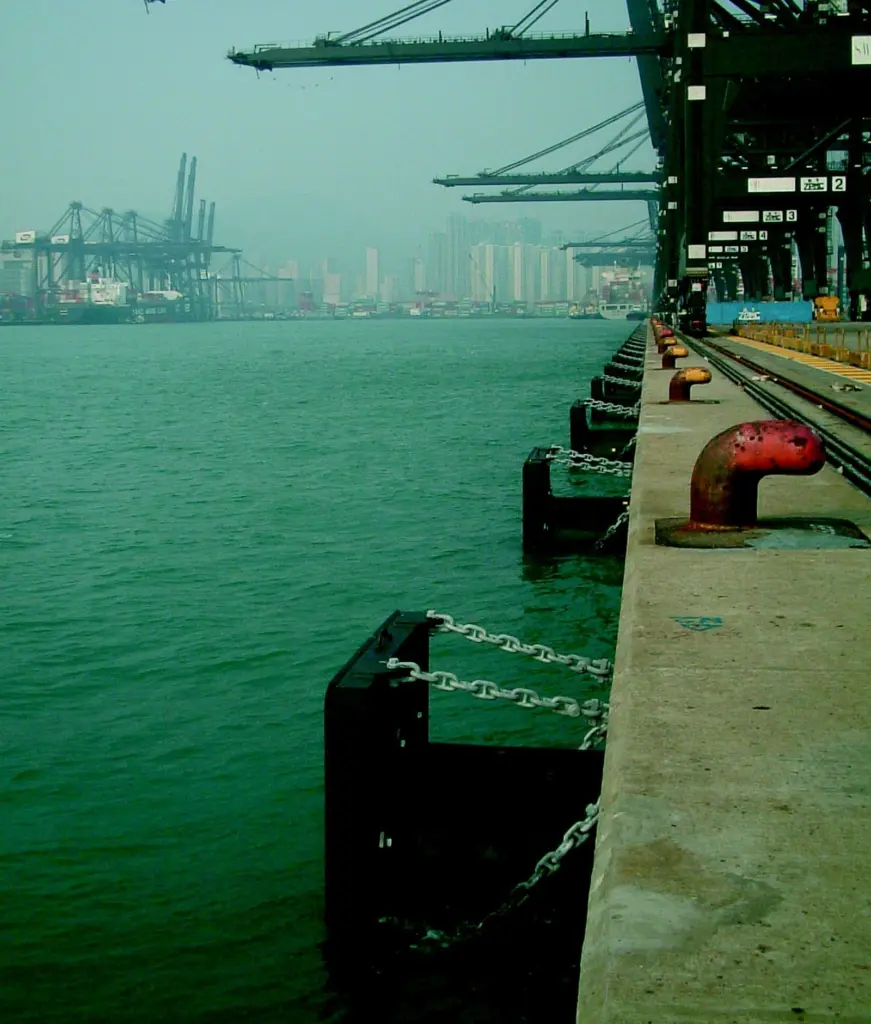
The race is on amongst Asian ports to capture the massive newbuilds coming onstream over the next few years. If not in the first ranking, then ports aspire at least to be wellpositioned to handle those vessels which will be dislodged from the East-West routes and end up in regional and feeder trades.
“Certainly the competition amongst ports to maintain hub port status is strong, and the competitive advantage may go to the operators who can berth super post-Panamax vessels, ” says Fentek’s Singapore-based Chris Millwood. He says that in a changing competitive environment, port planning for fendering upgrades must go hand-in-hand with planning for trade growth.
“Many Asian ports are operating on berths developed over the last 15 years and have fender systems adequate for the current size of vessels. A small number of operators are planning further ahead, building structures strong enough to allow future fender and crane upgrades, while operating with interim-sized marine fenders.
“Other operators are catering for the larger vessels in future port extensions. So for the majority of operators, they have planned well ahead for when and where to upgrade fender systems.”
Energy Absorption Capacity
But what of those that have not? “There is at least one port where the failure rate of marine fender systems is continually high on berths that have been operating for five years or less. Sometimes it is difficult to gauge whether such problems arise from the energy absorption capacity requirement being underestimated, or the design or capacity of the fender itself being substandard.
“Maintenance also plays a part in fender systems, with the higher water temperatures and corresponding higher corrosion rates in Asia, and in many ports poor maintenance programmes may mean the life of fender systems being drastically reduced. This may provide an opportunity for the operator to upgrade the fender system entirely, ” he says.
Asked about the implications for ports in the current climate of larger vessel designs, Millwood says this has to be put in the context of what a fender system is designed to do. “The function of a fender system is to provide adequate energy absorption capacity for the range of vessels using the berth. For example, currently a berth catering for vessels up to 8,000TEUs may have existing fender systems capable of absorbing up to 1,000 kN. m berthing energy.
“With vessels on major shipping routes now expected to surpass 12,000TEUs, the required energy absorption capacity may exceed 1,500 kN. m. Any port operator wishing to berth such a vessel will need to improve its fender systems accordingly.
“Specific information on design features of the super postPanamax vessels is currently vague, and critical features such as bow flare, bulbous bow and bow radius, which are important in reducing a vessel’s drag and improving ultimate capacity, may also have a large impact on fender design.”
Such information flow is important to ports in the Asian region where continued rapid growth in containerised cargo has led to the development and expansion of many ports. Major operators such as HPH, APM Terminals, P&O, PSA, DPW, etc. , have built a strong regional presence and are currently preparing their facilities for the larger-sized vessels.
Cascade Effect
Regional ports too are eyeing the cascade effect and the probability that larger vessels will filter down and replace others in the feeder trades. Millwood says while this is likely to impact ports in terms of how well equipped they are with fendering, that impact will not be immediate.
“While there may be some follow-on effect for feeder ports, this will take more time to be realised, mainly because growth in containerised cargo in Asia is still expected to remain strong. While planning of berths and building of super post-Panamax vessels is currently underway, additional cargo volumes generated by these vessels may merely keep up with projected growth.”
Millwood feels ports are pretty diligent when reconsidering their fendering requirements when larger vessels start calling. “Generally, ports ensure the primary concerns are investigated, meaning available draught, crane outreach and fender system capacity. Each of these may have an impact on the wharf structure.
“The fender system, however plays a very important role as the cost and construction time for upgrading an existing facility can be substantially reduced if a fender system can be designed to meet the energy absorption capacity requirements while not exceeding the allowable reaction force of the structure.”
Millwood cautions that ports still need to keep a close watch on their future needs in a time of competitive pressures. “Certainly there is adequate focus on the energy absorption capacity of fender systems now, however the ever-competitive nature of port construction is leading to the supply of unproven products and substandard accessories.
“Fender systems need to be viewed in their entirety, and further focus must be placed on specifications. These must adequately spell out the design and performance requirements of the fender panels in particular, along with chain systems, fixings and other accessories.”
Related Articles
 CONTAINER & CARGO HANDLING
 CONTAINER & CARGO HANDLING
 BULK HANDLING