![PortStrategy[GreenPort]](https://www.portstrategy.com/wp-content/uploads/2026/09/PortStrategyGreenPort.svg)






Bulked up boxes
Developments in containerised bulk handling offer benefits for ports. John Bensalhia reports
Progress. A flexible word, and one that can vary, depending on your point of view. A music album download may be instant, convenient – but where’s the album sleeve to look at? Likewise, an eBook can be bought without the need for going to the shops – but where’s that unique smell of a printed book? And let’s not forget the latest phone or computer upgrade – in theory, it’ll provide easy, speedy use. In practice, will probably slow things to a crawl.
But in some cases, progress can have its benefits. Take the notion of modern containerised bulk handling, which has been used to great effect in regions such as South America, Africa and Australia. Modern methods have yielded a number of benefits for ports in many spheres, such as cost, volume and ease of use.
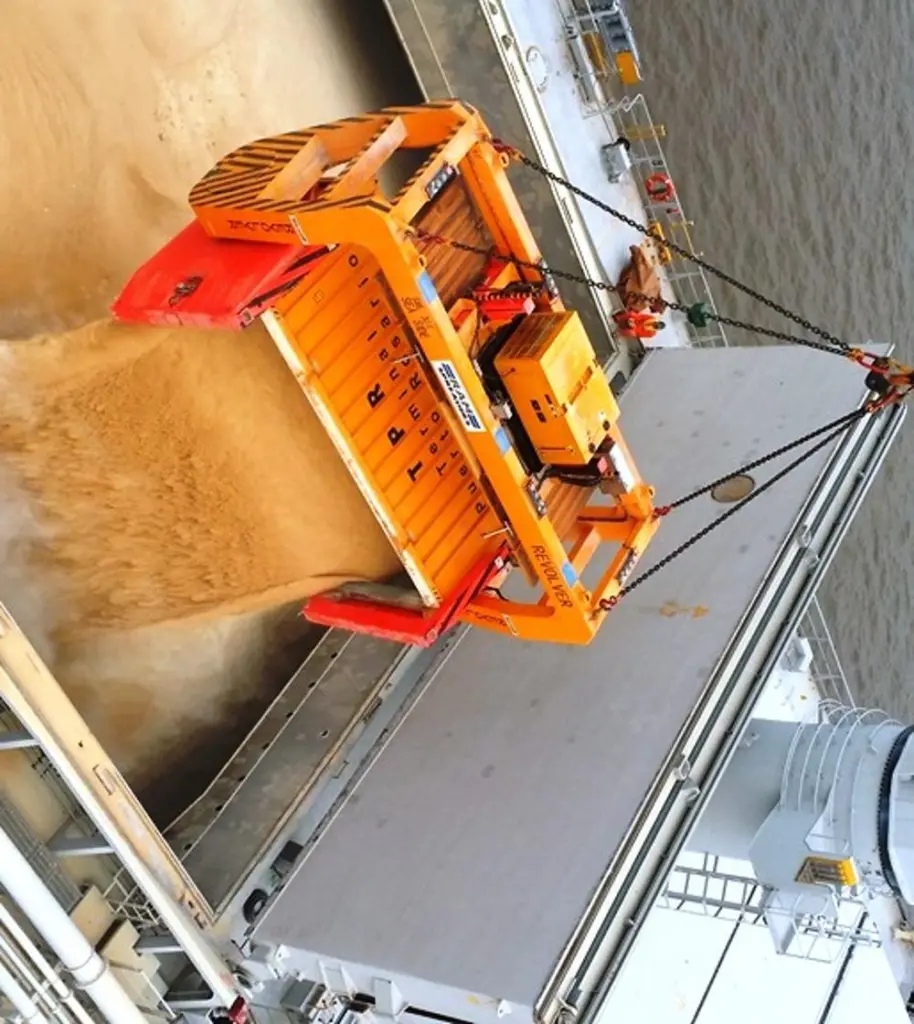
Transnet Port Terminals’ Port Elizabeth Container Terminal has been using the process of containerised bulk handling, also known as Skiptainer. The port is known for exporting manganese, and thanks to the modern containerised process, productivity has been considerably boosted from its original target of 15 skips per hour to between 21 and 24 skips an hour.
Joel G. Shirriff, Ausenco’s vice president and global practice lead, Terminals & Transportation, says that there are three key benefits to modern containerised bulk systems. “The biggest single operational benefit to implementing a containerised bulk handling system is the flexibility that it provides to the commodity producer in getting cargo to market.
“Unlike traditional bulk facilities that are built around specific cargoes, the containerised logistics can be moved between any available general cargo dock facility, and containers handled by either shore cranes or ship’s gear. This flexibility allows the producer to not only find the best deal from local stevedoring companies, it provides an option to continue operating even if the primary facility is damaged or blocked by labour disruption.”
Maintaining integrity
Mr Shirriff says that the next major benefit is maintaining product integrity. “In a conventional system, expensive cargo like metal concentrates is often re-handled by mobile equipment at the port or up-stream transfer stations, where it is subject to contamination, co-mingling with other products, and general product loss. With containers, it is sealed at the mine, and in most cases does not need to be opened again until it is put onto the ship.”
Environmental benefits round out the top three. As Mr Shirriff explains, conventional bulk movement, whether by truck or by train, will not always protect the cargo from being blown or spilled to the environment. “Open back trucks are used heavily around the world, and typically only have a rolling tarp on top of the box to protect the cargo from blowing off the top. If one of these trucks goes off the road, it will inevitably spill cargo onto the roadside. In a containerised system, the cargo is sealed, and even if it is being moved by a truck that goes off the road, it would take a very serious crash to cause the container to spill.”
In terms of financial benefits, Mr Shirriff explains that the greatest of these is seen by new producers in the saving in capital investment from not having to build a new bulk facility. “This is particularly true for smaller isolated mine developments that could not justify the cost of a full bulk terminal on its own. The container option will allow the producer to utilise existing general cargo facilities, or at least minimise investment by only having to build a general cargo facility that can be used by others.”
In addition, while it is not consistent across all geographies, the movement of containers by truck and rail is generally less expensive (as a contract operation) than bulk, as the equipment is generally more available and less expensive.
Cup of cocoa
The Port of Amsterdam, the world’s largest import cocoa port, has seen an increase in the use of containers. “As such, we receive bulk vessels carrying cocoa in bulk and we receive cocoa in containers via barge or deep-sea,” says Anthony van der Hoest, cluster manager logistics at the Port of Amsterdam. “The cocoa is shipped in containers in bags of 65kg (the original cocoa bags), big bags or bulk whereas the cocoa shipped by bulk vessels usually is shipped in bulk.
“In the last decades, we have seen a big shift from using bulk vessels to using containers. Obviously container shipping has become more competitive (both price and sailing time) and equipment has been developed to allow for (semi-automatic) discharge of bags from containers. The loading of cocoa, mainly originating from West Africa, is often still manual labour. The shift from bulk to containers has resulted in a reduction of bulk ships calling Amsterdam and an increased need to invest in new equipment for discharging containers and container handling equipment.
“We as a port do not handle or discharge the containers ourselves. For cocoa trade, this work is done by cocoa warehousing companies known as ‘cacao vemen’ in the Netherlands. Apart from the use of containers in seagoing trade, we also see the use of specialised containers for intermodal transport.”
Containers have also been used to transport waste from the UK to the Port of Amsterdam by SCS Multiport. “By developing specialised containers, SCS Multiport was able to enter into this typical bulk segment,” says Mr van der Hoest. “Waste is carried via short sea from the UK to the Netherlands and is burnt by several electricity plants in the region of the Port of Amsterdam creating energy and heat for the region.”
But as Mr Shirriff points out though, traditional bulk methods will still be needed in certain cases: “While containerised bulk systems offer a flexible option for smaller volume bulk producers to move their cargo, conventional bulk terminals will always be necessary. Higher volume and lower value cargoes like coal and iron ore are not practical to be shipped in containers as the traditional bulk methods for this are far more efficient.”
“Common user facilities that can absorb the economy of scale and move the cargo for multiple producers will grow in popularity. These will likely continue to use conventional bulk technology for loading ships, but receiving cargo by container will need to be incorporated.”
Offering a number of operational benefits, modern containerised bulk handling looks set to have a positive future. Mr van der Hoest concludes: “With ever decreasing container freight rates and the necessity to balance trade, shipping cargoes in bulk containers may become a more viable option for other bulk commodities as well.”
A HOLISTIC LOGISTICS SOLUTION
The Las Bambas Logistics project is an example of how the modern containerised bulk handling system has provided many benefits.
The aim of the project was to devise and implement a complete logistics system for containerised bulk handling of 1.5m tonnes/year of copper concentrate from the mine site to a third party export facility. The system design spans the mine load-out to Peru’s Matarani Port, for a project which is near Cusco at 4,300 m above sea level. In accordance with the client’s requirements, the system was totally integrated and features a a 420 km truck haul, a transfer station, and a 310 km rail haul to the port.
The key to the new system is versatility. What it allows for is efficient, fast container handling. Brought in either by rail or truck, the containers are then stockpiled in extant sheds with the aid of mobile equipment. Not only did this versatile system allow for early export shipping prior to the completion of the new berth facilities, it also meant that containers could be stored on-site for direct unloading into the hold of the ship.
Ausenco’s customised logistics solution provides a wealth of benefits for the Las Bambas project. Lower cost is a notable boon – in this case, capital and operating costs are reduced for the truck fleet as well as rail operating costs in comparison to conventional bulk. The solution also meant getting rid of the bulk transfer at Pillones which would have brought its own costs and concerns.
The risk factor is also lowered thanks to the new system: both for trucking (on the haul road and through local communities) and just as importantly, for the environment. Any risk of spillage and loss incurred during handling, transfer and transportation has been notably cut.
Related Articles
 CONTAINER & CARGO HANDLING
 CONTAINER & CARGO HANDLING
 BULK HANDLING