![PortStrategy[GreenPort]](https://www.portstrategy.com/wp-content/uploads/2026/09/PortStrategyGreenPort.svg)






Captive to Casablanca
Moroccos original super-port risks being overshadowed by national neighbours, as Stevie Knight explains
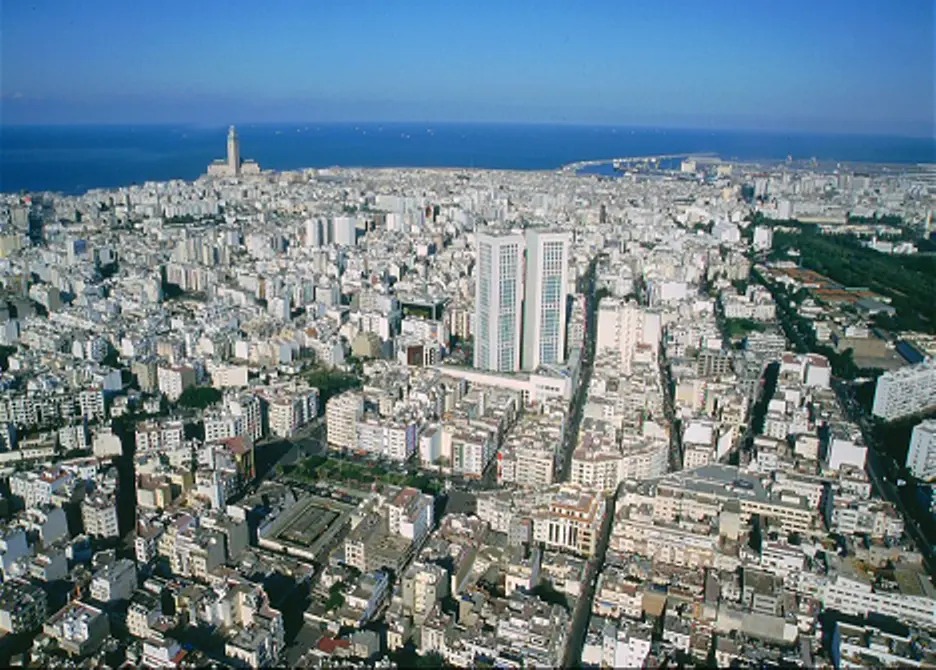
Casablanca has grown up with the tension of a sprawling city. But there’s another tension, created by the vision of TangerMed not far down the Moroccan coast – although as they say, the relationship ‘is complicated’.
At present, Casablanca is mainly served by ro-ro and feeder-sized ships which traverse the short routes between North Africa and Europe.
Outpaced by the larger TangerMed port which started operating just a few years ago, it is now more obviously struggling with its efficiency. However, to put it into perspective, almost a third of the whole of Morocco’s production units and well over half of all its industrial labour is located in and around the port – which means it is a magnet for the impoverished labourers in the rest of the country.
So, despite everything it can’t be considered a small operation. There is the sheer scale of Casablanca’s immediate hinterland and the large, semi-captive population behind it to consider: the port actually handles well over one third of the total national traffic.
In order to avoid meltdown caused by many clashing agendas – not least fisheries and tourism – the Agence Nationale de Port (ANP) has recently been trying to sort out the tangle which involves carving up both responsibilities and space, and providing areas for new development.
One of the most recently completed projects has been the car terminal; developed in conjunction with Spain’s Autoterminal SA it has a capacity for storing 5,000 to 6,000 vehicles in a three-storey building.
Although the handling of the larger size of containerships remains limited, there’s a wide range of activities, including general cargo, ro-ro and bulk handling in the port, and the box side still sees a respectable throughput. The first terminal, managed by national operator Marsa Maroc, has a capacity of 700,000 teu. The second concession was won by Somaport, (a CMA-CGM initiative) and started work in 2009 with a capacity of 300,000 teu.
Construction work on the new $215m third container terminal at Casablanca began in mid-October 2008. However, it’s not finished, and bureaucracy means it’s a slow process.
Further, the authority has not yet nailed its colours to the mast on expected capacity, although some of the mystery should be lifted as an industry source says that (at time of writing) the tender papers are about to be released. However, the ANP has indicated that it’s looking at “medium-sized ships”, which seems sensible given that, although its proud of the fact it can handle 35 ships at a time, these are really very small craft considering the upscaling prevalent in the industry.
There’s another pressure that’s been on and off for some time: the haunting possibility of a new container terminal at the oil port of Mohammedia just 23km away. Oddly enough, this means that Casablanca is perversely linked to the fortunes of TangerMed, as there’s indications that the success of TangerMed in attracting traffic will impact on the viability of the Mohammedia Container Terminal. The reasoning is, if traffic stays with middling volumes but a large slice of this is mopped up by TangerMed (the tipping point is around a third), the project at Mohammedia isn’t really worth it.
However, the impact of having both TangerMed and the possibility of Mohammedia on the doorstep may also have lit the charged subject of port reforms, which started with the splitting of the overall body into Marsa Maroc (SODEP) and the ANP several years ago, creating a port operator and a distinct, regulatory body.
Despite this, there is now a ‘slowly-slowly’ approach in place: in 2006 workers were irate that the reforms still only allowed two companies into concessions. Strikes followed labour disputes and so when Somaport took over the second terminal in 2009, a trade-off meant the new facility had to take on a number of workers over and above those actually required.
Other initiatives are still moving ahead. As part of the expansion there’s a new access road to the port, and new projects include a group of logistic zones, the first being in Zenata, north of Casablanca, with a link through to the port. Further, there are road and rail connection projects, with the blue skies aim of not just linking up Morocco’s larger cities, but also bringing Algiers, Tunis and Tripoli that much closer.
Related Articles
 CONTAINER & CARGO HANDLING
 CONTAINER & CARGO HANDLING
 BULK HANDLING