![PortStrategy[GreenPort]](https://www.portstrategy.com/wp-content/uploads/2026/09/PortStrategyGreenPort.svg)





Careful costing key to effective dust control
Controlling and managing dust emissions can best be accomplished if a few simple guidelines are adhered to; and plant used to control emissions is selected with life cycle costs in mind, writes David Foxwell.
The acquisition of bulk facilities such as bulk ore terminals as ‘brownfield’ developments is often accompanied by a legacy of pollution control issues relating to dust emissions and dust nuisance. As Dr Owen Harrop of environmental management consultants BMT Cordah in the UK and David Wignall BMT Asia Pacific Pte explain, the problem arises because brownfield bulk ore terminals operating within established ports are often situated close to urban environments as their growth has historically been linked to the towns and communities around them.
Such close proximity of local communities to terminals raises concerns about the effects of airborne dust, the result being that port operators’ ability to comply with air quality standards or guidelines comes under increasing public scrutiny.
One common approach to pollution control is to upgrade the ore handling plant at brownfield terminals, replacing or upgrading plant and machinery used for unloading, stacking out and loading out bulk ore, in the hope that this alone will manage the risk of dust nuisance.
However, as Harrop and Wignall point out, upgrading any ore plant is a significant capital investment and the plant procured will have sophisticated mechanical, electrical and control systems that have to be capable of operating in a harsh environment, and of being operated close to design limits.
The challenge, therefore, is to achieve a balance between capital expenditure, operational performance, maintenance requirements and operational costs, and a mismatch between the design specification for a piece of equipment and the equipment’s actual operating profile – for example seeking to regularly reach 120% of design throughput rates or achieve utilisation levels of 95% against a designed 80% – will inevitably increase the failure rate of the equipment, and could exacerbate problems with dust whilst reducing profitability.
LONG-TERM IMPLICATIONS “The reduced availability of the equipment for preventive maintenance will also lead to an inevitable increase in the failure rate, ” Harrop explains. “All these pressures will lead to a reduced effective life for the equipment and increases in dust emissions, so the selection of such plant has long term implications for a terminal.”
In Harrop’s view, any equipment selected by a terminal should have an effective life of 20 years or so, so it is vital that the procurement process takes account of the long term effects of any decision. “The best way for a port manager to balance capital cost, maintenance and operating cost and operational performance is through ‘life cycle costing, ‘” says Harrop, this being a decision-making process that is based on the projected costs of supporting the plant throughout the life of that plant.
Within the life cycle costing process decisions have to be based on a detailed consideration of the business requirements for the plant as well as its the cost and detailed technical aspects. The aim is to ensure that the plant meets the handling requirements of the terminal within set cost parameters. In this context it is important to note that the selection of plant that achieves high utilisation by being flexible – and often requires high maintenance – generally achieves a better return on the investment than specialist high capacity but dedicated plant that is often under utilized, ” Harrop notes.
On completion of a detailed feasibility study, a detailed performance specification should be prepared, and it is important that the specification sets out the throughput requirement of the proposed upgrade and how the upgrade is intended to be achieved.
“Appropriate performance specification clauses have to be developed for all aspects of the required equipment including peak and mean throughput rates to be achieved by the equipment; maximum downtime requirements and time between failure requirements; and dust suppression requirements based on the dusting levels that must be maintained in and around the equipment, ” Harrop concludes.
MAKE IT MODULAR, SAYS MANUFACTURER Turning to individual items of equipment such as loading chutes, manufacturers such as Cimbria Moduflex, who supply dust free loading chutes to ports, cite their advantages, sections or components of which can be quickly and easily replaced in the event of accidental damage or for reasons of wear. With this approach, besides savings in direct costs, there is an obvious secondary cost benefit in the form of reduced plant downtime.
As the company explains, customisation using standardised units provides other benefits too. Systems can be produced extremely quickly, and even if certain components have to be specially engineered, lead-time is reduced, and standardisation means replacements are always readily available for worn or damaged parts.
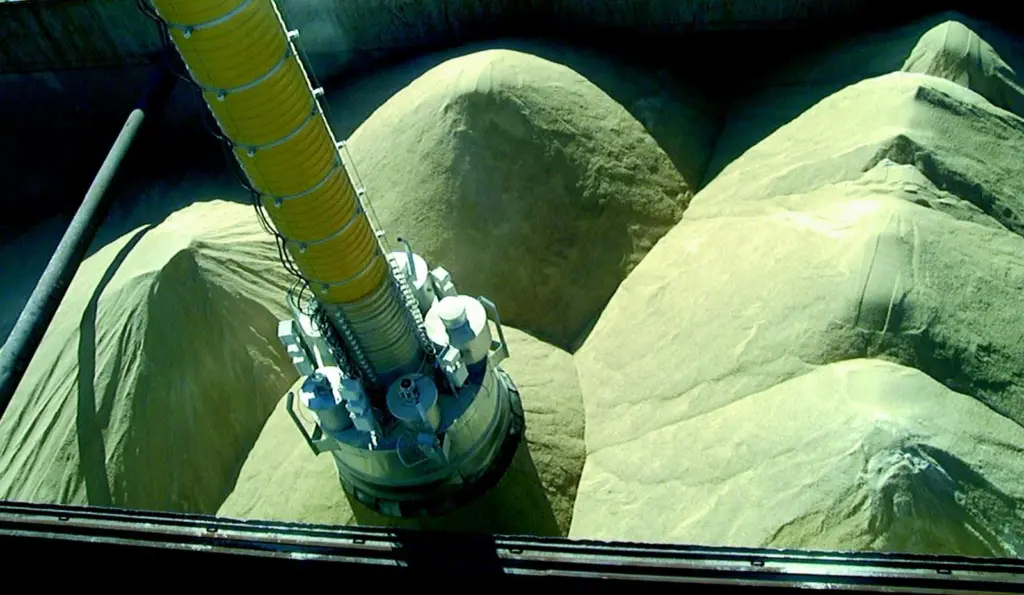
Cimbria Moduflex has delivered several ship loading chutes for ports recently, often as an integral part of a complete bulk handling system. The range of chutes it offers comprises V types, which are for connecting to an external filter bag system and VF types.
Unlike the method of dust elimination common to the V type loading chute – where dust is internally exhausted – the VF unit has a unique dust removal and filtration module integrated into the head of the delivery outlet. By removing the need for a remote filter bag station, claims Cimbria Moduflex, it can produce a capital saving of as much as 30-40% compared to conventional chutes of this order of size.
In the VF design, the delivery outlet is housed within an outer cylindrical dust guard structure equipped with a flexible skirt. Dust particles are sucked upwards through the annular space between the delivery outlet and the outer skirted structure and into the filtration modules.
The number of filtration modules is determined by the system’s throughput capacity. Each module is fully self-contained, with its own filter, compressor, pressure tank, ventilator and magnetic return valve units. A reverse jet air system returns all filtered dust into the material stream as is falls past the upper section of the delivery outlet. The maximum possible vertical length of a VF installation is 25 metres, and in addition to the above mentioned features, all of the systems can be supplied in accordance with the European ATEX-directive or the American Class II group G directive for explosion prevention approval.
Preventative Measures
BMT recommends the following preventative measures to control dust emissions:
Work being carried out in such a manner that avoidable dust is not generated.
Use of screens or other methods to prevent generation of dust.
The use of dust sheets and/or tarpaulins for off-site material handling activities.
Spraying or covering of materials from which dust may be generated when being transported to or from the site.
Watering or wetting by agent sprays material which has the potential to create dust prior to being loaded into or unloaded from vehicles.
Fitting of side and tailboards to any vehicle with an open load carrying area used for moving materials. Materials having the potential to create dust should not be loaded to a level higher than the side and tail boards.
Regular removal of dust on hard surfaced routes and road edges within the site.
Water spraying or total enclosure of stored materials.
Design and control of plant equipment and site vehicles to minimize dust release.
Effective tyre and wheel cleaning equipment to be installed and adequately maintained at all times.
On-site speed restrictions for site traffic.
Staff training.
Related Articles
 CONTAINER & CARGO HANDLING
 CONTAINER & CARGO HANDLING
 BULK HANDLING