![PortStrategy[GreenPort]](https://www.portstrategy.com/wp-content/uploads/2026/09/PortStrategyGreenPort.svg)






Cement handling
Vacuum or mechanical? It is an issue that the industry is beginning tobe familiar with – but which kind of unloader do you go with when thematerial in question is as low-cost, but potentially difficult, ascement? Stevie Knight investigates
While grabs have now been deemed unsuitable by most major harbours for cement handling, (although still used in places where environmental legislation has yet to catch up) the problem remains that a larger proportion of the price come down to handling – making it that much more of a central issue.
So, time and energy play a major part. As equipment manufacturer Ibau Hamburg explains, there is a vastly lower energy consumption for screw unloaders when compared with vacuum action ones – since the energy output needed comes to only about 35% of that of a vacuum system (0.4 to 0.5 kWh per tonne of cement), says the company.
But the issues don’t end at energy costs – especially since cement is, by all accounts, a pain to handle, and exposure to the dust can cause a number of nasties, from irritation to the eyes and skin all the way to respiratory problems. Not only this, but any spills have to be disposed of in a way that doesn’t threaten the local environment, it can’t simply be washed down in case it goes into the local drains and also can’t be put back with the rest in case it is contaminated.
In fact, as supplier Cemex points out, you want as closed a system as possible, with the least amount of human interaction – keeping the elements out and the dust in.
This, says Netherlands-based equipment supplier Kovako, constitutes one of the major differences between the two systems, in that the vacuum unloaders can simply blow the cement to the silo down standard tubing, keeping the system both as simple, and as closed, as it can be. Further, proponents of vacuum units say that wear and tear is much lower on this variety – and because no mechanical parts are in contact with the cement, downtime for maintenance is much shorter.
In answer, mechanical enthusiasts say tube-wear is still an issue, as is the energy outlay to produce necessary compression. Besides this, they say air filtration is still problematic, pointing out the best dust collectors on the market have an emission level of 10mg per normal cubic meter of air even if well maintained.
Further, when dealing with a non-abrasive material like cement, as Peter Göransson, sales manager and advisor for MacGregor Bulk says, dedicated mechanical ship unloaders will have an almost unlimited lifetime if well maintained. Backing this up, he adds: “MacGregor delivered the first ship unloader for cement in 1975”, and even after unloading 50m tonnes, it “is still in commercial operation”.
But, as both Kovako and Ibau point out, despite the discussions of relative merits, there is no universal terminal design. Each concept has its advantages and can integrate both mechanical and pneumatic equipment. It depends what you want to get out of your operation.
For medium- to long-term use with low handling capacities (and loading directly on to transport) a mobile mini-unit could be best, as it is a flexible system that can easily be moved around – and it doesn’t put a great deal of weight onto the quay. For the same projected life but with high handling capacities you are looking at larger, heavier machines – plus storage and conveyor/pipe systems between, which, again, could be pneumatic (one Kovako model can transport cement over 1,5 km). And for maximising a cramped space, it is possible that barge or ship-based unloaders could be the answer.
Although a semi-automated and dedicated operation like Goliath Cement in Australia just keeps pushing through cement at a rate of 1,200 tonnes per hour from self-unloading ships straight to 20,000 tonne silos, most ports require something for a bit less capital. Which generally means on the whole they pay a little more per tonne for it. So, whereas the Goliath terminal has gone for reduced energy consumption, other ports might well find vacuum more suitable, despite higher energy costs.
Another problem ports encounter is storage. Not many operations simply unload straight on to the transporting vehicles, which often means the introduction of silos or domes. However, an interesting development has come from the use of flat storage – which can be converted from other buildings as an intermediate solution. This option still has the ‘section’ dispensing action of a dome facility, with cement being distributed throughout the dust-tight building through ‘fluidslides’.
However, one of the most significant yet overlooked factors may be the clean up. Mario Raemmele of Ibau Hamburg points out that cement meeting water, including rain – “means you get concrete” with the obvious disastrous results for operations. Further, he goes on to explain that ships’ cargo holds have to be cleaned well, simply to avoid cross contamination to the next load.
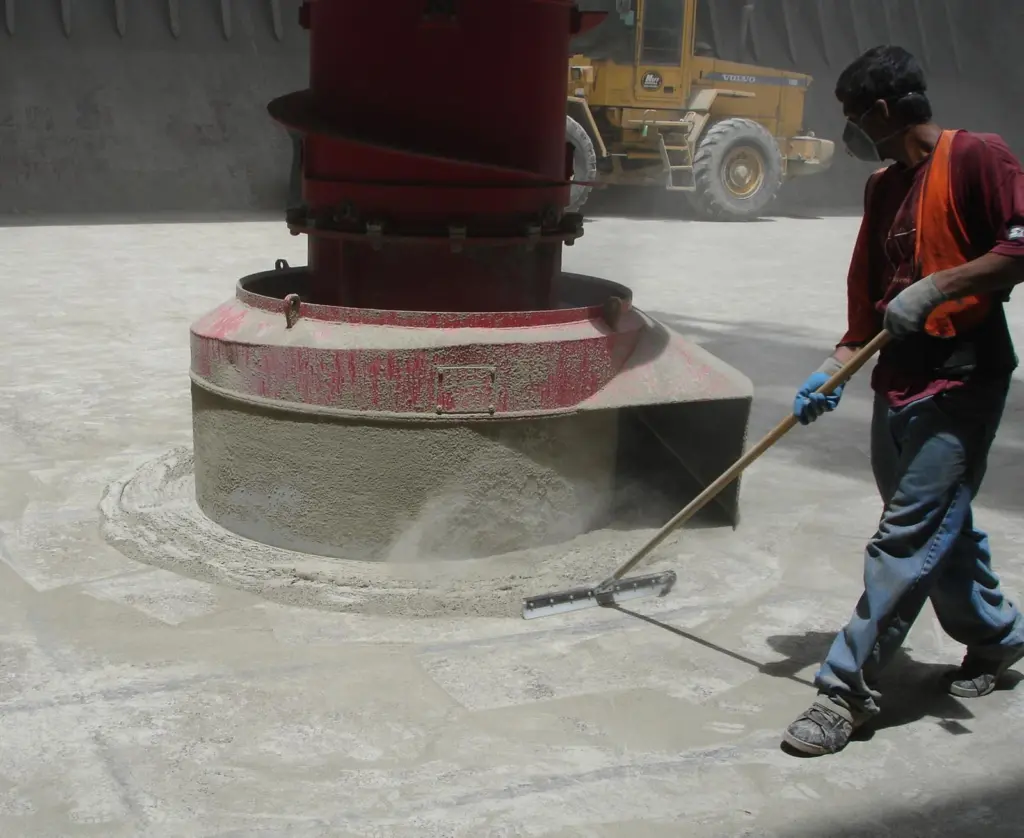
This can be tricky. If you have ever had to empty out a bag of flour, you will know that – usually – an amount gets stuck. It seems prosaic in this day and age, but getting at this last bit down to the bottom of the hold is usually done by poking it with long sticks, one worker tells Port Strategy.
And while the contracts from port to port are different, at the end of the day they usually have one thing in common, that is, after no more can be taken out by the unloader – it is down to manpower, either by the ship’s crew, the terminal operator, or the port.
Although companies like MacGregor have developed different types of clean up attachments to its Siwertell units to minimise this, the final sweeping and cleaning of the holds is still largely manual labour. In many cases this is down to ships crew or stevedoring companies. A nasty job, “but someone has to do it”, as Ibau Hamburg’s Mr Raemmele says.
However, suction proponents still say that vacuum equipment can get to parts others cannot reach, since screw unloaders generally point to one side, whereas, these units position themselves downwards, “just like a vacuum in a house,” explains Marcel van Rangelrooij of Kovako, which reduces clean up time considerably.
But if flexibility is an issue, mechanical units do have the edge as vacuum unloaders cannot pick up anything that reacts to heat or pressure. Some mechanical multipurpose unloaders can handle a variety of commodities (until investment in either a dedicated or true multi-material unloader is justified).
While these multipurpose units are most commonly used by operators handling commodities in a certain segment, it isn’t always the case. “Customers handle coal – salt, cement – grain, cement – clinker and a lot of other combinations,” says MacGregor’s Mr Göransson. This part of the clean up has been answered by, for example, designs that minimise dead pockets inviting build up. In addition, some models have a provision for vacuum cleaning or water flushing systems.
However, despite all this, one cement company employee points out that when an unloader is needed “it doesn’t matter to us a great deal whether it is a vacuum or screw unit that gets used, what matters is that it is available!”
Related Articles
 CONTAINER & CARGO HANDLING
 CONTAINER & CARGO HANDLING
 BULK HANDLING