![PortStrategy[GreenPort]](https://www.portstrategy.com/wp-content/uploads/2026/09/PortStrategyGreenPort.svg)






Cinderella city-port
Amsterdam can at last go to the Benelux ball as Stephanie Knight reports
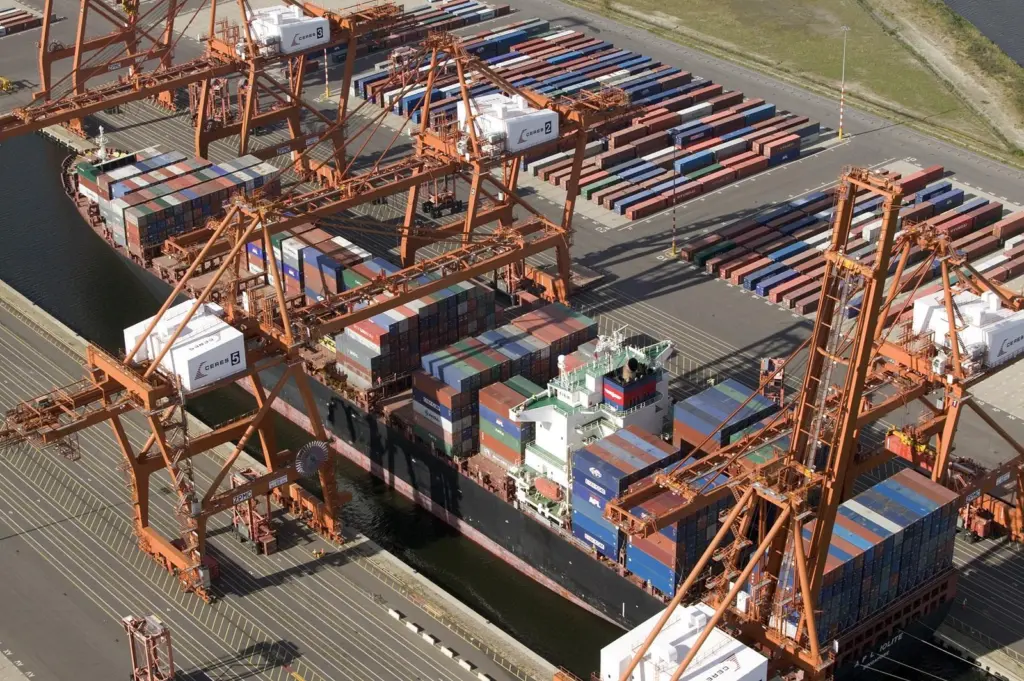
Living in the shadow of its much larger sister at Rotterdam, the Port of Amsterdam had, until fairly recently, been somewhat overlooked. But the opening, in 2002, of the ‘first of its kind’ Ceres Paragon terminal with 1 km of quay length and a double-sided indented berth – giving 250 moves per hour from nine gantry cranes capable of reaching 22 containers across – marked a turning point.
At that time, the port also had the other elements of success: modern, easy access to all major European inland waterways, solid roads and air links, a rail facility on the terminal and a competent labour force – and yet an eerie silence reigned at the terminal for almost three years, embarrassing the port authority who had paid as much as ¢130m ($201m) for it.
However, as Marina Schneider, of Amsterdam Port Authority points out, the terminal was “‘built because the city authorities believed in the project”, long before agreements were in place. So there was little alternative but to sit and wait for the ships to come in.
Happily, 2005 saw lines from Chile, China and South-East Asia relocating from Rotterdam due to congestion and in 2006 Amsterdam had a staggering 371% rise in containers year-on-year, an increase from 65,000 teu in 2005 to around 306,000 teu in 2006, making it the fastest growing container terminal in the region. To cap that, 2007 figures showed container numbers jumped by another 26%. One factor is the increasing number of large Grand Alliance ships. Ms Schneider tells Port Strategy that recently the third Asia deep-sea containership loop, EU5, has been added to two others already calling at the port.
On top of this, Amsterdam is now being served by new and more frequent intermodal services with its hinterland: Prague, Strasbourg, Duisburg and other parts of the Netherlands.
And the port’s latest cargo volumes show that throughput thoughout the Port of Amsterdam is continuing to expand at a healthy pace, 7.1% from 61m tonnes in 2006 to 65.4m tonnes in 2007.
Since Amsterdam Port Area is actually a cluster of inter-dependent ports reaching from the North Sea, another important development has been the extension and deepening of the IJgeul canal, forming a link so that fully laden bulk carriers with a draft of up to 17.8 metres can reach the North Sea Port of IJmuiden, go on to Beverwijk or Zaanstad or sail all the way into the Port of Amsterdam. For heavier loads, lighters operate ahead of the canal locks.
However, of the four locks used to transit ships into the canal, only the Northern Lock is still suitable for the escalating size of containerships. Constructed in 1929, its specifications are, to put it mildly, out of date, and a major leak is not out of the question. An increasing number of ships are incurring waiting times and the port authority is justifiably concerned.
According to the Zeetoegang IJmuiden (IJmuiden approach project) formed in 2004 through a partnership of government and business, a second large sea lock is the answer. The Noordersluis could then be drained for long overdue maintenance, and the new lock would be designed around the latest generation of containerships.
This means an investment of between ¢650m ($1bn) and ¢800m ($1.2bn) – a tidy sum. Despite some wobbling from the central government, exploratory work started in 2007, and is due to be finished this summer. However, the partnership has only secured ¢80m ($123.7m) so far – and is now looking at ‘creative arrangements’ for finance. A decision is expected in 2009.
And there are other threats in view. In response to the growing size of containerships, Rotterdam has its own well-publicised plans. Maasvlakte 2 – the new port and industrial zone – is specifically aiming to capture the new generation of super-sized containerships, and will have a 20 metre deep harbour directly on the sea.
Despite this, Ms Schneider is unconcerned: “We are still only running at 40% of our capacity: there’s no congestion and we can turn around a container in half an hour,” she says.
Related Articles
 CONTAINER & CARGO HANDLING
 CONTAINER & CARGO HANDLING
 BULK HANDLING