![PortStrategy[GreenPort]](https://www.portstrategy.com/wp-content/uploads/2026/09/PortStrategyGreenPort.svg)





Conveying the load
Moving coal from A to B is simply not enough. Todays coal handling systems need to offer more, as Iain MacIntyre explains
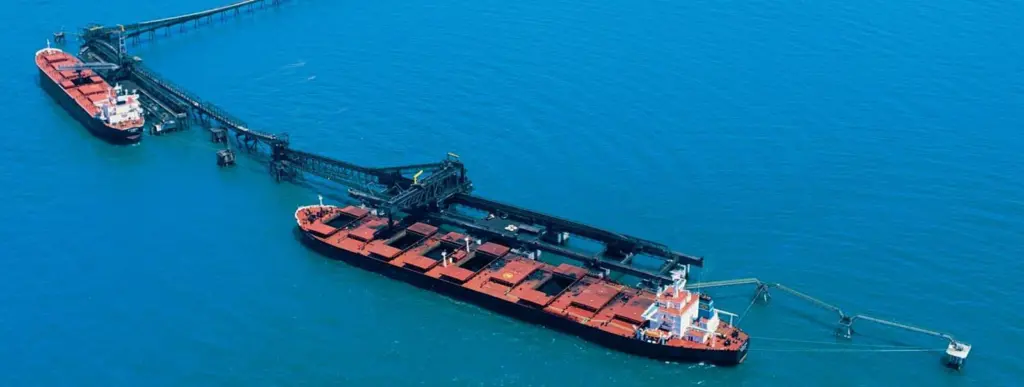
Australian coal conveyor system manufacturers are pursuing innovative new designs to balance increasingly-competing social, environmental and business objectives during the current coal boom. Cove Engineering’s Michael Lay says the challenge is to develop systems that use the minimum amount of components, require the least amount of power to operate, produce the minimum amount of noise and dust, and that are deliverable at least cost.
A key element to tackling the noise and dust issues is to ensure the most suitable idler types are selected for each application and that product is therefore “fully controlled”throughout the transfer process.
In addition to its established range of “hood and spoon” transfer systems,which Mr Lay says are increasingly being deployed in local coal-handling ports, Cove Engineering recently unveiled its Smart Frame idler structure. “Smart Frame facilitates the safe removal/replacement of damaged conveyor idlers without the need to lift the belting or manipulate the idler into awkward positions – idlers can actually be changed without stopping the conveyor belt if required,”says Mr Lay.
“The system operates by supporting each individual idler in a separate rotating frame, which allows the idler to be engaged/disengaged automatically from a cradle.The idler is manually placed into the cradle from outside the conveyor structure and as such there is no need to physically enter the conveyor ‘no-go’ area inside the stringers.”
Tasman Warajay general manager Bernie Halpin says his company has progressively refined and developed its CFMTS technology, which limits dust and noise generation by reducing the impact angles of the material stream within transfer chutes.
“The total cost of ownership for a conveyor system is greatly reduced in coal handling applications by the installation of a CFMTS chute, as chute liner maintenance is minimal, belt cover life is extended and spillage is reduced,”he says. Mr Halpin says major expansion works at Dalrymple Bay Coal Terminal,Hay Point Coal Terminal,CQPA Port of Gladstone and PWCS Kooragang Island have resulted in two record years of sales for Tasman Warajay.
Another company benefiting from the coal boom in Australia is Control Systems Technology (CST), which specialises in the supply of in-motion weighing technology to such mining companies as BHP Billiton. Although, CST managing director Ian Burrell says his company is striving to keep overheads in check so it is not caught in an “unworkable company dynamic” when the boom winds down again. An interesting challenge faced by CST has been to overcome market cynicism about the precision of its belt-weighing technology, says Mr Burrell. “CST has developed special designs for high-belt tension areas which enable accurate weighing where it was previously not possible,”he says.
“The main problem is the market’s generally-low expectation of accuracy from belt-weighing equipment, since much of the equipment they have purchased in the past does not meet performance expectations. “So now, if they want 1% real operation, they will often ask for a 0.25% system. This makes it difficult to gain acceptance for equipment which really does achieve nameplate performance, but which must necessarily have a higher initial investment cost.”
Related Articles
 CONTAINER & CARGO HANDLING
 CONTAINER & CARGO HANDLING
 BULK HANDLING