![PortStrategy[GreenPort]](https://www.portstrategy.com/wp-content/uploads/2026/09/PortStrategyGreenPort.svg)





FLTs
FLTs can be adapted to fit a number of uses, but dont expect to make savings on operating costs. Alex Hughes reports
Fork lift trucks (FLTs) play a key role in many behind-the-scenes activities at container and general cargo terminals around the globe and their all-round capabilities make them difficult to replace.
But in container handling operations, FLTs are not usually deployed in front line operations. Their main role remains in the stuffing and de-stuffing containers, according to one manufacturer. However, suggestions that terminals might be better off migrating to substitute equipment are not always supported.
“FLTs are uniquely engineered for use in low level handling operations. They can lift things from underneath, which other modes can’t,” says Linde’s Mark Timothy.
Ms Helen Salomonsson, marketing coordinator for Kalmar, which makes FLTs, reachstackers and straddle carriers, adds: “In container terminals, it might be possible for reachstackers or straddle carriers to undertake some of the tasks routinely undertaken by FLTs, but not all. In other types of applications, operators will often favour reachstackers fitted with a specialist tool carrier in place of an FLT. This might be the case when handling slabs, for example.
“Exactly which type of equipment is eventually used depends very much on the size of the terminal, although the size, flexibility and speed of FLTs can often work to their advantage.”
There are examples of both FLTs and reachstackers used in atypical roles. In Rotterdam, for example, FLTs are used with quick release frames to move empty containers, although there are clearly height restrictions associated with these kinds of moves. Meanwhile, at Thamesport, in the UK, several large trucks have been fitted with adaptable frames to allow them to lift containers from above. FLTs are also occasionally used to lift heavy objects, such as generators, but these have to be conveyed on flatbeds.
Hamburg, for its part, uses reachstackers fitted with hook positions under the main spreader beam so that slings and chains can be attached to allow something to be lifted vertically and stacked, rather than deploying an FLT, which could lift the consignment from below. But these types of operation do require some sort of framework to be attached and are not ideal.
In technology terms, FLT are less complex than reachstackers, which is reflected in their lower price. But are they any cheaper to operate? According to Ms Salomonsson when making like-for-like comparisons with machines of similar lifting capacity there is no real difference in operating cost.
“Reachstackers and fork lift trucks use the same drive line so the emissions and fuel consumption is about the same,” she says.
Commenting on environmental factors, Mr Timothy notes that, like all modern materials handling equipment, FLTs currently have Stage 3 engines, although will have to upgrade to Stage 4 compliant equipment by 2010. Engine emissions these days are much improved, especially when fitted with a catalytic converter and filters. Smaller, 10-ton FLTs can be equipped with exhaust cleaners, making them even cleaner and eminently suitable for working in covered environments.
“The migration from Stage 2 to Stage 3 engines also meant a cut in noise emissions. Cummins, for example, came out with an engine that was around 3dB quieter than its predecessors. Drive axles tend to run in oil, so they don’t make a lot of noise and the same is true for gearboxes,” states Mr Timothy.
He nevertheless points out that the advanced nature of the technology incorporated within FLTs engines means that, in reality, they are almost wholly electronically governed, which means adjustments have to be made using laptops, rather than spanners.
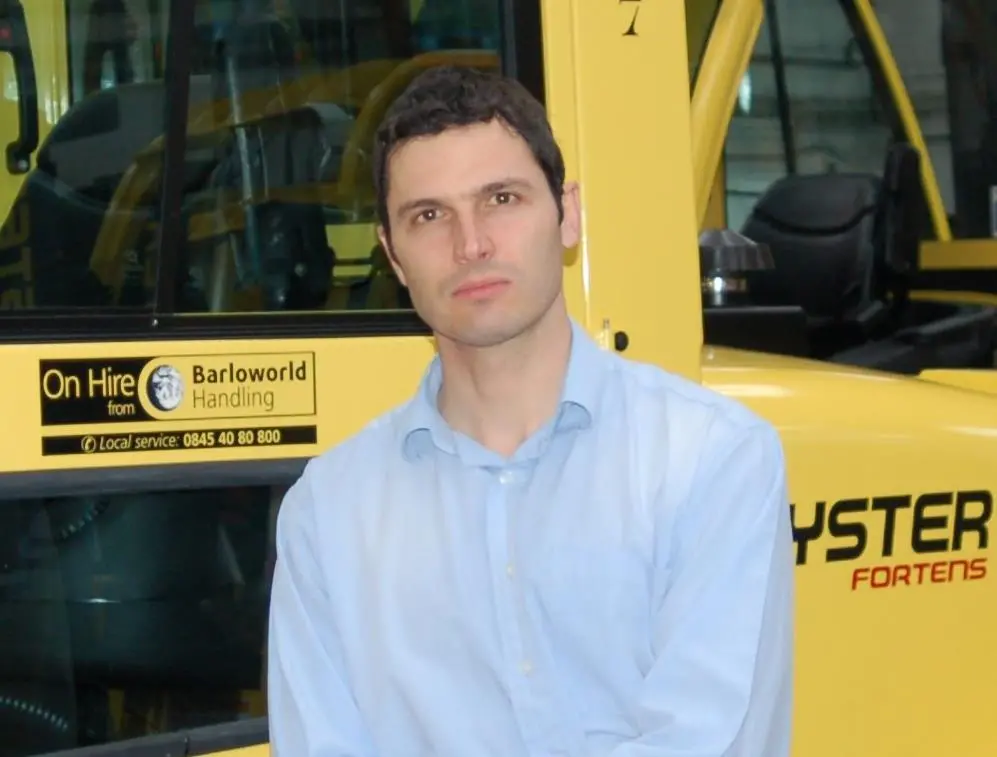
Roger Massey of Barloworld Handling, Hyster’s distribution partner in the UK, says, “As has happened in the automotive industry, FLTs have become more technologically advanced in recent years. Much of this technology, such as engine management systems and advanced diagnostics, is designed to make equipment more reliable and capable of alerting operators of any problems, so that a fix can be made before equipment breakdown. For the engineer, it is essential to have the right diagnostics, equipment, parts and training to facilitate a quick and effective repair.”
Intriguingly, while major engine overhauls can work out more expensive than they once did, because of the technology involved, Linde policy is to extend the time needed between service intervals, thereby cutting maintenance costs.
“Our aim is to have 1,000 hours between services. Other maintenance these days is relatively basic, involving changing oil and water. However, extending service intervals is only possible using a higher grade of oil, while FLTs also have to be fitted with higher capacity oil tanks,” says Mr Timothy.
Ms Salomonsson agrees that FLTs are relatively demanding machines technically and need to be maintained by a trained person. Nowadays, this requires good knowledge of electronics, she stresses. As for the expected working life of an FLT, she says this is hard to calculate, since it depends on several factors, such as the working environment where trucks are deployed, maintenance undertaken and the length of the average working day.
Mark Timothy calculates that, used for around 8-10 hours a day, a port terminal could expect to maintain a Linde machine in front line duties for around five years, before re-assignment to lighter duties. A terminal could therefore expect to retain ownership for 7-10 years.
According to Roger Massey: “In the UK, the average hire contract is five years. After this, the contract is either extended or the equipment is sold as used. A used truck might work for another 5 to 10 years, but it really depends on the type of truck, utilisation, the working environment and, critically, how it is treated and maintained.”
Some terminals, Mr Timothy adds, do run their FLTs around the clock. In this type of working environment, maintenance normally occupies a two-hour slot out of every 24. Failure to do this could lead in increasingly numerous stoppages.
“In the UK, most operators would be looking at a return on investment in no more than three years. But, we are increasingly seeing ownership of FLTs retained by a third-party, with the terminal itself undertaking a lease-rental agreement for the use of the FLT. This means less upfront investment for the terminal, although residual value is retained by another company,” says Mr Timothy.
Even when fully depreciated, FLTs that are no longer suitable for either front line or secondary duties can be refurbishment and re-sold on the second hand market. Denmark-based N.C. Nielsen, a Linde agent, specialises in this area and makes a very good living out of it, according to Mr Timothy, shipping refurbished machines all over the world.
Finally, in terms of operator training, Ms Salmonsson suggests that driving a reachstacker differs little from driving an FLT. However, she concedes that reachstackers enjoy better visibility. Mark Timothy points out that the major difference for novices is the fact that steering is done using the rear wheels, which can take some getting used to.
Related Articles
 CONTAINER & CARGO HANDLING
 CONTAINER & CARGO HANDLING
 BULK HANDLING