![PortStrategy[GreenPort]](https://www.portstrategy.com/wp-content/uploads/2026/09/PortStrategyGreenPort.svg)




Forming attachments
Very specific handling requirements often call for dedicated FLT attachments, says Alex Hughes
The need to minimise accidental damage during the handling of high-value products is leading forklift truck attachment manufacturers to embrace high-tech solutions – but lower tech upgrades have a part to play, too.
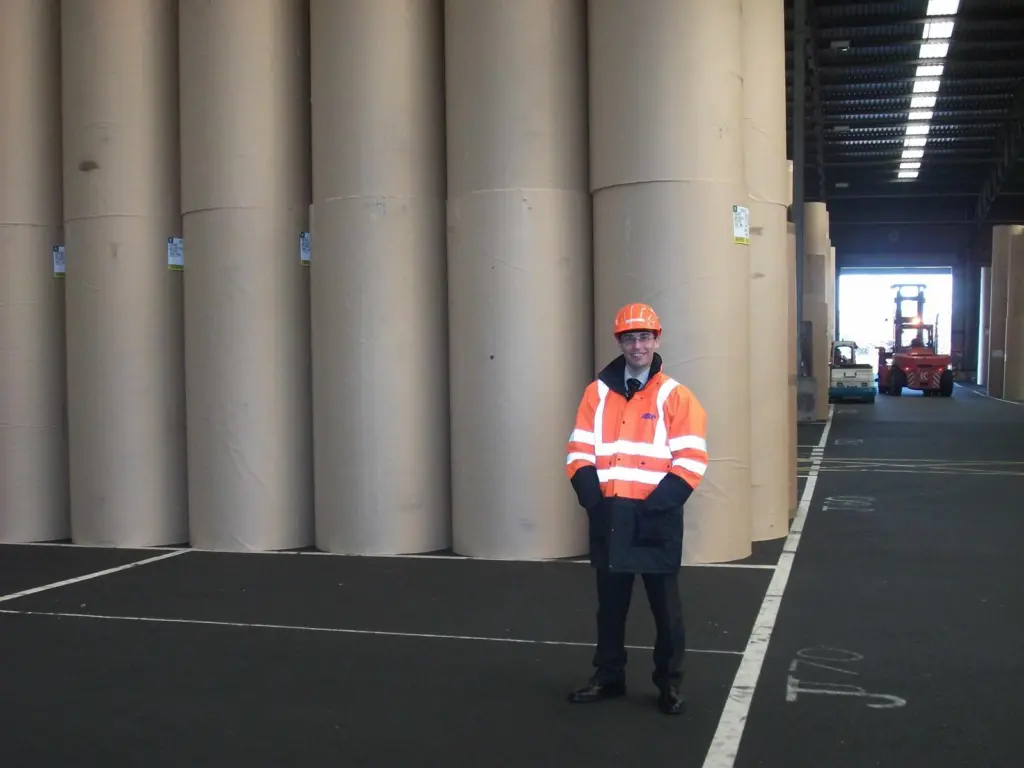
ABP’s Finland Terminal at the Port of Hull specialises in the handling of paper products, deploying FLTs fitted with clamp attachments to unload reels from ro-ro vessels and transport them to nearby storage sheds.
Terminal operations manager Danny Carmichael says Bolzoni Auramo equipment is now preferred, since it allows FLT operators to get into tighter stows more easily because of the design of the paws. “Not only can the stowage on board often be quite tight but we also like to get as much stock as possible into the sheds, so we need a clamp that allows us to do that,” he says.
Having previously operated a mix of Cascade and Bolzoni Auramo attachments, today the Finland Terminal operates a uniform fleet of Bolzoni Auramo clamp-fitted FLTs. “The Italian manufacturer has a proven record and having uniform technology at the terminal also helps to cut down on maintenance costs and spares provision,” says Mr Carmichael.
The introduction some four years ago of super-jumbo reels meant that existing single clamps with four paws had to be replaced by tower clamps with eight paws. The terminal therefore acquired three larger trucks fitted with so-called “intelligent reel clamps” – Bolzoni’s CTX brand. These FLTs are equipped with onboard computers which detect any slippage as the reels are being handled.
“This takes the manual pressure setting away from the driver,” says Mr Carmichael. “Instead, it is the clamp itself that decides the pressure to be applied on the reel. The initial clamp uses a base pressure set by us but, several times each second, the computer checks how hard the reel is being squeezed and makes adjustments in clamping force accordingly.”
The three CTX-equipped trucks exclusively handle the largest reels, which weigh up to 6.5 tonnes and have a salvage value in excess of £3,000. Nevertheless, even using the most sophisticated equipment, there has still been some damage to the super-jumbo reels, although Mr Carmichael stresses that this has been infinitesimally small in overall percentage terms.
Maintenance of the CTXs is undertaken by Bozoni’s own approved maintenance supplier in the UK, since this requires the use of special diagnostic software and a laptop. Maintenance of other units is subcontracted to a hydraulics specialist which will even revulcanise the face of the pads to ensure that the rubber is always in good condition.
Despite the success of the CTXs, Finland Terminal will not be switching over entirely to these more sophisticated clamps, because the average size of reel handled would not justify the additional cost. Indeed, Mr Carmichael says that Bolzoni’s new “forcematic” system, which can be retrofitted to existing mechanical units, may well be the way forward. This is based around a hydraulic governor that determines how heavy the reel is and what force is required to clamp it. There are no electronics involved, so it is a much simpler system than the CTX. These systems, he says, are successfully working elsewhere.
In the meantime, the Finland Terminal’s existing equipment has been through a refurbishment programme. Some five-year-old attachments have been stripped down and rebuilt using new components, which should enhance their working life for a further five years. In terms of book value, clamp-fitted FLTs are zero-rated after eight years in service and generally withdrawn altogether after a decade’s work in the port. However, in recent years most have been taken on operating leases, meaning that the entire fleet is renewed every seven years.
Italy’s Bolzoni Auramo and US-based Cascade are the world’s leading manufacturers of FLT attachments.
Carlo Sallarini, marketing and sales director of Bolzoni Auramo, says attachments are invariably supplied to the end user at the time of their placing an order for a new FLT.
“Attachments are not standalone products,” he stresses. “When an operator places an order for a new FLT they will specify which attachment they will need and the machine will be supplied with it already installed. Given that most FLTs working in paper handling, for example, are dedicated units, the attachment will usually remain fitted to a truck throughout its working life.”
Bolzoni’s involvement in paper reel handling is through a Finnish subsidiary, which has been active in this market for many years. This company has good contacts with the paper industry throughout Scandinavia, the leading paper production area in Europe. As a result, the attachments that it sells are specifically aimed at paper product handling. This, emphasises Mr Sallarini, is particularly important given that terminal operators must undertake damage-free handling, of individual reels of high-quality paper that can be worth €4,000 ($5,586).
However, Bolzoni’s approach has been to offer a raft of possible solutions for operators, encompassing mechanical, hydraulic and electronic systems to control handling and avoid damage. Indeed, Mr Sallarini notes that, when end users specify attachments, they won’t necessarily be looking for the cheapest price; how the technology performs is often the most important factor.
“Despite the fact that our most sophisticated solution, the CTX, incorporates a lot of electronics, its development was predicated on the fact that it would have to be able to function in a particularly tough environment. In ports, they are fitted to 10-12 tonne capacity FLTs, so they have to be both tough and reliable,” he says. Occasionally there have to be adjustments to the system to handle different sizes or weights of reels, he adds, but that this can be done either by plugging in a laptop or by having a simple console display in the cab of the FLT.
Depending on the exact usage, each attachment will last five to 10 years. Pressed on ROI, Mr Sallarini hesitates to give an exact time frame, given that so much depends on where the attachment is used and on what particular products. On average, he calculates that ROI should be achievable within two to three years, although he stresses that this is only possible if correct maintenance procedures are adhered to.
Because FLTs with dedicated attachments are often developed for very specific handling requirements, trying to relocate them to a new location can be difficult. While there is a small secondhand market, acknowledges Mr Sallarini, trying to place an attachment-equipped FLT is not necessarily easy.
Related Articles
 CONTAINER & CARGO HANDLING
 CONTAINER & CARGO HANDLING
 BULK HANDLING