![PortStrategy[GreenPort]](https://www.portstrategy.com/wp-content/uploads/2026/09/PortStrategyGreenPort.svg)






Grab your conkers!
A carefully selected and properly maintained bulk unloader can save you money, as Patrik Wheater finds out
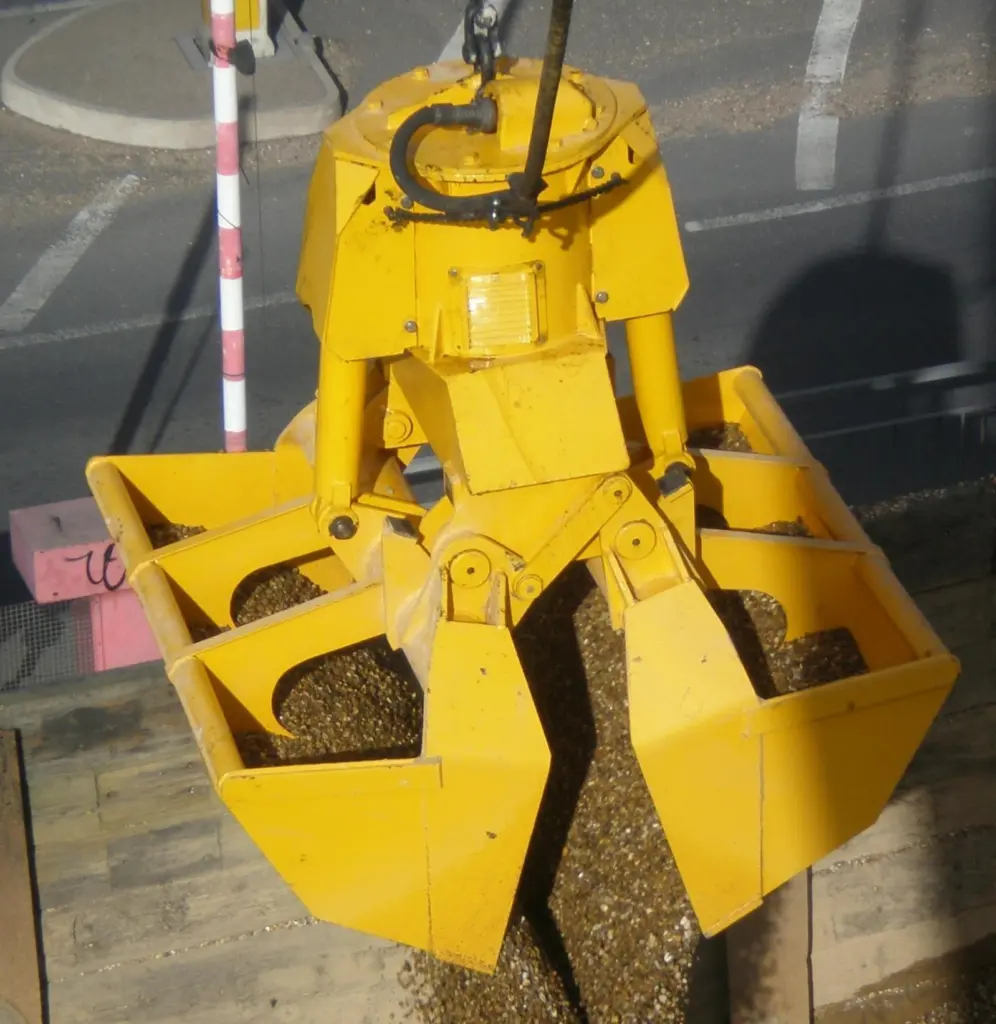
It’s that time of year when schoolboys the length and breadth of Britain will be looking to harden their horse chestnuts. They might bake them, boil them, soak them in vinegar, or surreptitiously coat their nuts with varnish before hammering a nail into each one.
A 10 inch long piece of string, usually a shoelace, will then be threaded though the hole, with a large knot tied at one or indeed both ends – there is no hard fast rule on this – before the games begin. A veritable hoard of ‘conkers’ is of course recommended since no matter how meticulous the hardening stage, they all will inevitably break in the end.
And that dear reader is pretty much the same with the bulk grab unloader. According to John Leggett, “they’re all just conkers on a string”.
Mr Leggett, the owner of Leggett Engineering, a UK-based supplier and repairer of hydraulic and rope-operated grabs and other cargo handling equipment, says that no matter what you do, at some point the grab just won’t grab, it won’t work, it won’t open or the latching mechanism will become unreliable.
Mr Leggett singles out the self releasing/self-latching-type systems as being particularly vulnerable than other designs simply because their operation demands that they have to be ‘landed’ on a cargo, grid or a hopper before the locking mechanism is released and the grab opens. This, he says, makes the grab more susceptible to wear and tear and components will get damaged.
The most common faults Leggett Engineering deals with relate to wear and tear to pivots and bushes, while abrasive aggregates can play havoc with bearings. But many operators believe that such simple systems are easy to repair and often carry out the work themselves. “Many operators think they can repair them, but they just botch it up,” says Mr Leggett, who is confident that he can completely refurbish a grab for about 50% less than the cost of a new one.
“Repair is one thing, but getting spare parts or having parts made takes time. Nine times out of ten, most grabs are repairable and most operators do see them as piece of kit that does need to be maintained. But badly-maintained systems can have cost implications, especially when tonnage is down because bulk materials are leaking out all over the jetty or between the ship and shore,” he says.
Of course, one way of extending a grab’s longevity is to make absolutely certain that the type of grab selected is actually suited to the crane and the type of bulk cargo it is handling.
For instance, operators should really avoid using rope grabs in favour of hydraulic systems when handling scrap and iron ore. A rope grab can be used but it is just not as efficient, says Mr Leggett. When scrap is stockpiled, it tends to lock together so you need a grab heavy enough to dig in and bury itself into the material. A rope-driven system is simply not able to carry the weight.
Another issue raised by the repair specialist is that size does matter. Scrap and iron ore grabs are usually small orange peel-type systems, whereas fertilisers or feed stocks, for example, require larger clamshell-type grabs. But some companies fail to get the right grab for the job.
“It is a big area and grab material can vary greatly. Some operators don’t correctly size the grab for the crane or the safe working load of the job,” says Mr Leggett, revealing that one bulk handler he knows uses just one type of grab for different types of aggregate: wet sand and dry stone. Although both of these cargoes are classed as aggregate material their weights differ greatly, which could mean that the undisclosed company’s crane is operating well above its safe working load.
Mr Leggett says that a rope-operated grab is best for most bulk cargoes, but an electro hydraulic unit is the best way of “converting a non-bulk crane to a bulk crane”.
Riny Stoutjesdijk, marketing manager for Nemag, the Dutch specialist in rope-driven grabs in the medium to large size range, says that while 99% of its customers do have a dedicated grab for each specific type of mainly dry bulk cargoes, there are those smaller operators whose budgets just don’t allow for this.
However, customers in the segments that Nemag serve really know what they’re doing. If you compare this to a small stevedore company that handles one or two ships a month then it just cannot afford to have a dedicated grab for each specific material because the maths don’t add up. But having differentgrabs for different materials really does make difference, says Mr Stoutjesdijk. “It increases productivity by up to 10%. This way they get the most out of productivity.”
A typical Nemag customer runs high lift capacity machines with high berth occupancy, and mainly handles coal and iron ore. The grabs it manufacturers are between the 20t and 85t lifting capacity range with the focus on bespoke grabs designed for dry bulk cargoes. It also manufactures cactus grabs for handling scrap.
Michael Ibarth, marketing director with German materials handling specialist Sennebogen Maschinenfabrik, which supplies mainly hydraulic-based systems, is another that emphasises the importance of sourcing the right grab for the right job, but believes emphatically that electro-hydraulic-driven grabs are more efficient across the board.
“A trend we are seeing is that customers are not looking for rope-driven cranes as the heavier grabs on mobile harbour cranes tend to swing quite a bit. Also the handling capacity is significantly lower than the hydraulic machines,” he says.
“These machines use much less energy and operating costs are lower than a typical mobile harbour crane, but the main point is that the handling capacity is 20%-25% higher.”
Sennebogen has recently supplied its new D-Series 880 EQ model to the bulk port at Shoreham, on the UK’s south coast. With a reach of 24 m and a maximum load of 38t, the bulk handler is mainly used to unload steel rollers weighing up to 30t and structural steel carriers for the new ParkerSteel processing plant.
The port handles about 2m tonnes of a wide variety of different goods each year, and felt the Sennebogen machine provided a “cost-effective and sophisticated machine that can easily master the increasing size and weight requirements of the handling process”.
Related Articles
 CONTAINER & CARGO HANDLING
 CONTAINER & CARGO HANDLING
 BULK HANDLING