![PortStrategy[GreenPort]](https://www.portstrategy.com/wp-content/uploads/2026/09/PortStrategyGreenPort.svg)






INVESTMENT IN QUALITY PAYS OFF
Gantry motion reels have not changed much in the last few years so I will focus primarily on trolley mounted cable reels servicing the trolley to headblock/spreader electrical connections.
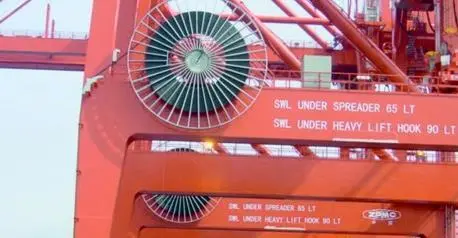
Crane hoist speeds continue to improve and it is not uncommon to see light-load speeds around 180 metres/min. New cranes are being considered with hoist speeds 190 metres/min or higher. With trolley speeds over 240 or in some cases 300 metres/min and total lift heights in excess of 54 metres, gravity fed cable buckets are no longer a viable option. Even more dramatic, hoist and trolley accelerations have increased by 50% in the last five years. The trolley cable reels are evolving to meet these crane speed and acceleration demands using more powerful motors and drives as well as more mature control algorithms to prevent slack or overstressed cables.
Higher speeds and accelerations, more reliable components, and more troubleshooting and maintenance options help improve overall crane reliability and productivity.
There are basically two approaches to cable reel drives: direct drive (rigidly coupled), and permanent magnetic clutch. Either system can be applied for reels in the size ranges typical for trolley/spreader reels. Direct drive systems tend to be smaller and mechanically less complicated, however they require more elaborate control systems to handle the cable without slack or damage. Magnetic clutch systems are often favoured by crane OEMs since they are easier to control. They have the drawback of being mechanically more complicated and having less direct control over the reel position and cable tension. Another drawback is the common misconception that separating the motor inertia from the reel reduces the need for adequate cable protection during rapid stops. This may result in under-designed cable anchors on the headblock.
Mono-spiral versus level-wind reels is another difference between various reel setups. Each system has its advantages and disadvantages and each system can be made to work well.
There is real utility in using the simplest cable adequate for the job.
Even with the best designed systems to date, the possibility of damage to the spreader cable exists and reducing the cost and complexity of replacement cable is a big plus. Also, smaller cables with fewer conductors allow for better reeling behavior. Most spreader manufacturers now offer communication devices which multiplex hundreds of signals onto two simple electrical conductors in the cable, eliminating the need for large cables with fibre optics, twisted shielded pairs, or other custom-type features which add expense and downtime to cable replacement. Higher strength cables with Kevlar reinforcement are a must for the high reeling tensions caused by high suspended lengths and rapid hoist acceleration.
Using fibre optics in the main power gantry reels for high bandwidth communications with the wharf is still a very viable option as these cables tend to last much longer than their trolley/headblock counterparts.
When purchasing new trolley reels, it’s important that reels are designed with the main hoist parameters in mind. They must be capable of handling the speeds and duty cycles present in the main hoist system. This calls for an entirely different class of mechanism than is suitable in gantry reels and the drives and components must be chosen accordingly. As with any crane system, reliability is key, and an investment in high quality machinery will pay off with reduced downtime and higher productivity.
Another area that is key and is often overlooked, is the anchor device on the dead end of the cable on the headblock. The anchor has to have sufficient flexibility to allow for “surge” of the cable without overstressing the cable while maintaining enough tension to help prevent slack cable. As with anything mounted on the spreader or headblock, it must be hardened to shock and vibration and be robust enough to really take a beating.
I do know that we have yet to see any one manufacturer get it right and as such we expect to see the technology continue to mature over the next few years.
Related Articles
 CONTAINER & CARGO HANDLING
 CONTAINER & CARGO HANDLING
 BULK HANDLING