![PortStrategy[GreenPort]](https://www.portstrategy.com/wp-content/uploads/2026/09/PortStrategyGreenPort.svg)




IS IT A MACHO THING OR WHAT?
Every one knows that big ports need big cranes and the major operators like to be seen to lead the field in buying big. This, however, is not entirely logical. Nick Elliott talks about it to Richard Clarke, director of ports at Halcrow.
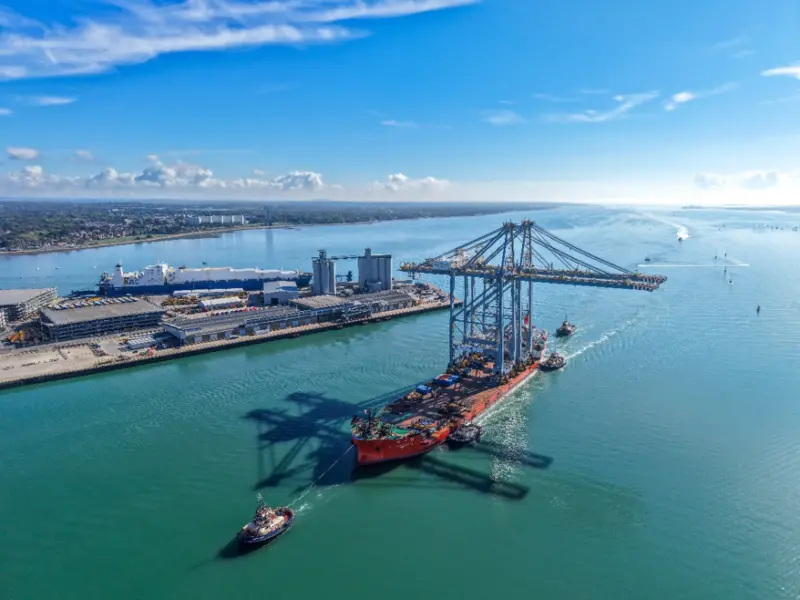
Big ships need big cranes – there’s no argument about that. On the contrary, there’s much debate at present around the problem of new ship designs with unmanageable draughts and air draughts. This becomes an issue when such a vessel berths in semi-laden condition but with, say, seven tiers of hi-cube boxes on deck. Modern cranes have plenty of outreach but are they tall enough? ‘Giraffing’ the cranes would seem to be the answer and this is a subject PS will be returning to very shortly.
But back to the other end of the spectrum. Big ships need big cranes but small ships don’t. And in any transhipment situation, 50% of boxes are going to be handled on and off smaller ships: regional liner services, feeders or barges.
As Halcrow’s Richard Clarke points out: “Everybody gets carried away with the idea that every ship must be able to go onto every berth. But once you go beyond 1,200 metres of berth, you can without doubt afford to have dedicated feeder or small ship berths.
“People think they must buy the biggest cranes in the world but, particularly if you talk to the crane operators, servicing a small ship with a big crane is very difficult and very slow.”
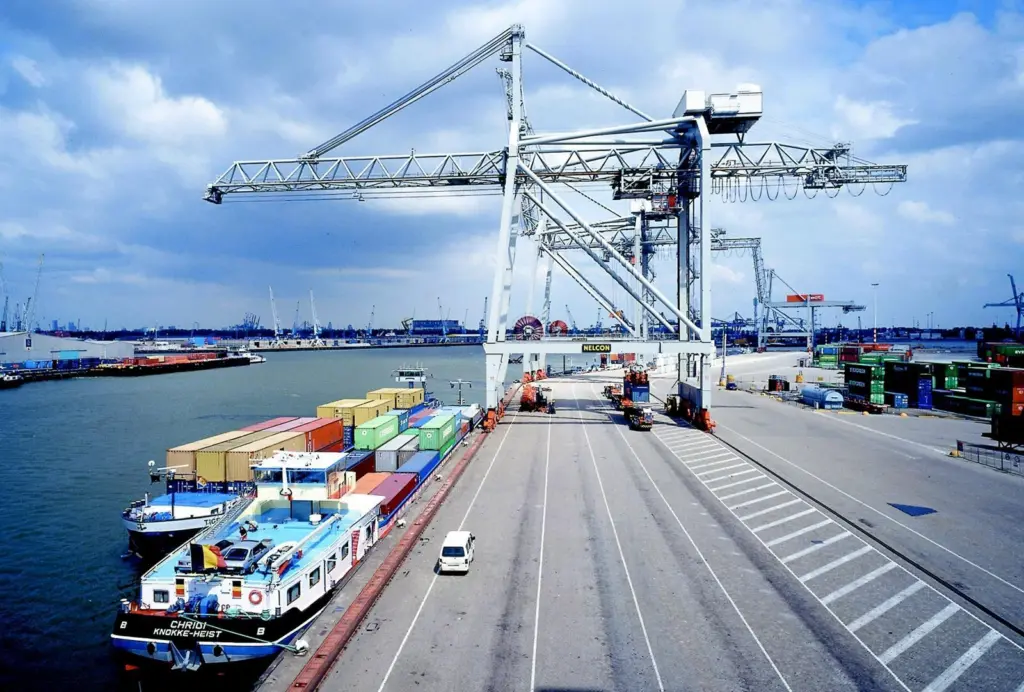
He has discussed the issue with ECT in Rotterdam who have dedicated Nelcon barge cranes and get significantly better productivity out of them than when they use a big crane – which they occasionally have to – on the same operation. In such instances, says Clarke: “You’re using a US$6-7m piece of kit when a US$2.5m crane will do the job faster. And a maximum-sized Rhine barge is as big as a North Sea feeder so the same applies to terminals serving feeder vessels.” Clarke has suggested to clients who already have an adequate large crane set that they should consider putting two smaller cranes on the end of the berth. These, if not totally dedicated, would at least have a feeder emphasis.
There are attempts being made by at least one European crane manufacturer, Konecranes, to tackle the problem. An elevating jib, which can vary the height of the whole jib structure, may be the answer to both the handling of smaller vessels and even the high air draught behemoths mentioned above.
Clarke explains the two specific difficulties he sees with working small ships with big cranes. “One is the fact that the driver is a long, long way above the deck and therefore his ability to see where the top of the container guides are is very much impaired. The other problem comes when you pick the container up from the ship and start to trolley back. When the container is just above the deck of the ship, it’s the pendulum length of the container beneath the jib which creates the problem. If you look at the natural swing period of the container under the crane, on the small crane it has swung back to the central position when you’re over the truck on the quayside. But with very big cranes, because the swing period is much longer, when you get back to the position above the truck the thing is on maximum swing. You can get round that with a good operator or an anti-sway system on the crane but always, if it’s trying to fix itself, then it takes time and that slows the crane down.
“It’s fundamental physics and you can’t get away from it, ” says Clarke. The real problem is the distance below the jib to the level of the boxes and that’s what an elevating jib system addresses by bringing the jib down closer to the ship.
Meanwhile, many new terminals are buying the biggest cranes they can find when it is very unlikely that they’ll ever see the size of ship to justify them. For example, they may only ever have 300 metres of quay line, or because of channel depth restrictions, or simply for reasons of geography. So besides spending too much money they will actually hamper the operation if they target big ships and don’t get them.
WHAT’S TO BE DONE?
So what’s to be done? Clarke’s perception is that the European manufacturers are focusing more on these issues partly perhaps because they have been struggling to compete with the likes of ZPMC in the big crane market so they are looking to carve a niche for themselves. For example, the cabs of the Nelcon (now Kalmar) barge handling cranes at ECT are fixed on the frame of the crane not the trolley so the driver does not experience the acceleration of the trolley. These cabs are fixed just above deck level so he gets a very good view of what is going on at deck level on the barge.
Clarke believes that these points can best be demonstrated with simulation. For practical reasons it is difficult to do live research on container handling on the terminal but it can be done relatively easily on the simulator. “Total Soft Bank, for example, do a very good crane simulator, ” he says and he’d like to produce a set a benchmark figures to actually demonstrate his point. “It would be a nice research project for somebody, ” he muses.
Related Articles
 CONTAINER & CARGO HANDLING
 CONTAINER & CARGO HANDLING
 BULK HANDLING