![PortStrategy[GreenPort]](https://www.portstrategy.com/wp-content/uploads/2026/09/PortStrategyGreenPort.svg)





Large surface area
Choosing hardstanding means balancing capex costs with maintenance savings. Felicity Landon reports
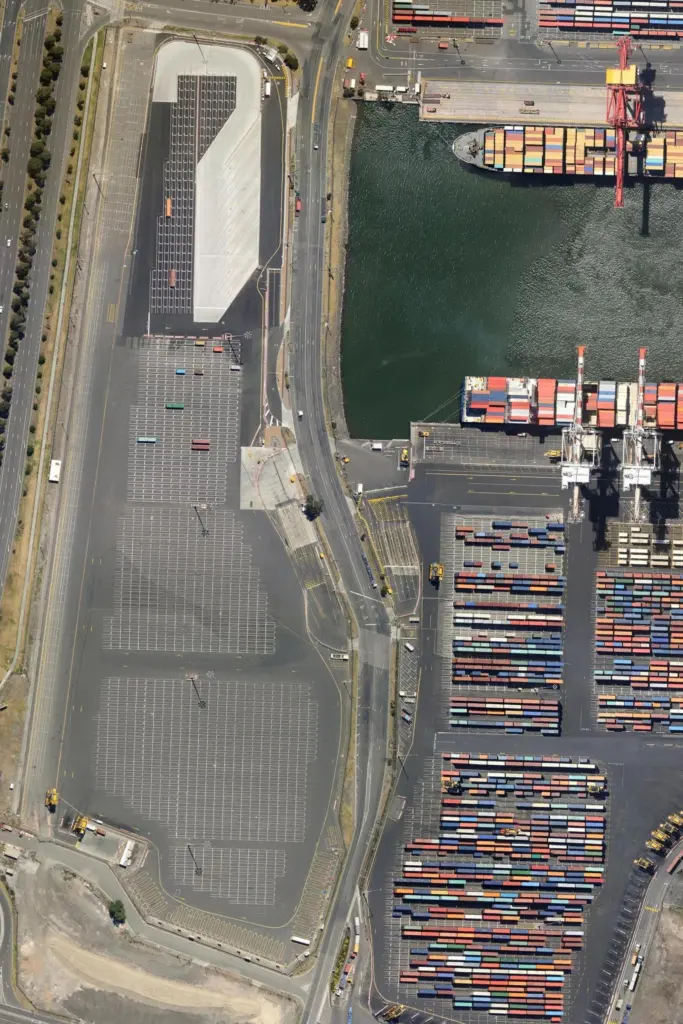
Weighing up the options
Many factors dictate the type of surface used in a terminal or port, says Eugene Cheah, business development manager for energy, mining and ports at Australian construction company Fulton Hogan.
“These include the existing ground conditions, the container and cargo loadings, the traffic of the various port operations, the environment, the budget, and operational and time constraints. Because each case is so different, we put together a design, programme and costing to suit the client’s needs.
How would he weigh up the options? “Concrete is durable but also the most expensive to construct and replace – and it has the longest curing time, which affects operations. Asphalt can be less expensive but risks damage from high loadings, channelised wheel paths, destruction from fuel and hydraulic spills and deformation from container corner castings.
“There are other options, though – we have a number of proprietary products that can meet the specific needs.” These include RigiPhalt, a flexible open-grade asphalt with its voids filled with a stiff cementitious grout, to provide resistance against steel castings, high static and channelised wheel loads. This surface was used by Fulton Hogan for the Port of Newcastle’s common user facility. PortPhalt is a highly modified asphalt designed for deformation resistance and load spreading capacity, and was used by at Patrick’s Port Botany, Sydney terminal.
Among the challenges for port surfacing, Mr Cheah lists rutting or channelisation, which normally happens either side of container stacks, at truck grids and sometimes on runways where straddles are automated.
“Hitting a rut when you are sitting on a straddle carrier a few storeys high can provide OH&S issues for the driver.”
Indentations happen when the corner castings of containers place high loadings on the pavement – a five-high stack of 25-tonne containers equates to more than 30 tonnes’ loading per small casting.
As for operational disruption: “The cost of downtime to repair hardstands is very high. When no containers or equipment are being moved, then no income is being made. We are often called in to fix up pavement failure and work closely with operations to minimise downtime.
Related Articles
 CONTAINER & CARGO HANDLING
 CONTAINER & CARGO HANDLING
 BULK HANDLING