![PortStrategy[GreenPort]](https://www.portstrategy.com/wp-content/uploads/2026/09/PortStrategyGreenPort.svg)





Liscont emerges from handling cocoon with full RTG operation
Portugals deep-sea container terminal, Liscont, is in the final stages of transforming its yard into a completely rubber-tyred gantry-based (RTG) operation.During Port Strategys visit to the terminal in February, a new yard management system had just gone live, although terminal manager Carlos Figueiredo conceded that the thick fog enveloping the river did not help a smooth introduction.
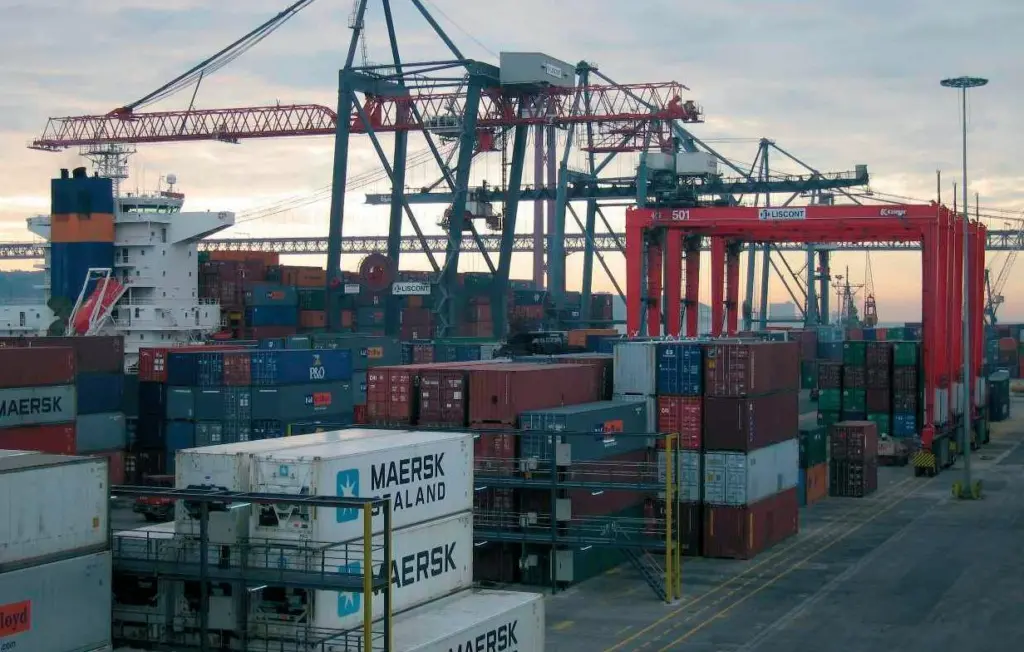
RTG operators now receive data on their cab monitor via a radio link with the yard management system. This determines where individual boxes should be positioned in the stack and basically refuses to release twist locks if location instructions are not being followed.
“The Kalmar DGPS system fitted to the RTGs not only helps with driving, but also ensures fail-safe operation within the stack,”says Mr Figueiredo.
Now that Kalmar’s Smart Rail system is active, RTGs are designated to specific stacks, although priority at all times remains focused on supplying docked vessels with despatch cargo. Previously, one reachstacker was allocated per quay crane to supply it with export boxes, while others undertook delivery both from the railway and from incoming road vehicles.
“Our yard management system provides a pre-planning schedule, with the yard being divided into working areas, which can be bigger or smaller depending on the density of work required,”explains Mr Figueiredo. The terminal operates seven RTGs, which have one-over-five and seven plus one stacking capabilities.The yard is prepared by reserving certain areas for specific vessels, with most export containers then stacked there.
“Sometimes, we keep all containers for one vessel in an individual block, but occasionally this is simply not convenient. This is because, from time to time, we need to concentrate two gantry cranes on one vessel; in order to guarantee an acceptable flow of boxes from the yard to the quay, this means having to move two RTGs on to a single block,which is not the optimum way of operating these types of crane,” Mr Figueiredo says.
Indeed, he is ever mindful of the need of upping productivity, which slipped to 21-22 moves during the conversion period.While technically it would be possible to achieve the aim of reaching 35 moves per crane hour, Mr Figueiredo points out that the main restriction remains the feed from the yard.
While five-high stacks inevitably result in significant amounts of shuffling, yard productivity is further squeezed when receiving containers at the same time that yard cranes are servicing a vessel on dock. “There are times when you simply cannot get enough containers under the quay cranes to ensure a continuous work load.”
Related Articles
 CONTAINER & CARGO HANDLING
 CONTAINER & CARGO HANDLING
 BULK HANDLING