![PortStrategy[GreenPort]](https://www.portstrategy.com/wp-content/uploads/2026/09/PortStrategyGreenPort.svg)






MOBILITY EQUALS FLEXIBILITY
Mobile pneumatic ship unloaders find their place where flexibility comes before pure capacity – and if storage space is at a premium, reports Alex Hughes .
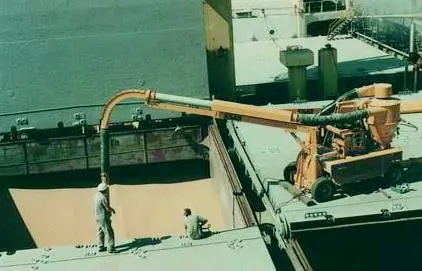
In the world of the pneumatic ship unloader, “mobile” has become something of an elastic term. Many manufacturers insist that practically their entire range of models can be moved relatively easily and should therefore be considered “mobile”. To a certain extent, they are correct. Rail-mounted pneumatic gantry unloaders, for example, do move up and down the quay as and when required, while self-propelled rubber-tyred units are certainly even more agile, offering the possibility of transport between working sites within the same port. However, for true mobility, it is the smaller units that can be loaded directly into a 20′ container which offer the greatest degree of flexibility.
But, why would you want to invest in such a highly mobile unit anyway? Tomas Kisslinger, managing director of German manufacturer Neuero notes that smaller unloaders are frequently acquired by stevedoring companies which make use of quays on an ad hoc basis, where volume is small and the cost of the investment is a key factor.
Furthermore, any significant distance between workstations means it definitely makes more sense to use a mobile unloader.
Notwithstanding these arguments, mobile pneumatic unloaders do not offer the same degree of cost flexibility when compared with standard mobile loading equipment which can often consist of little more than a belt-conveyor linking a hopper and chute. This is because pneumatic unloaders have much higher power consumption. So, whereas a good economic case can often be made for bringing in mobile units to load one-off consignments at non-specialist quays, even though productivity would be a lot less than at a dedicated terminal, acceptable margins would be much harder to achieve using mobile pneumatic unloaders for similar inbound consignments.
“The potential is still there for using ad hoc mobile unloaders, ” Anders Elias, of UK-based AS-C Materials Handling Ltd insists, citing the case of a feed mill, which might have to pay double the cost of importing 5,000 tonnes of a particular product through an established bulk handling facility than would be the case if it made use of leased mobile equipment at a general purpose quay.
Indeed, Daniel Samain of Belgian manufacturer Vigan points out that in bulk terminals in the developed world, the trend is towards concentrating large volumes of bulk in specialist terminals which means that larger less-mobile equipment is preferred because of its better all-round productivity vis-a-vis smaller mobile units. However, he emphasises that in North Africa, for example, stevedoring companies do tend to move about from harbour to harbour and from product to product and cannot therefore justify investment in large gantry pneumatic unloaders.
OBVIATING THE NEED FOR PORT STORAGE Nevertheless, Kisslinger rejects all suggestions that small mobile unloaders should therefore be considered to be suitable purely for niche operations. “Even major operators, such as GCSS-Egypt, use mobile units to unload big vessels. Over there, it is not uncommon to use 14 machines working alongside one another, each unloading directly onto individual trucks, thereby obviating the need for storage within the port.
Used in this way, average unloading capacity is better than for a fixed installation requiring much higher levels of investment. Furthermore, even mobile units can be connected to a filter-equipped hopper to cut environmentally unfriendly emissions.”
Even so, stresses Anders Elias, the larger the volume moved, the less sense it makes to deploy pneumatic equipment at all. He explains that, when dealing with vessels in the 65,000-100,000dwt range, where unloading rates of 1,000-1,500tph are commonplace, a belt unloader will consume just 0.25kW per tonne handled, a chain-system 0.6kW and a screw-system 0.7kW-0.8kw. Pneumatic unloaders, which consume much more energy, would not therefore be competitive for a stevedoring company handling annual volumes of 23m tonnes, he argues, although this is disputed by Vigan, which claims its larger pneumatic unloaders are similarly competitive.
Despite this it can often make sense to deploy a smaller pneumatic unloader alongside a large mechanical unloader, since these latter units invariably leave a 20-40cm residue at the bottom of a hatch which is often then cleared through the use of a Bobcat, although could just as easily be sucked out by a back-up pneumatic unloader.
Nevertheless, in terms of overall effectiveness, the rule of thumb is that the smaller and more mobile the unloader, the lower the percentage of its nominal hourly capacity can be used, suggests Samain. “A large gantry pneumatic unloader probably operates up to 80% of its nominal capacity, while an intermediate self-propelled tower pneumatic unloader will achieve 70%, because these are usually deployed on small ships. However, the smallest units, which are often slung on board a vessel, have shorter booms, so have to have more horizontal hoses attached, with flexible curves. Worse still, they have to move along the hold, which loses time.”
The UK-based Nectar Group, which is heavily involved in bulk handling operations worldwide, has accumulated extensive experience with smaller mobile pneumatic ship unloaders. Guy Wilkes, group marketing manager, emphasises the flexibility of these diminutive machines, which he refers to as “vacuvators”, pointing out that in Karachi, for example, record daily throughputs of 8,000 tonnes had been achieved by his company. In addition, Nectar has used vacuvators on lightening duties in such diverse ports as Vladivostok and Nacala in Mozambique.
So, what exactly should a good mobile pneumatic unloader be able to offer? Wilkes stresses the need for low operating costs when compared to the volume of product that units are required to move.
Furthermore, they must be easy to maintain, be equipped with high quality fans, have a suitable dust filter system and also fast connecting sucking pipes. In addition, the outreach must be sufficient, while to be flexible in the truest sense of the word, a unit has to be self-propelled, too. However, in terms of size, the machine needs to be as small as possible to enable it to be both easily positioned on a vessel’s deck and also transported in a standard container. Finally, weight has to be kept to an absolute minimum to enable individual unloaders to be easily lifted on board.
AIR-BASED SYSTEMS EASIER TO CLEAN As for the speed of switching between various bulk products, this depends on whether a powder, a granular or “sticky” product is being handled. The level of contamination is also key, in that the presence of dust, sand or grit all require the application of a filter, which in turn adds to the overall length of time required before contrasting products can be handled. However, air-based systems are comparatively easy to clean out and can therefore switch quickly between products such as cement, grain or alumina.
Asked to put a figure on the average working life of one of the smaller pneumatic ship unloaders that his company makes, Vigan’s Samain cites filter-equipped units that handle some 3m tonnes annually which have required no heavy maintenance for over five years.
“High capacity and a long working life are not therefore a contradiction, ” he emphasises, pointing out that if a unit is fitted with a multi-stage turbo blower, for example, it could conceivably go a whole decade without incurring major problems.
However, he maintains that the best way of insuring a long working life is to invite the customer to send a technician to the manufacturing plant to see the machine actually being built, which is something Vigan offers as standard to all purchasers. Knowledge built up during that period can be key in understanding the exact requirements for both repairing the unloader and making sure it is used in such a way that it will go on working.
Operators still prefer outright purchase to the leasing or hiring of units, point out both Neuero and Vigan. Neurero’s Kisslinger claims this is because it works out cheaper in the longer term, while a healthy second-hand market for units helps to offset some of the investment risk involved. “Especially in under-developed countries, operators simply have to know that they do have equipment available if they are offered a contract; they cannot always rely on short-term leases, ” insists Samain, who points out that full service companies such as Nectar therefore come into their own in such circumstances.
AS-C’s Elias, nevertheless, believes that a reasonably sound economic case could be made for leasing a mobile pneumatic unloader capable of handling annual volumes of 60,000-150,000 tonnes, where a stevedoring company is handling consignments at a number of sites for limited periods.
Related Articles
 CONTAINER & CARGO HANDLING
 CONTAINER & CARGO HANDLING
 BULK HANDLING